
Maroon 5 - Back At Your Door Chords
Before you play, tune your guitar and use the tools below to set up your view and flow.
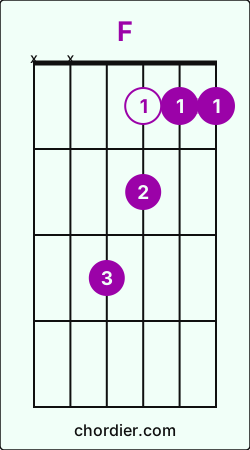 Guitar F chord diagram
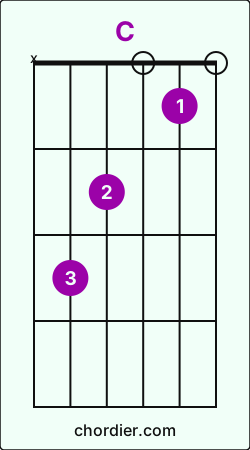 Guitar C chord diagram
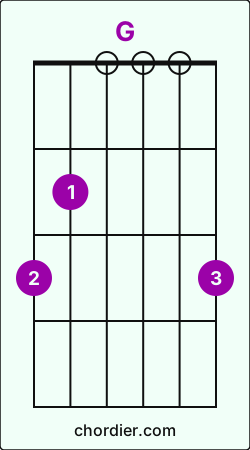 Guitar G chord diagram
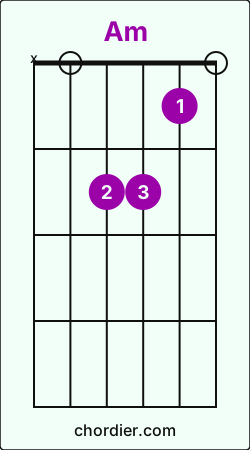 Guitar Am chord diagram
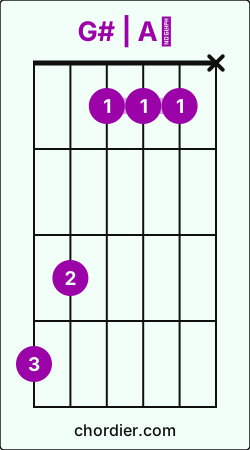 Guitar G# | A♭ chord diagram
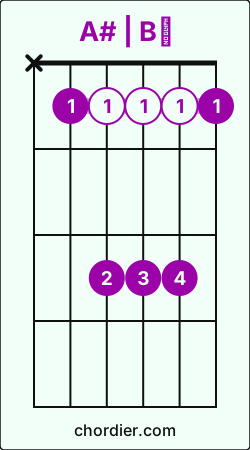 Guitar A# | B♭ chord diagram
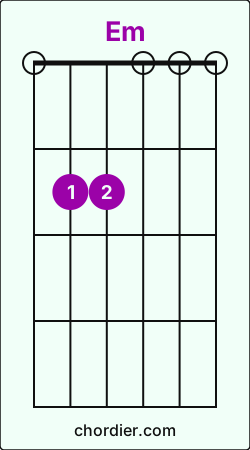 Guitar Em chord diagram
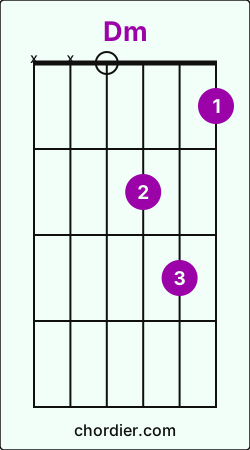 Guitar Dm chord diagram
[Opening]
From the moment the [F]lights went [C]off,
Everything had [G][Am]changed.
Lie awake in an [F]empty room,
In my [C]head it all feels [G]the [Am]same.
Like the taste of the [F]day you left,
It still [C]lingers on [G]my [Am]breath.
And the dampness of [F]tears that left,
That [C]stain where you [G]had [Am]wept.
All alone with the [F]negligee,
That still [C]hangs off of [G]my [Am]bed.
I keep meaning to [F]give it away,
But I [C]just leave it there [G]instead.
[verse 2]
No need to [Am]cry about [F]it,
I can not [C]live without it,
[G#]Every time I [Bb]wind up [G]back at [C]your [Am]door.
Why do you [Am]do this to [F]me?
You [C]penetrate right through me.
[G#]Every time I [Bb]wind up [G]back at [C]your door.
[verse 3]
3 more days ‘til I see your face,
I’m afraid it’s far too much.
Cook a meal and fix up the place,
Dial your number, hang it up.
[verse 4]
If I took you for granted,
I apologize for acting tough.
You’re my reason for living,
And there’s no way I’m giving up, oh.
[verse 5]
Chorus 2 has the same rhythm
and same chords as Chorus 1.
[verse 6]
No need to cry about it,
I can not live without it,
Every time I wind up back at your door.
[verse 7]
Why do you do this to me?
You penetrate right through me.
Every time I wind up back at your door.
[verse 8]
Now [Em]every [Dm]evening is a [F][C]bitter fight,
And I’m [Em]eating all [Dm]alone on a [F][C]Friday night.
And I [Em]know what your [Dm]friends say,
“He’s just [F]wasting your love [C]and time.”
[F]I will never [G]let you change your mind.
[verse 9]
No need to [Am]cry about [F]it,
I can not [C]live without it,
[F]Every time I[C] wind u[G]p back at yo[C]ur do[Am]or.
Why do you [Am]do this to [F]me?
You [C]penetrate right through me.
[G#]Every time I [Bb]wind up [G]back at [C]your [Am]door.
No need to [Am]cry about [F]it,
I may just [C]die without it,
[F]Every time I[C] wind u[G]p back at yo[C]ur do[Am]or.
Why do you [Am]do this to [F]me?
You [C]penetrate right through me.
[G#]Every time I [Bb]wind up [G]back at [C]your door.
[Closing]
[G#]Every time I [Bb]wind up [G]back at [C]your door.
[G#]Every time I [Bb]wind up [G]back at [C]your door.
How to play Back At Your Door on Guitar (Step-by-step)
Maroon 5 - Back At Your Door on guitar requires 8 chords and 12 core chord transitions. You can find the full step-by-step guide below. Before you start, tune your instrument. The song uses the ↓-↓↑-↓↑-↓↑ pattern; practice it muted first, or simplify to downstrokes while you learn the changes.
Back At Your Door uses these transitions most often: F → C (17), Am → F (11), and C → G (8). These transitions may feel a little challenging at first, but with steady practice you can play this song quickly.When you are ready, begin with F - C chord transition.
1. F → C chord transition
To move from F to C;
- While playing F, lift your pinky from D string fret 3.
- Lift your index finger from E string fret 1 and place it on B string fret 1.
- Slide your middle finger from G string fret 2 to D string fret 2.
- Keep ring finger on A string fret 3.
2. C → G chord transition
To move from C to G;
- Lift your index finger from B string fret 1 and place it on A string fret 2.
- Slide your middle finger from D string fret 2 to E string fret 3.
- Lift your ring finger from A string fret 3 and place it on E string fret 3.
3. G → Am chord transition
To move from G to Am;
- Lift your index finger from A string fret 2 and place it on B string fret 1.
- Slide your middle finger from E string fret 3 to D string fret 2.
- Lift your ring finger from E string fret 3 and place it on G string fret 2.
4. Am → F chord transition
To move from Am to F;
- Lift your index finger from B string fret 1 and place it on E string fret 1.
- Slide your middle finger from D string fret 2 to G string fret 2.
- Lift your ring finger from G string fret 2 and place it on A string fret 3.
- Place pinky on D string fret 3.
5. C → G# chord transition
To move from C to G#;
- Lift your index finger from B string fret 1 and place it on D string fret 1.
- Slide your middle finger from D string fret 2 to A string fret 3.
- Lift your ring finger from A string fret 3 and place it on E string fret 4.
6. G# → Bb chord transition
To move from G# to Bb;
- Lift your index finger from D string fret 1 and place it on A string fret 1.
- Slide your middle finger from A string fret 3 to D string fret 3.
- Lift your ring finger from E string fret 4 and place it on G string fret 3.
- Place pinky on B string fret 3.
7. Bb → G chord transition
To move from Bb to G;
- While playing Bb, lift your pinky from B string fret 3.
- Slide your index finger on A string from fret 1 to fret 2.
- Slide your middle finger from D string fret 3 to E string fret 3.
- Lift your ring finger from G string fret 3 and place it on E string fret 3.
8. C → Am chord transition
To move from C to Am;
- Keep index finger on B string fret 1.
- Keep middle finger on D string fret 2.
- Lift your ring finger from A string fret 3 and place it on G string fret 2.
9. C → Em chord transition
To move from C to Em;
- While playing C, lift your index finger from B string fret 1.
- Lift your middle finger from D string fret 2 and place it on A string fret 2.
- Slide your ring finger from A string fret 3 to D string fret 2.
10. Em → Dm chord transition
To move from Em to Dm;
- Lift your middle finger from A string fret 2 and place it on G string fret 2.
- Slide your ring finger from D string fret 2 to B string fret 3.
- Place index finger on E string fret 1.
11. Dm → F chord transition
To move from Dm to F;
- Lift your index finger from E string fret 1 and place it on E string fret 1.
- Keep middle finger on G string fret 2.
- Slide your ring finger from B string fret 3 to A string fret 3.
- Place pinky on D string fret 3.
12. F → G chord transition
To move from F to G;
- While playing F, lift your pinky from D string fret 3.
- Lift your index finger from E string fret 1 and place it on A string fret 2.
- Slide your middle finger from G string fret 2 to E string fret 3.
- Lift your ring finger from A string fret 3 and place it on E string fret 3.
Back At Your Door chord transition analysis
A short, data-driven summary of the chord flow in Back At Your Door.
- Back At Your Door includes 86 chord transitions, 12 of them unique.
- These transitions represent 0.02% of all chord transitions in Chordier.
- Back At Your Door contains 6 of the top 10 transitions across Chordier.
- These transition patterns show how Back At Your Door connects to the rest of Chordier. Mastering them helps you move to similar songs faster.After C, the most likely next chords across Chordier are G (35%), F (16%), and D (11%).
- C → G: 35%
- C → F: 16%
After F, the most likely next chords across Chordier are C (40%), G (21%), and Am (11%).- F → C: 40%
- F → G: 21%