
Gerry Rafferty - Baker Street Chords
Before you play, tune your guitar and use the tools below to set up your view and flow.
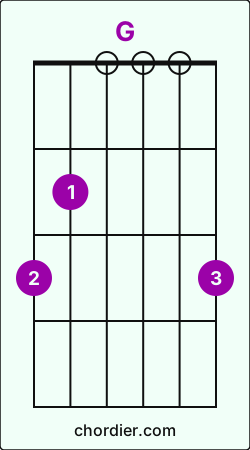 Guitar G chord diagram
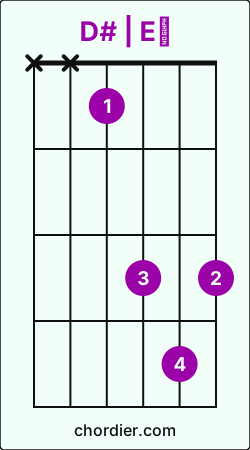 Guitar D# | E♭ chord diagram
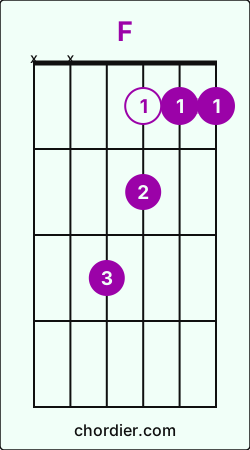 Guitar F chord diagram
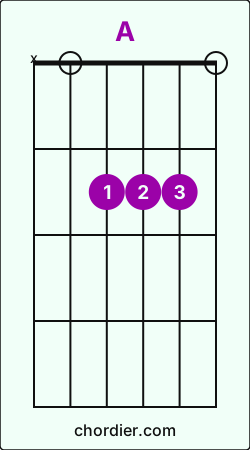 Guitar A chord diagram
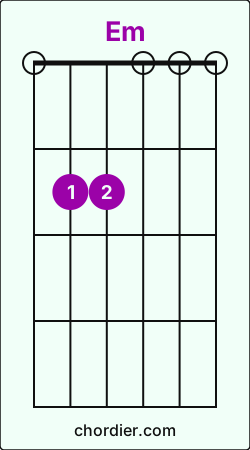 Guitar Em chord diagram
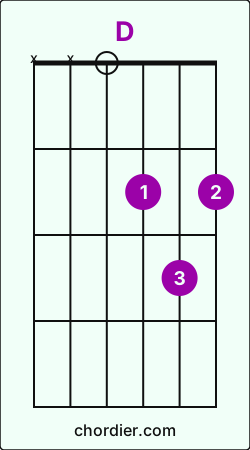 Guitar D chord diagram
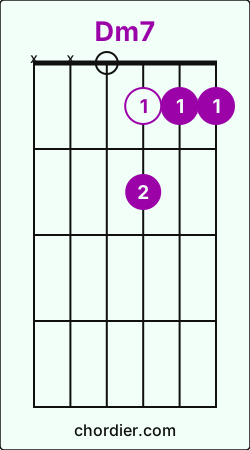 Guitar Dm7 chord diagram
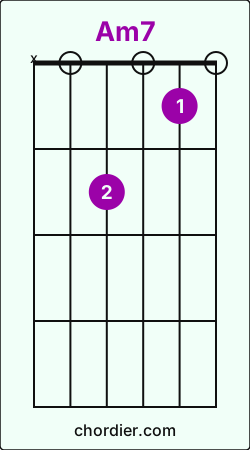 Guitar Am7 chord diagram
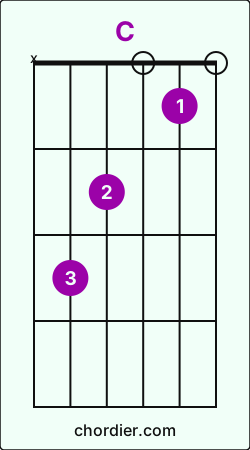 Guitar C chord diagram
[Opening]
[G] [D#] [F] [G] [D#] [F] [G] [D#] [F]
[A]Winding your way down on Baker Street [A]
[A]Light in your head, and dead on your feet
Well an [Em]other crazy day, you [G]drink the night away
And [D]forget about [D]every[D]thing
[verse 2]
[A]This city desert makes you feel so cold,
its [A]got [A]so many people but its got no soul
And it’s [Em]taken you so long to [G]find out you were wrong
When you [D]thought it held [D]every[D]thing.
[verse 3]
[Dm7]You used to think that it was [Am7]so easy,
[Dm7]You used to say that it was [Am7]so easy
But [C]you’re trying, [G]you’re trying [D]now [D]
[Dm7]Another year and then you’d [Am7]be happy,
[verse 4]
[Dm7]Just one more year and then you’d [Am7]be happy
But [C]you’re crying, [G]you’re crying [A]now [F]
[interlude]
[D] [F] [D] [F] [C] [A] [G]
[verse 5]
[A]Way down the street there’s a lot in his place, [A]
[A]He opens the door, he’s got that look on his face
And he [Em]asks you where you’ve been, you [G]tell him who you’ve seen
And you talk [D]about anything
[verse 6]
[A]He’s got this dream about buying some land, [A]he’s gonna
[A]Give up the booze and the one night stands
And then he’ll [Em]settle down, it’s a [G]quiet little town
And for [D]get about everything
[verse 7]
[Dm7]But you know he’ll always [Am7]keep moving,
[Dm7]You know he’s never gonna [Am7]stop moving
‘Cause [C]he’s rolling, [G]He’s the rolling [D]stone [D]
[Dm7]And when you wake up it’s a [Am7]new morning,
[Closing]
[Dm7]The sun is shining it’s a [Am7]new morning
And [C]you’re going, [G]you’re going home [A] [F]
[outro]
[D] [F] [D] [F] [C] [A] [G]
How to play Baker Street on Guitar (Step-by-step)
Gerry Rafferty - Baker Street on guitar requires 9 chords and 16 core chord transitions. You can find the full step-by-step guide below. Before you start, tune your instrument. The song uses the ↓-↓↑-↓↑-↓↑ pattern; practice it muted first, or simplify to downstrokes while you learn the changes.
Baker Street uses these transitions most often: Dm7 → Am7 (8), G → D (6), and A → Em (4). These transitions may feel a little challenging at first, but with steady practice you can play this song quickly.When you are ready, begin with G - D# chord transition.
1. G → D# chord transition
To move from G to D#;
- Lift your index finger from A string fret 2 and place it on D string fret 1.
- Slide your middle finger from E string fret 3 to E string fret 3.
- Lift your ring finger from E string fret 3 and place it on G string fret 3.
- Place pinky on B string fret 4.
2. D# → F chord transition
To move from D# to F;
- Lift your index finger from D string fret 1 and place it on E string fret 1.
- Slide your middle finger from E string fret 3 to G string fret 2.
- Lift your ring finger from G string fret 3 and place it on A string fret 3.
- Slide your pinky from B string fret 4 to D string fret 3.
3. F → G chord transition
To move from F to G;
- While playing F, lift your pinky from D string fret 3.
- Lift your index finger from E string fret 1 and place it on A string fret 2.
- Slide your middle finger from G string fret 2 to E string fret 3.
- Lift your ring finger from A string fret 3 and place it on E string fret 3.
4. F → A chord transition
To move from F to A;
- While playing F, lift your pinky from D string fret 3.
- Lift your index finger from E string fret 1 and place it on D string fret 2.
- Keep middle finger on G string fret 2.
- Slide your ring finger from A string fret 3 to B string fret 2.
5. A → Em chord transition
To move from A to Em;
- While playing A, lift your index finger from D string fret 2.
- Lift your middle finger from G string fret 2 and place it on A string fret 2.
- Slide your ring finger from B string fret 2 to D string fret 2.
6. Em → G chord transition
To move from Em to G;
- Lift your middle finger from A string fret 2 and place it on E string fret 3.
- Slide your ring finger from D string fret 2 to E string fret 3.
- Place index finger on A string fret 2.
7. G → D chord transition
To move from G to D;
- Lift your index finger from A string fret 2 and place it on G string fret 2.
- Slide your middle finger from E string fret 3 to E string fret 2.
- Lift your ring finger from E string fret 3 and place it on B string fret 3.
8. D → A chord transition
To move from D to A;
- Lift your index finger from G string fret 2 and place it on D string fret 2.
- Slide your middle finger from E string fret 2 to G string fret 2.
- Slide your ring finger on B string from fret 3 to fret 2.
9. D → Dm7 chord transition
To move from D to Dm7;
- While playing D, lift your ring finger from B string fret 3.
- Lift your index finger from G string fret 2 and place it on B string fret 1.
- Slide your middle finger from E string fret 2 to G string fret 2.
10. Dm7 → Am7 chord transition
To move from Dm7 to Am7;
- Keep index finger on B string fret 1.
- Lift your middle finger from G string fret 2 and place it on D string fret 2.
11. Am7 → C chord transition
To move from Am7 to C;
- Keep index finger on B string fret 1.
- Keep middle finger on D string fret 2.
- Place ring finger on A string fret 3.
12. C → G chord transition
To move from C to G;
- Lift your index finger from B string fret 1 and place it on A string fret 2.
- Slide your middle finger from D string fret 2 to E string fret 3.
- Lift your ring finger from A string fret 3 and place it on E string fret 3.
13. G → A chord transition
To move from G to A;
- Lift your index finger from A string fret 2 and place it on D string fret 2.
- Slide your middle finger from E string fret 3 to G string fret 2.
- Lift your ring finger from E string fret 3 and place it on B string fret 2.
14. F → D chord transition
To move from F to D;
- While playing F, lift your pinky from D string fret 3.
- Lift your index finger from E string fret 1 and place it on G string fret 2.
- Slide your middle finger from G string fret 2 to E string fret 2.
- Lift your ring finger from A string fret 3 and place it on B string fret 3.
15. F → C chord transition
To move from F to C;
- While playing F, lift your pinky from D string fret 3.
- Lift your index finger from E string fret 1 and place it on B string fret 1.
- Slide your middle finger from G string fret 2 to D string fret 2.
- Keep ring finger on A string fret 3.
16. C → A chord transition
To move from C to A;
- Lift your index finger from B string fret 1 and place it on D string fret 2.
- Slide your middle finger from D string fret 2 to G string fret 2.
- Lift your ring finger from A string fret 3 and place it on B string fret 2.
Baker Street chord transition analysis
A short, data-driven summary of the chord flow in Baker Street.
- Baker Street includes 68 chord transitions, 16 of them unique.
- These transitions represent 0.02% of all chord transitions in Chordier.
- Baker Street contains 5 of the top 10 transitions across Chordier.
- These transition patterns show how Baker Street connects to the rest of Chordier. Mastering them helps you move to similar songs faster.After A, the most likely next chords across Chordier are D (29%), G (13%), and E (12%).
- A → G: 13%
- A → Em: 7%
After D, the most likely next chords across Chordier are G (29%), A (17%), and Em (17%).- D → A: 17%
- D → F: 2%