
Ralph McTell - Barges Chords
Before you play, tune your guitar and use the tools below to set up your view and flow.
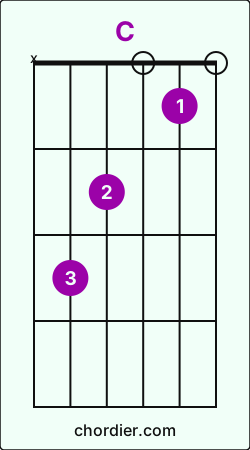 Guitar C chord diagram
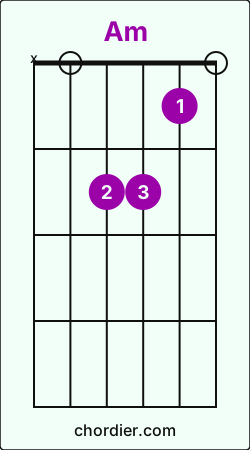 Guitar Am chord diagram
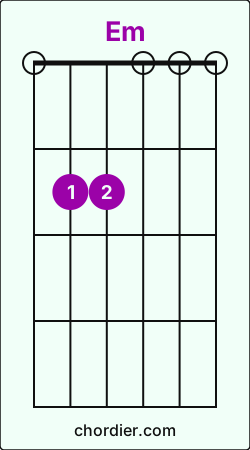 Guitar Em chord diagram
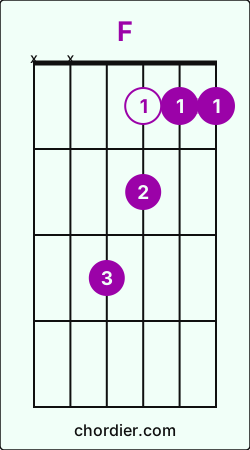 Guitar F chord diagram
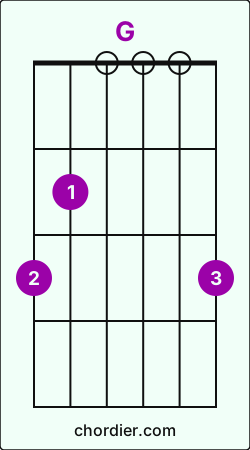 Guitar G chord diagram
[Opening]
[C]Me and my [Am]brother re[C]turned to the [Am]water,
[C]I saw a [Em]pike that [F]was two feet [C]long.
[Am]Two small ma[C]gicians, [Am]each with a [C]jam jar
cast [Am]spells on the wa[C]ter with [G]hazel twig [Am]wands.
[verse 2]
[C]Country boys [Am]catch tadpoles, [C]dive into [Am]water,
made [C]shy by their [Em]laughter, we [F]wandered down [C]stream.
And [Am]summer rolled [C]o’er us with [Am]no compli[C]cations,
sat [Am]thinking of [C]Mama, [G]sometimes in [Am]dreams.
[verse 3]
[C]Stand by the draw[Am]bridge [C]waiting for [Am]barges,
[C]waiting a[Em]round for [F]smiles from the [C]man.
[Am]Lifting the [C]bridge whilst [Am]watching the [C]horses,
[Am]dragging the [C]slow boats [G]up the ca[Am]nal.
[verse 4]
[C]I do re[Am]member the [C]times but no [Am]number,
[C]after the [Em]day, but be[F]fore evening [C]comes.
[Am]Waiting for [C]castles and [Am]kettles with [C]roses,
[Am]painted on [C]barges that [G]sailed into the [Am]sun.
[Closing]
[C]Oh see the [Am]river run, [C]that was when [Am]man begun
[C]Open the [Em]lock, let the [F]boats sail [C]on
[Am]Taking their [C]castles and [Am]kettles with [C]roses
With [Am]summers of [C]childhood leaving [G]smiles on the [Am]man
How to play Barges on Guitar (Step-by-step)
Ralph McTell - Barges on guitar requires 5 chords and 6 core chord transitions. You can find the full step-by-step guide below. Before you start, tune your instrument. The song uses the ↓-↓↑-↓↑-↓↑ pattern; practice it muted first, or simplify to downstrokes while you learn the changes.
Barges uses these transitions most often: Am → C (29), C → Am (25), and C → Em (5). These transitions may feel a little challenging at first, but with steady practice you can play this song quickly.When you are ready, begin with C - Am chord transition.
1. C → Am chord transition
To move from C to Am;
- Keep index finger on B string fret 1.
- Keep middle finger on D string fret 2.
- Lift your ring finger from A string fret 3 and place it on G string fret 2.
2. C → Em chord transition
To move from C to Em;
- While playing C, lift your index finger from B string fret 1.
- Lift your middle finger from D string fret 2 and place it on A string fret 2.
- Slide your ring finger from A string fret 3 to D string fret 2.
3. Em → F chord transition
To move from Em to F;
- Lift your middle finger from A string fret 2 and place it on G string fret 2.
- Slide your ring finger from D string fret 2 to A string fret 3.
- Place index finger on E string fret 1.
- Place pinky on D string fret 3.
4. F → C chord transition
To move from F to C;
- While playing F, lift your pinky from D string fret 3.
- Lift your index finger from E string fret 1 and place it on B string fret 1.
- Slide your middle finger from G string fret 2 to D string fret 2.
- Keep ring finger on A string fret 3.
5. C → G chord transition
To move from C to G;
- Lift your index finger from B string fret 1 and place it on A string fret 2.
- Slide your middle finger from D string fret 2 to E string fret 3.
- Lift your ring finger from A string fret 3 and place it on E string fret 3.
6. G → Am chord transition
To move from G to Am;
- Lift your index finger from A string fret 2 and place it on B string fret 1.
- Slide your middle finger from E string fret 3 to D string fret 2.
- Lift your ring finger from E string fret 3 and place it on G string fret 2.
Barges chord transition analysis
A short, data-driven summary of the chord flow in Barges.
- Barges includes 79 chord transitions, 6 of them unique.
- These transitions represent 0.02% of all chord transitions in Chordier.
- Barges contains 4 of the top 10 transitions across Chordier.
- These transition patterns show how Barges connects to the rest of Chordier. Mastering them helps you move to similar songs faster.After C, the most likely next chords across Chordier are G (35%), F (16%), and D (11%).
- C → G: 35%
- C → Am: 10%
After Am, the most likely next chords across Chordier are F (26%), G (21%), and C (16%).- Am → C: 16%