
Dean Lewis - Be Alright Chords
Before you play, tune your guitar and use the tools below to set up your view and flow.
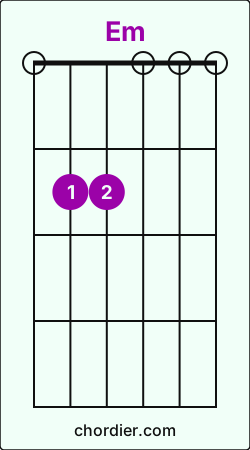 Guitar Em chord diagram
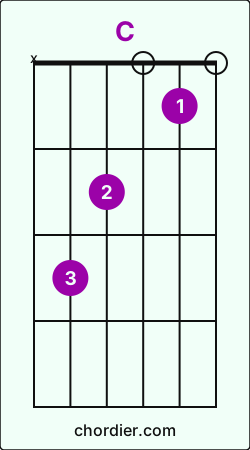 Guitar C chord diagram
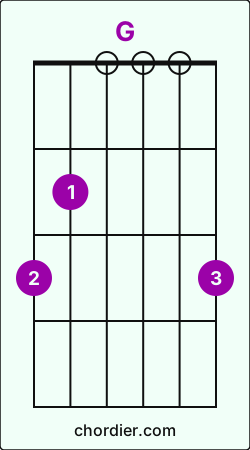 Guitar G chord diagram
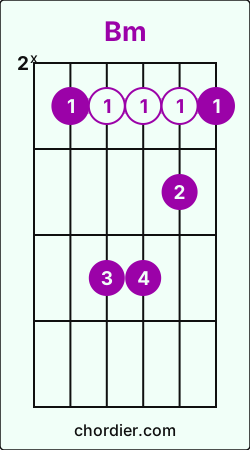 Guitar Bm chord diagram
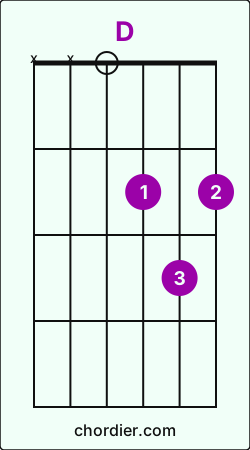 Guitar D chord diagram
[Opening]
[Em]I look up from the ground to see [C]your sad and teary eyes
You look [G]away from me and I see there’s [Bm]something you’re trying to hide
And [Em]I, reach for your hand but it’s [C]cold, you pull away again
And I, [G]wonder, what’s on [Bm]your mind-ind-ind
[verse 2]
[C]And then you say to me [Em]“you made a dumb mistake”
[D]You start to tremble and your [D]voice begins to break
You say the [C]cigarettes on the counter weren’t [Em]your friends,
They were my mates, and I [D]feel the colour draining from my [D]face
And my friends said…
[verse 3]
[Em]I know you love her but it’s [C]over mate, [G]it doesn’t matter, put [D]the phone away
[Em]It’s never easy to [C]walk away, but let her [G]go oh [D]oh oh, it’ll be alright.
[verse 4]
[Em]So I asked to look back at all the [C]messages you’d sent
And I [G]know it wasn’t right but it [Bm]was fucking with my head
[Em]And everything deleted like the [C]past, yeah it was gone
And [G]when I touched your face I [Bm]could tell you’re moving on
[verse 5]
[C]But it’s not the fact that [Em]you kissed him yesterday
It’s the [D]feeling of betrayal, that I [D]just can’t seem to shake
And [C]everything I know tells me [Em]that I should walk away
But I [D]just want to [D]stay, and my friends said…
[chorus]
[Em]I know you love her but it’s [C]over mate, [G]it doesn’t matter, put [D]the phone away
[Em]It’s never easy to [C]walk away, but let her [G]go oh [D]oh oh, it’ll be okay
[Em]It’s gonna hurt for a [C]bit of time, [G]so, bottoms up, let’s [D]forget tonight
[Em]You’ll find another and [C]you’ll be just fine, let her [G]go oh oh [D]oh
[verse 6]
But [Em]nothing [C]heals, the [G]past like [D]time
[Em]and they can’t [C]steal, the [G]love you’re born to [D]find
But [Em]nothing [C]heals, the [G]past like [D]time
[Em]And they can’t [C]steal, the [G]love you’re born to [D]find
[chorus]
[Em]I know you love her but it’s [C]over mate, [G]it doesn’t matter, put [D]the phone away
[Em]It’s never easy to [C]walk away, but let her [G]go oh [D]oh oh, it’ll be okay
[Em]It’s gonna hurt for a [C]bit of time, [G]so, bottoms up, let’s [D]forget tonight
[Em]You’ll find another and [C]you’ll be just fine, let her [G]go oh oh [D]oh
[Closing]
It’ll be [Em]alright, [C]it’ll be [G]alright [D]
It’ll be [Em]alright, [C]it’ll be [G]alright [D]
It’ll be [Em]alright..
How to play Be Alright on Guitar (Step-by-step)
Dean Lewis - Be Alright on guitar requires 5 chords and 8 core chord transitions. You can find the full step-by-step guide below. Before you start, tune your instrument. The song uses the ↓-↓↑-↑↓↑ pattern; practice it muted first, or simplify to downstrokes while you learn the changes.
Be Alright uses these transitions most often: C → G (20), Em → C (20), and D → Em (18). These transitions may feel a little challenging at first, but with steady practice you can play this song quickly.When you are ready, begin with Em - C chord transition.
1. Em → C chord transition
To move from Em to C;
- Lift your middle finger from A string fret 2 and place it on D string fret 2.
- Slide your ring finger from D string fret 2 to A string fret 3.
- Place index finger on B string fret 1.
2. C → G chord transition
To move from C to G;
- Lift your index finger from B string fret 1 and place it on A string fret 2.
- Slide your middle finger from D string fret 2 to E string fret 3.
- Lift your ring finger from A string fret 3 and place it on E string fret 3.
3. G → Bm chord transition
To move from G to Bm;
- Lift your index finger from A string fret 2 and place it on E string fret 2.
- Slide your middle finger from E string fret 3 to B string fret 3.
- Lift your ring finger from E string fret 3 and place it on D string fret 4.
- Place pinky on G string fret 4.
4. Bm → Em chord transition
To move from Bm to Em;
- While playing Bm, first lift your index finger and pinky.
- Lift your middle finger from B string fret 3 and place it on A string fret 2.
- Slide your ring finger on D string from fret 4 to fret 2.
5. Bm → C chord transition
To move from Bm to C;
- While playing Bm, lift your pinky from G string fret 4.
- Lift your index finger from E string fret 2 and place it on B string fret 1.
- Slide your middle finger from B string fret 3 to D string fret 2.
- Lift your ring finger from D string fret 4 and place it on A string fret 3.
6. Em → D chord transition
To move from Em to D;
- Lift your middle finger from A string fret 2 and place it on E string fret 2.
- Slide your ring finger from D string fret 2 to B string fret 3.
- Place index finger on G string fret 2.
7. D → C chord transition
To move from D to C;
- Lift your index finger from G string fret 2 and place it on B string fret 1.
- Slide your middle finger from E string fret 2 to D string fret 2.
- Lift your ring finger from B string fret 3 and place it on A string fret 3.
8. G → D chord transition
To move from G to D;
- Lift your index finger from A string fret 2 and place it on G string fret 2.
- Slide your middle finger from E string fret 3 to E string fret 2.
- Lift your ring finger from E string fret 3 and place it on B string fret 3.
Be Alright chord transition analysis
A short, data-driven summary of the chord flow in Be Alright.
- Be Alright includes 92 chord transitions, 8 of them unique.
- These transitions represent 0.02% of all chord transitions in Chordier.
- Be Alright contains 5 of the top 10 transitions across Chordier.
- These transition patterns show how Be Alright connects to the rest of Chordier. Mastering them helps you move to similar songs faster.After Em, the most likely next chords across Chordier are C (26%), G (18%), and D (17%).
- Em → C: 26%
- Em → D: 17%
After C, the most likely next chords across Chordier are G (35%), F (16%), and D (11%).- C → G: 35%
- C → Em: 8%