
Train - Call Me Sir Chords
Before you play, tune your guitar and use the tools below to set up your view and flow.
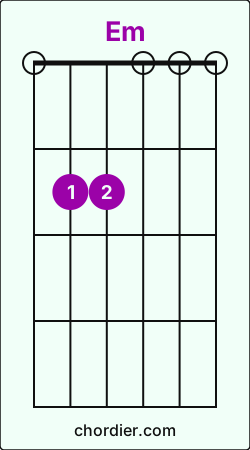 Guitar Em chord diagram
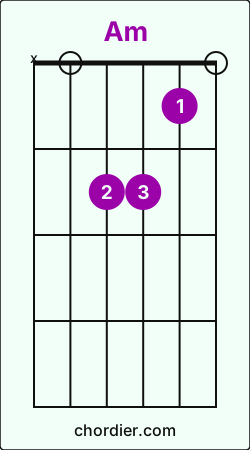 Guitar Am chord diagram
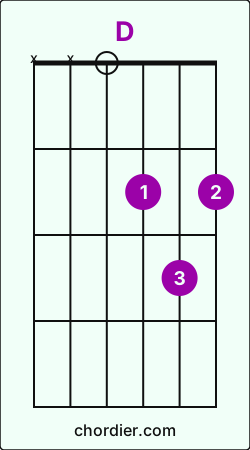 Guitar D chord diagram
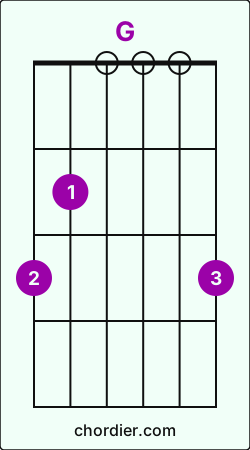 Guitar G chord diagram
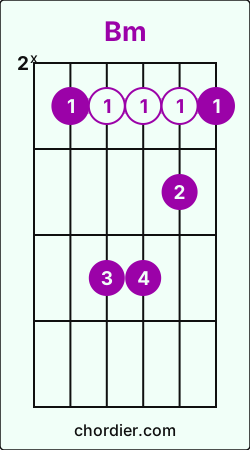 Guitar Bm chord diagram
[chorus]
[Em]When I ride by [Am]myself, I don’t ever get no [D]help
But when I roll up with [G]her, [Bm]everybody calls me [Em]Sir
No matter how long I [Am]stay, they never ever know my [D]name
But when I walk in with [G]her, [Bm]everybody calls me Sir
[Opening]
[Em]Northern [Em]California, [Em] [Am]same old Friday [Am]night
[D]Tend to be [D]invisible under[G]neath these city [Bm]lights
[Em]Then I met my [Em]baby, [Am]felt like I struck [Am]gold
[D]Now they treat me [D]like [D]royalty [G]everywhere I [Bm]go (oh oh oh [Em]oh)
[chorus]
[Em] [Em]When I [Em]ride by [Am]myself, [Am]I don’t [Am]ever get [D]no help
But [D]when I roll up with [G]her, [Bm]everybody calls me [Em]Sir
No [Em]matter [Em]how long I [Am]stay, they [Am]never ever know [D]my name
But [D]when I [D]walk in with [G]her, [Bm]everybody calls me [Em]Sir
[verse 2]
[Em]Oh oh oh [Em]oh oh oh oh oh o[Em]h oh[Am]oh, [Am] [Am]call me Sir
[D]Oh oh oh [D]oh oh oh oh oh [D]oh [G]oh oh [Bm](oh oh oh [Em]oh)
[verse 3]
[Em]I ain’t going [Em]nowhere [Am]unless he’s there with [Am]me
[D]’Cause I don’t stand in [D]line no [D]more, [G]admission’s always [Bm]free
[Em]He could break the [Em]law, he could [Am]break your heart in [Am]two
[D]But I promise [D]that you won’t care [G]when he smiles at [Bm]you (oh oh oh [Em]oh)
[chorus]
[Em] [Em]When I [Em]ride by [Am]myself, [Am]I don’t [Am]ever get no [D]help
But [D]when I roll up with [G]her, [Bm]everybody calls me [Em]Sir
No [Em]matter [Em]how long I [Am]stay, they never ever know my [D]name
But [D]when I [D]walk in with [G]her, [Bm]everybody calls me [Em]Sir
[verse 4]
[Em]Oh oh oh [Em]oh oh oh oh oh [Em]oh oh [Am]oh, call me Sir
[D]Oh oh oh [D]oh oh oh oh oh [D]oh [G]oh oh, (a [Bm]ha) call me [Em]Sir
Oh oh oh [Em]oh oh oh oh oh (come on) [Em]oh [Am]oh oh, call [D]me Sir
Oh oh oh [D]oh oh oh oh oh [D]oh [G]oh oh [Bm](oh oh oh [Em]oh)
(She makes me feel like a billion bucks bruh, yeah)
[verse 5]
[Em]Every time we hit the streets it’s like a world premiere
[Am]She make me feel like Sia swinging from that chandelier
(Went [D]from) marginally famous to the top of the A list
And [G]just for future reference, here’s a [Bm]tip, Mr. Belvedere
[Em]Never judge a book by its cover
[Am]And never judge an ugly duckling duckling by his mother
The [D]Frog Prince got kissed, her lips granted his wish
It’s a [G]sad world when your net worth [Bm]determines your lover
[Em]But what would I ever do without you huh?
[Am]I prolly wouldn’t have a clue without you
But [D]one thing’s for sure, is when I pull up with her
Don’t [G]refer to me as Travie, [Bm]you can, you can call me Sir
[Closing]
[Em]Oh oh oh [Em]oh oh oh oh oh [Em]oh oh [Am]oh, call me Sir
(What would I ever do without you, what would I ever do without you)
[D]Oh oh oh [D]oh oh oh oh oh [D]oh [G]oh oh [Bm]call me [Em]Sir
(What would I ever do without you)
[Em]Oh oh oh [Em]oh oh oh oh oh [Em]oh oh [Am]oh, call me Sir
(What would I ever do without you, what would I ever do without you)
[D]Oh oh oh [D]oh oh oh oh oh [D]oh [G]oh oh [Bm]call me [Em]Sir
(What would I ever do without you)
How to play Call Me Sir on Guitar (Step-by-step)
Train - Call Me Sir on guitar requires 5 chords and 5 core chord transitions. You can find the full step-by-step guide below. Before you start, tune your instrument. The song uses the ↓-↓↑-↓↑-↓↑ pattern; practice it muted first, or simplify to downstrokes while you learn the changes.
Call Me Sir uses these transitions most often: Am → D (18), Bm → Em (18), and D → G (18). These transitions may feel a little challenging at first, but with steady practice you can play this song quickly.When you are ready, begin with Em - Am chord transition.
1. Em → Am chord transition
To move from Em to Am;
- Lift your middle finger from A string fret 2 and place it on D string fret 2.
- Slide your ring finger from D string fret 2 to G string fret 2.
- Place index finger on B string fret 1.
2. Am → D chord transition
To move from Am to D;
- Lift your index finger from B string fret 1 and place it on G string fret 2.
- Slide your middle finger from D string fret 2 to E string fret 2.
- Lift your ring finger from G string fret 2 and place it on B string fret 3.
3. D → G chord transition
To move from D to G;
- Lift your index finger from G string fret 2 and place it on A string fret 2.
- Slide your middle finger from E string fret 2 to E string fret 3.
- Lift your ring finger from B string fret 3 and place it on E string fret 3.
4. G → Bm chord transition
To move from G to Bm;
- Lift your index finger from A string fret 2 and place it on E string fret 2.
- Slide your middle finger from E string fret 3 to B string fret 3.
- Lift your ring finger from E string fret 3 and place it on D string fret 4.
- Place pinky on G string fret 4.
5. Bm → Em chord transition
To move from Bm to Em;
- While playing Bm, first lift your index finger and pinky.
- Lift your middle finger from B string fret 3 and place it on A string fret 2.
- Slide your ring finger on D string from fret 4 to fret 2.
Call Me Sir chord transition analysis
A short, data-driven summary of the chord flow in Call Me Sir.
- Call Me Sir includes 90 chord transitions, 5 of them unique.
- These transitions represent 0.02% of all chord transitions in Chordier.
- Call Me Sir contains 1 of the top 10 transitions across Chordier.
- These transition patterns show how Call Me Sir connects to the rest of Chordier. Mastering them helps you move to similar songs faster.After Em, the most likely next chords across Chordier are C (26%), G (18%), and D (17%).
- Em → Am: 12%
After D, the most likely next chords across Chordier are G (29%), A (17%), and Em (17%).- D → G: 29%