
Mumford & Sons - The Cave Chords
Before you play, tune your guitar and use the tools below to set up your view and flow.
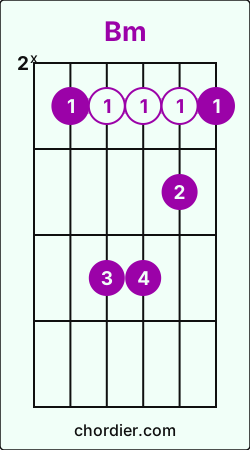 Guitar Bm chord diagram
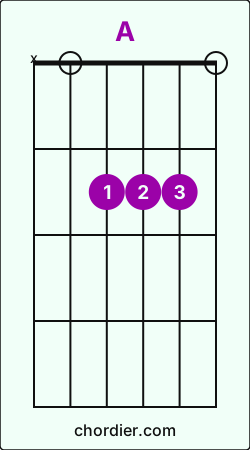 Guitar A chord diagram
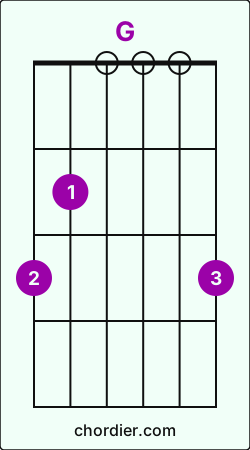 Guitar G chord diagram
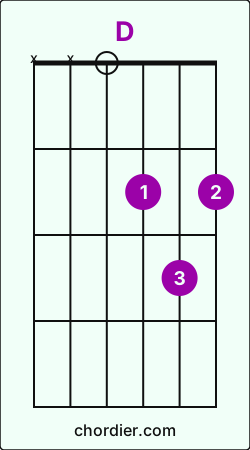 Guitar D chord diagram
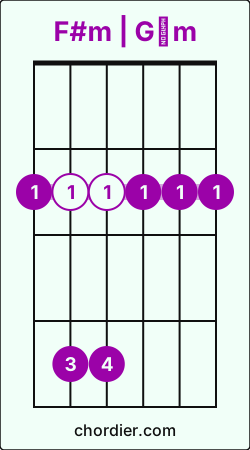 Guitar F#m | G♭m chord diagram
[Opening]
[Bm] [A] [G]
It’s empty In the [Bm]valley of your [D]heart
The sun It rises [Bm]slowly as you [D]walk
Away from all the [Bm]fears and all the [D]faults you’ve [F#m]left be [D]hind [G] [D]
The harvest left no [Bm]food for you to [D]eat
You cannibal you [Bm]meat eater you [D]see
But l have seen ltte [Bm]same I know the [D]shame in [F#m]your de [D]teat [G] [D]
[chorus]
But [D]I will [G]hold on [D]hope and I won’t [G]let you [D]choke
[G]On the [D]noose a [A]round your neck
And [Bm]I’ll find [G]strength in [D]pain and [Bm]I will [G]change my [D]ways
I’ll [G]know my [D]name as It’s [A]called again [A]
[interlude]
[Bm] [D] [Bm] [D]
[Bm] [D] [F#m] [D] [G] [D]
[verse 2]
‘Cause I have other [Bm]things to fill my [D]time
You take what Is [Bm]yours and I’ll take [D]mine
Now let me at the [Bm]truth which will re [D]fresh my [F#m]broken [D]mind [G] [D]
So tie me to a [Bm]post and block my [D]ears
I can see widows and [Bm]orphans through my [D]tears
I know my call des [Bm]plte my faults and des[D]pite my [F#m]growing [D]fears [G] [D]
[chorus]
But [D]I will [G]hold on [D]hope and I won’t [G]let you [D]choke
[G]On the [D]noose a [A]round your neck
And [Bm]I ‘ll find [G]strength In [D]pain and [Bm]I will [G]change my [D]ways
I’ll [G]know my [D]name as it’s [A]called again [D]
[verse 3]
So come out of your [Bm]cave walking on your [D]hands
And see the world [Bm]hanging upside [D]down
You can understand de[Bm]pendence when you [D]know the [F#m]maker’s IF]hand [G] [D]
So [D]make your [G]siren’s call and [D]sing [G]all you [D]want
[Closing]
I [G]will not [D]hear what you [A]have to say
cause [Bm]I need [G]freedom [D]now and [Bm]I need [G]lo know [D]how
To [G]live my [D]life as It’s [A]meant to be [A]
[interlude]
[D] [G] [D] [D] [G] [D]
[G] [D] [A]
[D] [G] [D] [D] [G] [D]
[G] [D] [A]
[chorus]
And [D]I will [G]hold on [D]hope and I won’t [G]let you [D]choke
[G]On the [D]noose a [A]round your neck
And [Bm]I’ll find [G]strength in [D]pain and l [Bm]will [G]change my [D]ways
I’ll [G]know my [D]name as it’s [A]called again [A] [D]
How to play The Cave on Guitar (Step-by-step)
Mumford & Sons - The Cave on guitar requires 5 chords and 8 core chord transitions. You can find the full step-by-step guide below. Before you start, tune your instrument. The song uses the ↓-↓↑-↑↓↑ pattern; practice it muted first, or simplify to downstrokes while you learn the changes.
The Cave uses these transitions most often: G → D (36), D → G (27), and D → Bm (20). These transitions may feel a little challenging at first, but with steady practice you can play this song quickly.When you are ready, begin with Bm - A chord transition.
1. Bm → A chord transition
To move from Bm to A;
- While playing Bm, lift your pinky from G string fret 4.
- Lift your index finger from E string fret 2 and place it on D string fret 2.
- Slide your middle finger from B string fret 3 to G string fret 2.
- Lift your ring finger from D string fret 4 and place it on B string fret 2.
2. A → G chord transition
To move from A to G;
- Lift your index finger from D string fret 2 and place it on A string fret 2.
- Slide your middle finger from G string fret 2 to E string fret 3.
- Lift your ring finger from B string fret 2 and place it on E string fret 3.
3. G → Bm chord transition
To move from G to Bm;
- Lift your index finger from A string fret 2 and place it on E string fret 2.
- Slide your middle finger from E string fret 3 to B string fret 3.
- Lift your ring finger from E string fret 3 and place it on D string fret 4.
- Place pinky on G string fret 4.
4. Bm → D chord transition
To move from Bm to D;
- While playing Bm, lift your pinky from G string fret 4.
- Lift your index finger from E string fret 2 and place it on G string fret 2.
- Slide your middle finger from B string fret 3 to E string fret 2.
- Lift your ring finger from D string fret 4 and place it on B string fret 3.
5. D → F#m chord transition
To move from D to F#m;
- While playing D, lift your middle finger from E string fret 2.
- Lift your index finger from G string fret 2 and place it on E string fret 2.
- Slide your ring finger from B string fret 3 to A string fret 4.
- Place pinky on D string fret 4.
6. D → G chord transition
To move from D to G;
- Lift your index finger from G string fret 2 and place it on A string fret 2.
- Slide your middle finger from E string fret 2 to E string fret 3.
- Lift your ring finger from B string fret 3 and place it on E string fret 3.
7. D → A chord transition
To move from D to A;
- Lift your index finger from G string fret 2 and place it on D string fret 2.
- Slide your middle finger from E string fret 2 to G string fret 2.
- Slide your ring finger on B string from fret 3 to fret 2.
8. F#m → G chord transition
To move from F#m to G;
- While playing F#m, lift your pinky from D string fret 4.
- Lift your index finger from E string fret 2 and place it on A string fret 2.
- Slide your ring finger from A string fret 4 to E string fret 3.
- Place middle finger on E string fret 3.
The Cave chord transition analysis
A short, data-driven summary of the chord flow in The Cave.
- The Cave includes 144 chord transitions, 8 of them unique.
- These transitions represent 0.04% of all chord transitions in Chordier.
- The Cave contains 2 of the top 10 transitions across Chordier.
- These transition patterns show how The Cave connects to the rest of Chordier. Mastering them helps you move to similar songs faster.After D, the most likely next chords across Chordier are G (29%), A (17%), and Em (17%).
- D → G: 29%
- D → A: 17%
After G, the most likely next chords across Chordier are C (25%), D (24%), and Am (13%).- G → D: 24%
- G → Bm: 4%