
Taylor Swift - Change Chords
Before you play, tune your guitar and use the tools below to set up your view and flow. Using the Transpose tool, switch to G key to play this song with easier chords.
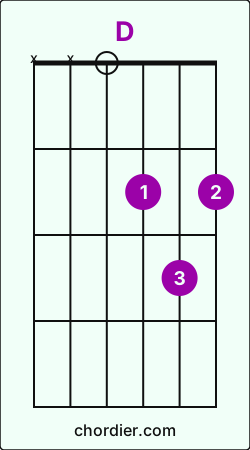 Guitar D chord diagram
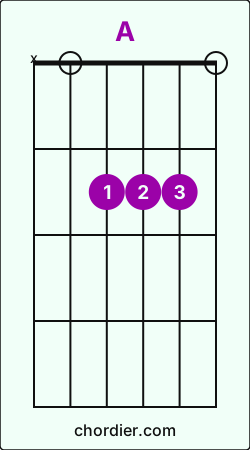 Guitar A chord diagram
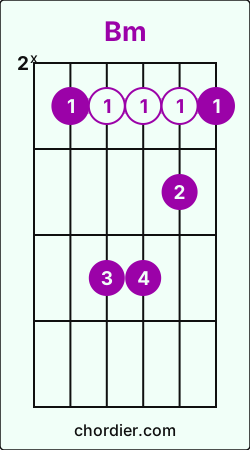 Guitar Bm chord diagram
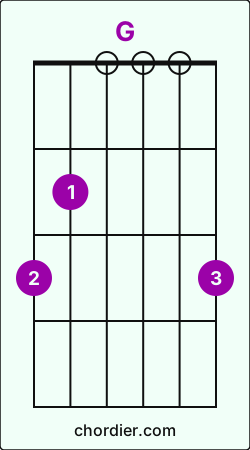 Guitar G chord diagram
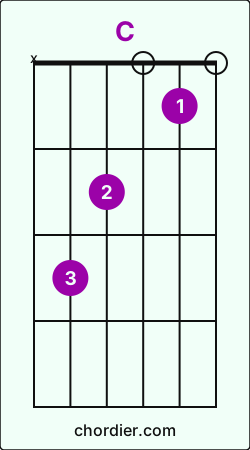 Guitar C chord diagram
[Opening]
[D] [A] [Bm] [G] [D] [A] [Bm] [G]
[D]And it’s a sad picture, [A]the final blow hits you
[Bm]Somebody else gets what you [G]wanted again
[D]You know it’s all the same, [A]another time and place
[Bm]Repeating history, and you’re [G]getting sick of it
[Bm]But I believe in [G]whatever you [A]do
And I’ll do [G]anything to see it [A]through
[chorus]
Because these things will [D]change, can you feel it [A]now?
These walls that they [Bm]put up to hold us back will [G]fall down
This [D]revolution, the time will [A]come for us to finally [Bm]win [G]
We’ll sing [D]hallelujah, [A]we’ll sing [Bm]hallelujah [G]
Oh [D]Oh…
[verse 2]
[D]So we’ve been outnumbered, [A]raided and now cornered
[Bm]It’s hard to fight when the [G]fight ain’t fair
[D]We’re getting stronger now, [A]find things they never found
[Bm]They might be bigger, but we’re [G]faster and [A]never scared
[Bm]You can walk [G]away and say we don’t [A]need this
[G]But There’s something in your eyes, says we can [A]beat this
[chorus]
Because these things will [D]change, can you feel [A]it now?
These walls that they [Bm]put up to hold us back will [G]fall down
This revolution, [D]the time will [A]come for us to finally [Bm]win [G]
We’ll sing [D]hallelujah, [A]we’ll sing [Bm]hallelujah [G]
Oh [D]Oh…
[verse 3]
[Bm] [G] [D] [A] [Bm] [G] [D] [A]
[D]Tonight we [G]stand, get off our [Bm]knees
To fight for what we [G]worked for all these years [D]
The battle was [G]long, it’s the fight of our [Bm]lives
We’ll stand up [G]champions tonight
[verse 4]
It was the night [D]things changed, can you see it now? [A]
These walls that they put [Bm]up to hold us back [G]fell down
[Closing]
It’s a revolution, [D]throw your hands up, [A]cause we never gave in [Bm] [G]
We sang [D]hallelujah, [A]we sang [Bm]hallelujah [G]
[D]Hallelujah [A] [Bm] [G]
[outro]
[D] [A] [Bm] [C] [D] [A] [Bm] [C]
How to play Change on Guitar (Step-by-step)
Taylor Swift - Change on guitar requires 5 chords and 8 core chord transitions. You can find the full step-by-step guide below. Before you start, tune your instrument. The song uses the ↓-↓↑-↓↑-↓↑ pattern; practice it muted first, or simplify to downstrokes while you learn the changes.
Change uses these transitions most often: Bm → G (22), A → Bm (20), and D → A (20). These transitions may feel a little challenging at first, but with steady practice you can play this song quickly.When you are ready, begin with D - A chord transition.
1. D → A chord transition
To move from D to A;
- Lift your index finger from G string fret 2 and place it on D string fret 2.
- Slide your middle finger from E string fret 2 to G string fret 2.
- Slide your ring finger on B string from fret 3 to fret 2.
2. A → Bm chord transition
To move from A to Bm;
- Lift your index finger from D string fret 2 and place it on E string fret 2.
- Slide your middle finger from G string fret 2 to B string fret 3.
- Lift your ring finger from B string fret 2 and place it on D string fret 4.
- Place pinky on G string fret 4.
3. Bm → G chord transition
To move from Bm to G;
- While playing Bm, lift your pinky from G string fret 4.
- Lift your index finger from E string fret 2 and place it on A string fret 2.
- Slide your middle finger from B string fret 3 to E string fret 3.
- Lift your ring finger from D string fret 4 and place it on E string fret 3.
4. G → D chord transition
To move from G to D;
- Lift your index finger from A string fret 2 and place it on G string fret 2.
- Slide your middle finger from E string fret 3 to E string fret 2.
- Lift your ring finger from E string fret 3 and place it on B string fret 3.
5. G → A chord transition
To move from G to A;
- Lift your index finger from A string fret 2 and place it on D string fret 2.
- Slide your middle finger from E string fret 3 to G string fret 2.
- Lift your ring finger from E string fret 3 and place it on B string fret 2.
6. D → Bm chord transition
To move from D to Bm;
- Lift your index finger from G string fret 2 and place it on E string fret 2.
- Slide your middle finger from E string fret 2 to B string fret 3.
- Lift your ring finger from B string fret 3 and place it on D string fret 4.
- Place pinky on G string fret 4.
7. Bm → C chord transition
To move from Bm to C;
- While playing Bm, lift your pinky from G string fret 4.
- Lift your index finger from E string fret 2 and place it on B string fret 1.
- Slide your middle finger from B string fret 3 to D string fret 2.
- Lift your ring finger from D string fret 4 and place it on A string fret 3.
8. C → D chord transition
To move from C to D;
- Lift your index finger from B string fret 1 and place it on G string fret 2.
- Slide your middle finger from D string fret 2 to E string fret 2.
- Lift your ring finger from A string fret 3 and place it on B string fret 3.
Change chord transition analysis
A short, data-driven summary of the chord flow in Change.
- Change includes 99 chord transitions, 8 of them unique.
- These transitions represent 0.03% of all chord transitions in Chordier.
- Change contains 3 of the top 10 transitions across Chordier.
- These transition patterns show how Change connects to the rest of Chordier. Mastering them helps you move to similar songs faster.After G, the most likely next chords across Chordier are C (25%), D (24%), and Am (13%).
- G → D: 24%
- G → A: 6%
After A, the most likely next chords across Chordier are D (29%), G (13%), and E (12%).- A → D: 29%
- A → G: 13%