
John Williamson - Cootamundra Wattle Chords
Before you play, tune your guitar and use the tools below to set up your view and flow.
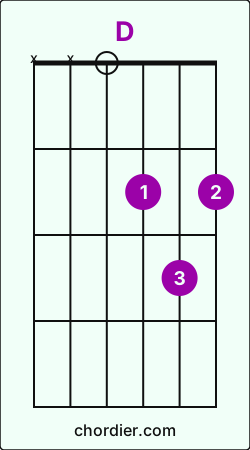 Guitar D chord diagram
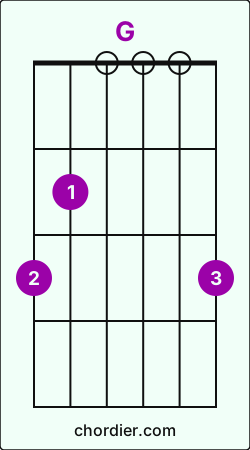 Guitar G chord diagram
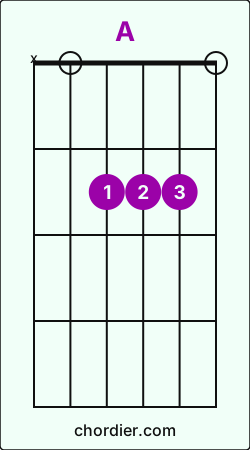 Guitar A chord diagram
[Opening]
Don’t go [D]looking through that old camphor [G]box , Woman
You [D]know those old things only make you [G]cry
When you [D]dream upon that little bunny [G]rug
[D]Makes you think that life has passed you [G]by
[verse 2]
There are [D]days when you wish the world would [G]stop, Woman
But [D]then you know some wounds would never [G]heal
When I [D]browse the early pages of the [G]children
It’s [G]then I know exactly how you [D]feel
[chorus]
Hey its [G]July and the winter sun is [D]shining
and the [G]Cootamundra wattle is my [D]friend
For [G]all at once my childhood never [D]left me,
cause [A]wattle blossoms bring it back a[D]gain
[verse 3]
It’s[D]Sunday and you should stop the[G]worry, Woman
[D]Come out here and sit down in the[G]sun
[D]Can’t you hear the magpies in the [G]distance?
[D]Don’t you feel the new day has [G]begun?
[verse 4]
[D]Can’t you hear the bees making [G]honey, Woman?
In the [D]spotted gums where the bell birds [G]ring
You might [D]grow old and bitter ‘cause you [G]missed it
You [G]know some people never hear such [D]things
[chorus]
Hey its [G]July and the winter sun is [D]shining
and the [G]Cootamundra wattle is my [D]friend
For [G]all at once my childhood never [D]left me,
cause [A]wattle blossoms bring it back a[D]gain
[interlude]
[D] [G] [D] [G]
[verse 5]
Don’t [D]buy the daily papers any[G]more, Woman
Read [D]all about what’s going on in [G]hell
[D]They don’t care to tell the world of [G]kindness
[D]Good news never made a paper [G]sell
[Closing]
There’s [D]all the colours of the rainbow in the [G]garden, Woman
And [D]symphonies of music in the [G]sky
[D]Heaven’s all around us if you’re looking [G]
But [G]how can you see it if you [D]cry?
[chorus]
Hey its [G]July and the winter sun is [D]shining
and the [G]Cootamundra wattle is my [D]friend
For [G]all at once my childhood never [D]left me,
cause [A]wattle blossoms bring it back a[D]gain
How to play Cootamundra Wattle on Guitar (Step-by-step)
John Williamson - Cootamundra Wattle on guitar requires 3 chords and 2 core chord transitions. You can find the full step-by-step guide below. Before you start, tune your instrument. The song uses the ↓-↓↑-↑↓↑ pattern; practice it muted first, or simplify to downstrokes while you learn the changes.
Cootamundra Wattle uses these transitions most often: D → G (32), G → D (32), and A → D (3). These transitions may feel a little challenging at first, but with steady practice you can play this song quickly.When you are ready, begin with D - G chord transition.
1. D → G chord transition
To move from D to G;
- Lift your index finger from G string fret 2 and place it on A string fret 2.
- Slide your middle finger from E string fret 2 to E string fret 3.
- Lift your ring finger from B string fret 3 and place it on E string fret 3.
2. D → A chord transition
To move from D to A;
- Lift your index finger from G string fret 2 and place it on D string fret 2.
- Slide your middle finger from E string fret 2 to G string fret 2.
- Slide your ring finger on B string from fret 3 to fret 2.
Cootamundra Wattle chord transition analysis
A short, data-driven summary of the chord flow in Cootamundra Wattle.
- Cootamundra Wattle includes 70 chord transitions, 2 of them unique.
- These transitions represent 0.02% of all chord transitions in Chordier.
- Cootamundra Wattle contains 2 of the top 10 transitions across Chordier.
- These transition patterns show how Cootamundra Wattle connects to the rest of Chordier. Mastering them helps you move to similar songs faster.After D, the most likely next chords across Chordier are G (29%), A (17%), and Em (17%).
- D → G: 29%
- D → A: 17%
After G, the most likely next chords across Chordier are C (25%), D (24%), and Am (13%).- G → D: 24%