
Dodie Clark - Dear Happy Chords
Before you play, tune your guitar and use the tools below to set up your view and flow.
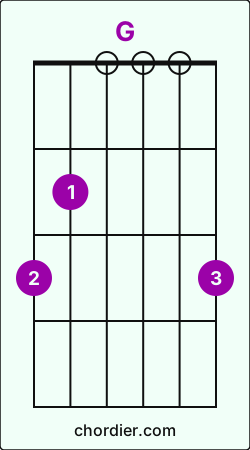 Guitar G chord diagram
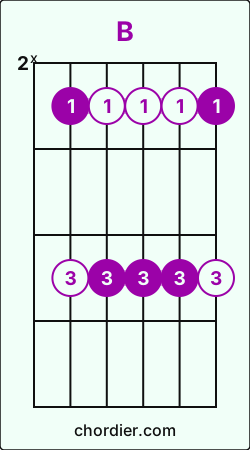 Guitar B chord diagram
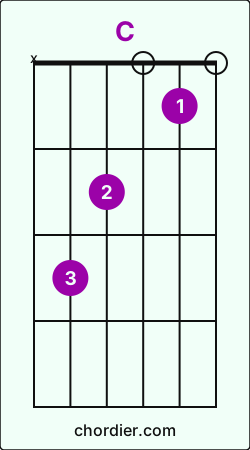 Guitar C chord diagram
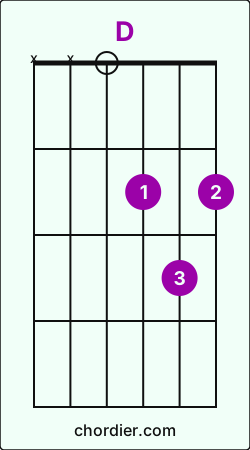 Guitar D chord diagram
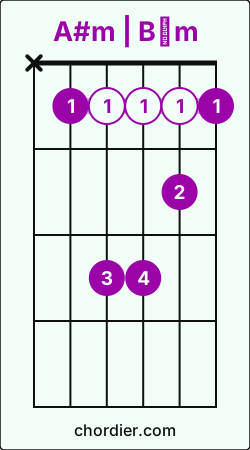 Guitar A#m | B♭m chord diagram
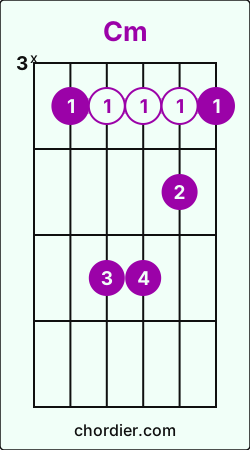 Guitar Cm chord diagram
[Opening]
[G]I missed you dearly, [B]thought I was nearly.
[C]There forever, at [D]last together.
[G]Is our time fleeting, [B]is even meeting?
A [C]healthy idea, or am I [D]getting too near?
[chorus]
[G]Don’t try to [B]fight it,
I’m [C]here for to[A#m]night.
And I’ll be [G]waiting for you,
Un[A#m]til we me[D]et aga[G]in.
[verse 2]
[G]I know it’s scary, [B]but don’t be wary.
If we [C]don’t have that long, let’s not [D]waste it feeling wrong.
[G]This isn’t the end, I’m your [B]lifelong friend.
Sure [C]it’s been a while, but I’ll be [D]here when you smile.
[chorus]
[G]So don’t try to [B]fight it,
I’m [C]here for to[A#m]night.
And I’ll be [G]waiting for you,
Un[A#m]til we me[D]et aga[G]in, ohh.
[verse 3]
[C]Mmm [Cm]mmm [G]mmm
[C]Mmm [Cm]mmm [D]mmm
[Closing]
[G]Would you mind staying, [B]It’s getting late.
But I will [C]visit you soon, so just [D]try to get through.
[chorus]
[G]And don’t try to [B]fight it,
I’m [C]here for to[A#m]night.
And I’ll be [G]waiting for you,
Un[A#m]til we me[D]et aga[G]in.
How to play Dear Happy on Guitar (Step-by-step)
Dodie Clark - Dear Happy on guitar requires 6 chords and 11 core chord transitions. You can find the full step-by-step guide below. Before you start, tune your instrument. The song uses the ↓-↓↑-↑↓↑ pattern; practice it muted first, or simplify to downstrokes while you learn the changes.
Dear Happy uses these transitions most often: D → G (9), B → C (8), and G → B (8). These transitions may feel a little challenging at first, but with steady practice you can play this song quickly.When you are ready, begin with G - B chord transition.
1. G → B chord transition
To move from G to B;
- Lift your index finger from A string fret 2 and place it on E string fret 2.
- Slide your middle finger from E string fret 3 to D string fret 4.
- Lift your ring finger from E string fret 3 and place it on G string fret 4.
- Place pinky on B string fret 4.
2. B → C chord transition
To move from B to C;
- While playing B, lift your pinky from B string fret 4.
- Lift your index finger from E string fret 2 and place it on B string fret 1.
- Slide your middle finger on D string from fret 4 to fret 2.
- Lift your ring finger from G string fret 4 and place it on A string fret 3.
3. C → D chord transition
To move from C to D;
- Lift your index finger from B string fret 1 and place it on G string fret 2.
- Slide your middle finger from D string fret 2 to E string fret 2.
- Lift your ring finger from A string fret 3 and place it on B string fret 3.
4. D → G chord transition
To move from D to G;
- Lift your index finger from G string fret 2 and place it on A string fret 2.
- Slide your middle finger from E string fret 2 to E string fret 3.
- Lift your ring finger from B string fret 3 and place it on E string fret 3.
5. C → A#m chord transition
To move from C to A#m;
- Lift your index finger from B string fret 1 and place it on A string fret 1.
- Slide your middle finger from D string fret 2 to B string fret 2.
- Lift your ring finger from A string fret 3 and place it on D string fret 3.
- Place pinky on G string fret 3.
6. A#m → G chord transition
To move from A#m to G;
- While playing A#m, lift your pinky from G string fret 3.
- Slide your index finger on A string from fret 1 to fret 2.
- Slide your middle finger from B string fret 2 to E string fret 3.
- Lift your ring finger from D string fret 3 and place it on E string fret 3.
7. A#m → D chord transition
To move from A#m to D;
- While playing A#m, lift your pinky from G string fret 3.
- Lift your index finger from A string fret 1 and place it on G string fret 2.
- Slide your middle finger from B string fret 2 to E string fret 2.
- Lift your ring finger from D string fret 3 and place it on B string fret 3.
8. G → C chord transition
To move from G to C;
- Lift your index finger from A string fret 2 and place it on B string fret 1.
- Slide your middle finger from E string fret 3 to D string fret 2.
- Lift your ring finger from E string fret 3 and place it on A string fret 3.
9. C → Cm chord transition
To move from C to Cm;
- Keep index finger on B string fret 1.
- Slide your middle finger on D string from fret 2 to fret 1.
- Keep ring finger on A string fret 3.
- Place pinky on E string fret 3.
10. Cm → G chord transition
To move from Cm to G;
- While playing Cm, lift your pinky from E string fret 3.
- Lift your index finger from B string fret 1 and place it on A string fret 2.
- Slide your middle finger from D string fret 1 to E string fret 3.
- Lift your ring finger from A string fret 3 and place it on E string fret 3.
11. Cm → D chord transition
To move from Cm to D;
- While playing Cm, lift your pinky from E string fret 3.
- Lift your index finger from B string fret 1 and place it on G string fret 2.
- Slide your middle finger from D string fret 1 to E string fret 2.
- Lift your ring finger from A string fret 3 and place it on B string fret 3.
Dear Happy chord transition analysis
A short, data-driven summary of the chord flow in Dear Happy.
- Dear Happy includes 48 chord transitions, 11 of them unique.
- These transitions represent 0.01% of all chord transitions in Chordier.
- Dear Happy contains 3 of the top 10 transitions across Chordier.
- These transition patterns show how Dear Happy connects to the rest of Chordier. Mastering them helps you move to similar songs faster.After G, the most likely next chords across Chordier are C (25%), D (24%), and Am (13%).
- G → C: 25%
- G → B: 1%
After C, the most likely next chords across Chordier are G (35%), F (16%), and D (11%).- C → D: 11%
- C → Cm: 1%