
George Formby - Frigid Air Fanny Chords
Before you play, tune your guitar and use the tools below to set up your view and flow.
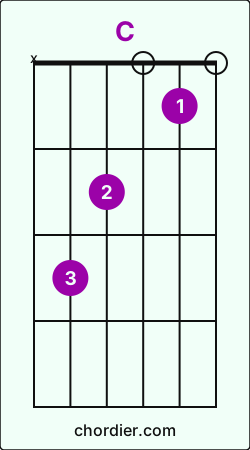 Guitar C chord diagram
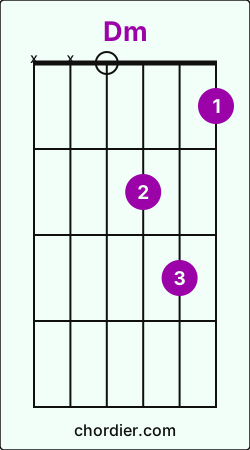 Guitar Dm chord diagram
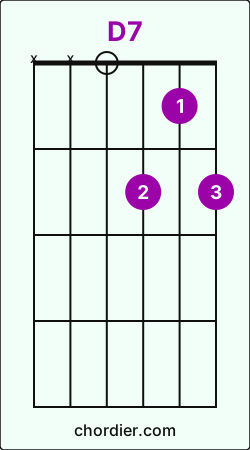 Guitar D7 chord diagram
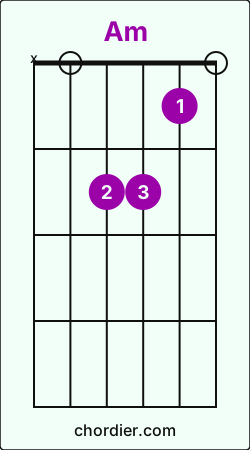 Guitar Am chord diagram
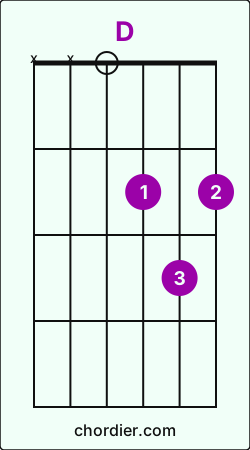 Guitar D chord diagram
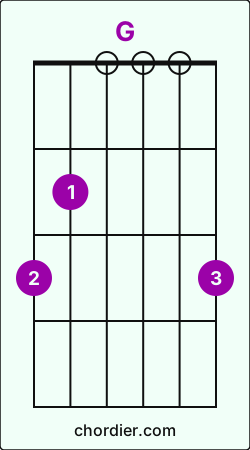 Guitar G chord diagram
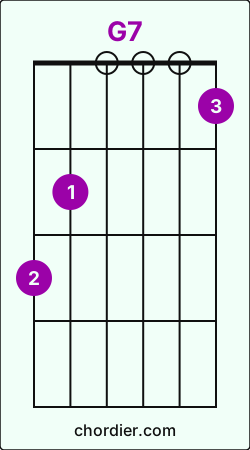 Guitar G7 chord diagram
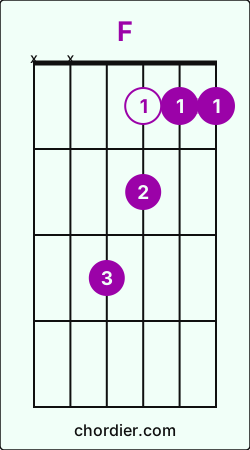 Guitar F chord diagram
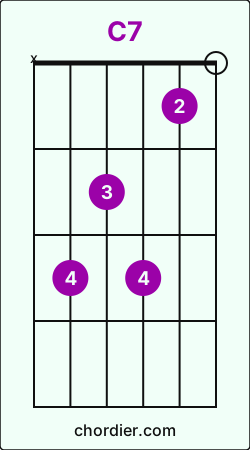 Guitar C7 chord diagram
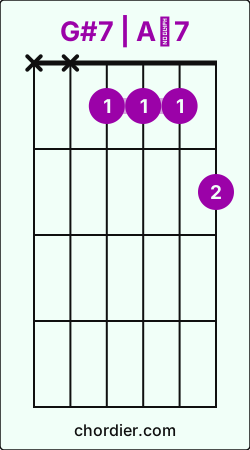 Guitar G#7 | A♭7 chord diagram
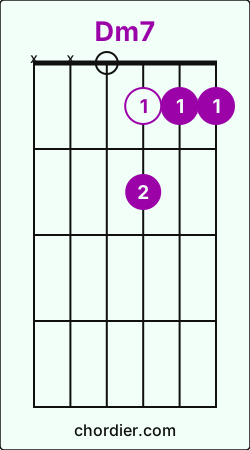 Guitar Dm7 chord diagram
[Opening]
[C]A foreign dame to England came, for [Dm]months she’d been afloat
[D7]Trave[Am]lling [D]first [C]class, [D7]that’s the worst class,
[G]on a [D7]cattle [G7]boat [Dm] [F]
[C]See her with a [F]gay rag [C]wrapped around her [F]hay bag,
[C]waggling her [C7]tambou[F]rine
[G7]That’s [C]Frigid Air [D7]Fanny
from the [G#7]Ar[G7]gen[C]tine [Am] [Dm7]
[verse 2]
[C]At the caba[F]ret show, rot[C]ten apples [F]they throw,
[C]shouting “Keep the [C7]party [F]clean”
[G7]That’s [C]Frigid Air [D7]Fanny
from the [G#7]Ar[G7]gen[C]tine [Am] [Dm7]
[verse 3]
Now [C7]don’t tell her she’s frozen mutton,
[F]for [C7]if [F]you [F]do
[D7]Soon you’ll get the frozen mitt
and the cold shoulder [G7]too [Dm] [F]
[C]You can recog[F]nise her, there’s [C]nothing to dis[F]guise her,
Ex[C]cpt a bit of [C7]crepe de [F]chine
[G7]That’s [C]Frigid Air [D7]Fanny
from the [G#7]Ar[G7]gen[C]tine [Am] [Dm7]
[verse 4]
Now [C]since a child, out in the wild,
that’s [Dm]where she used to dwell,
[D7]In [Am]the [D7]land [C]where [D7]beef gets canned there,
[G]she gets [D7]canned as [G7]well [Dm] [F]
[C]Sitting on an [F]ice box, [C]melting all the [F]ice blocks,
[C]She’s the hottest [C7]thing you’ve [F]seen
[G7]That’s [C]Frigid Air [D7]Fanny
from the [G#7]Ar[G7]gen[C]tine [Am] [Dm7]
[verse 5]
[C]When she does the [F]Rumba, [C]Policemen take her [F]number
And [C]firemen dash [C7]on the [F]scene
[G7]To [C]Frigid Air [D7]Fanny from the [G#7]Ar[G7]gen[C]tine [Am] [Dm7]
[verse 6]
Now [C7]don’t tell her she’s frozen mutton, [F]for [C7]if [F]you [F]do
[D7]Soon you’ll get the frozen mitt and the cold shoulder [G7]too [Dm] [F]
Her [C]teeth are not a [F]grand set, she [C]bought a second [F]hand set,
[C]And stuck’ Em [C7]in with seco[F]tine
[G7]That’s [C]Frigid Air [D7]Fanny from the [G#7]Ar[G7]gen[C]tine [Am] [Dm7]
[Closing]
Now [C7]don’t tell her she’s frozen mutton, [F]for [C7]if [F]you [F]do
[D7]Soon you’ll get the frozen mitt and the cold shoulder [G7]too [Dm] [F]
[C]People call her [F]two-faced, [C]tying up her [F]shoelace[C]
You can see the [C7]face they [F]mean
[G7]On [C]Frigid Air [D7]Fanny from the [G#7]Ar[G7]gen[C]tine [Am] [Dm7]
How to play Frigid Air Fanny on Guitar (Step-by-step)
George Formby - Frigid Air Fanny on guitar requires 11 chords and 22 core chord transitions. You can find the full step-by-step guide below. Before you start, tune your instrument. The song uses the ↓-↓↑-↓↑-↓↑ pattern; practice it muted first, or simplify to downstrokes while you learn the changes.
Frigid Air Fanny uses these transitions most often: F → C (19), C → F (14), and G7 → C (14). These transitions may feel a little challenging at first, but with steady practice you can play this song quickly.When you are ready, begin with C - Dm chord transition.
1. C → Dm chord transition
To move from C to Dm;
- Lift your index finger from B string fret 1 and place it on E string fret 1.
- Slide your middle finger from D string fret 2 to G string fret 2.
- Lift your ring finger from A string fret 3 and place it on B string fret 3.
2. Dm → D7 chord transition
To move from Dm to D7;
- Lift your index finger from E string fret 1 and place it on B string fret 1.
- Keep middle finger on G string fret 2.
- Slide your ring finger from B string fret 3 to E string fret 2.
3. D7 → Am chord transition
To move from D7 to Am;
- Keep index finger on B string fret 1.
- Lift your middle finger from G string fret 2 and place it on D string fret 2.
- Slide your ring finger from E string fret 2 to G string fret 2.
4. Am → D chord transition
To move from Am to D;
- Lift your index finger from B string fret 1 and place it on G string fret 2.
- Slide your middle finger from D string fret 2 to E string fret 2.
- Lift your ring finger from G string fret 2 and place it on B string fret 3.
5. D → C chord transition
To move from D to C;
- Lift your index finger from G string fret 2 and place it on B string fret 1.
- Slide your middle finger from E string fret 2 to D string fret 2.
- Lift your ring finger from B string fret 3 and place it on A string fret 3.
6. C → D7 chord transition
To move from C to D7;
- Keep index finger on B string fret 1.
- Lift your middle finger from D string fret 2 and place it on G string fret 2.
- Slide your ring finger from A string fret 3 to E string fret 2.
7. D7 → G chord transition
To move from D7 to G;
- Lift your index finger from B string fret 1 and place it on A string fret 2.
- Slide your middle finger from G string fret 2 to E string fret 3.
- Slide your ring finger on E string from fret 2 to fret 3.
8. D7 → G7 chord transition
To move from D7 to G7;
- Lift your index finger from B string fret 1 and place it on A string fret 2.
- Slide your middle finger from G string fret 2 to E string fret 3.
- Slide your ring finger on E string from fret 2 to fret 1.
9. G7 → Dm chord transition
To move from G7 to Dm;
- Lift your index finger from A string fret 2 and place it on E string fret 1.
- Slide your middle finger from E string fret 3 to G string fret 2.
- Lift your ring finger from E string fret 1 and place it on B string fret 3.
10. Dm → F chord transition
To move from Dm to F;
- Lift your index finger from E string fret 1 and place it on E string fret 1.
- Keep middle finger on G string fret 2.
- Slide your ring finger from B string fret 3 to A string fret 3.
- Place pinky on D string fret 3.
11. F → C chord transition
To move from F to C;
- While playing F, lift your pinky from D string fret 3.
- Lift your index finger from E string fret 1 and place it on B string fret 1.
- Slide your middle finger from G string fret 2 to D string fret 2.
- Keep ring finger on A string fret 3.
12. C → C7 chord transition
To move from C to C7;
- Keep index finger on B string fret 1.
- Keep middle finger on D string fret 2.
- Keep ring finger on A string fret 3.
- Place pinky on G string fret 3.
13. C7 → F chord transition
To move from C7 to F;
- Lift your index finger from B string fret 1 and place it on E string fret 1.
- Slide your middle finger from D string fret 2 to G string fret 2.
- Keep ring finger on A string fret 3.
- Lift your pinky from G string fret 3 and place it on D string fret 3.
14. F → G7 chord transition
To move from F to G7;
- While playing F, lift your pinky from D string fret 3.
- Lift your index finger from E string fret 1 and place it on A string fret 2.
- Slide your middle finger from G string fret 2 to E string fret 3.
- Lift your ring finger from A string fret 3 and place it on E string fret 1.
15. G7 → C chord transition
To move from G7 to C;
- Lift your index finger from A string fret 2 and place it on B string fret 1.
- Slide your middle finger from E string fret 3 to D string fret 2.
- Lift your ring finger from E string fret 1 and place it on A string fret 3.
16. D7 → G#7 chord transition
To move from D7 to G#7;
- While playing D7, lift your ring finger from E string fret 2.
- Lift your index finger from B string fret 1 and place it on D string fret 1.
- Slide your middle finger from G string fret 2 to E string fret 2.
17. G#7 → G7 chord transition
To move from G#7 to G7;
- Lift your index finger from D string fret 1 and place it on A string fret 2.
- Slide your middle finger from E string fret 2 to E string fret 3.
- Place ring finger on E string fret 1.
18. C → Am chord transition
To move from C to Am;
- Keep index finger on B string fret 1.
- Keep middle finger on D string fret 2.
- Lift your ring finger from A string fret 3 and place it on G string fret 2.
19. Am → Dm7 chord transition
To move from Am to Dm7;
- While playing Am, lift your ring finger from G string fret 2.
- Keep index finger on B string fret 1.
- Lift your middle finger from D string fret 2 and place it on G string fret 2.
20. Dm7 → C chord transition
To move from Dm7 to C;
- Keep index finger on B string fret 1.
- Lift your middle finger from G string fret 2 and place it on D string fret 2.
- Place ring finger on A string fret 3.
21. Dm7 → C7 chord transition
To move from Dm7 to C7;
- Keep index finger on B string fret 1.
- Lift your middle finger from G string fret 2 and place it on D string fret 2.
- Place ring finger on A string fret 3.
- Place pinky on G string fret 3.
22. F → D7 chord transition
To move from F to D7;
- While playing F, lift your pinky from D string fret 3.
- Lift your index finger from E string fret 1 and place it on B string fret 1.
- Keep middle finger on G string fret 2.
- Slide your ring finger from A string fret 3 to E string fret 2.
Frigid Air Fanny chord transition analysis
A short, data-driven summary of the chord flow in Frigid Air Fanny.
- Frigid Air Fanny includes 152 chord transitions, 22 of them unique.
- These transitions represent 0.04% of all chord transitions in Chordier.
- Frigid Air Fanny contains 2 of the top 10 transitions across Chordier.
- These transition patterns show how Frigid Air Fanny connects to the rest of Chordier. Mastering them helps you move to similar songs faster.After C, the most likely next chords across Chordier are G (35%), F (16%), and D (11%).
- C → F: 16%
- C → Am: 10%
After F, the most likely next chords across Chordier are C (40%), G (21%), and Am (11%).- F → C: 40%
- F → G7: 3%