
Monty Python - The Galaxy Song Chords
Before you play, tune your guitar and use the tools below to set up your view and flow. Using the Transpose tool, switch to A,E keys to play this song with easier chords.
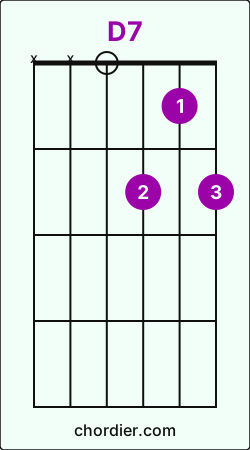 Guitar D7 chord diagram
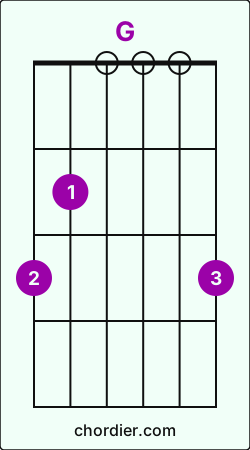 Guitar G chord diagram
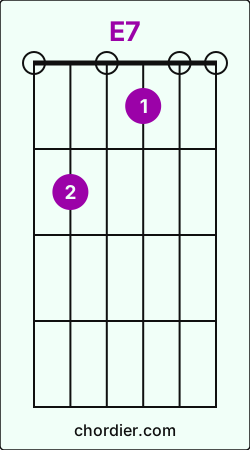 Guitar E7 chord diagram
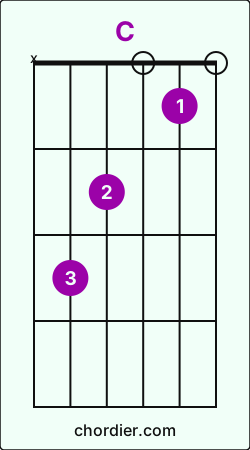 Guitar C chord diagram
[Opening]
[D7]Just re[G]member that you’re standing on a planet that’s evolving
revolving at nine hundred miles an [D7]hour
[D7]And orbiting at nineteen miles a second, so it’s reckoned
A sun that is the source of all our [G]power
[verse 2]
[G]The sun and you and me, and all the stars that we can see
Are [E7]moving at a million miles a [C]day
In an [G]outer spiral arm, at forty [G]thousand miles an hour
Of the [D7]galaxy we call the Milky [G]Way [D7] [G]
[verse 3]
[G]Our galaxy itself contains a hundred billion stars
It’s a hundred thousand light years side to [D7] side
[D7]It bulges in the middle, sixteen thousand light years thick
But out by us it’s just three thousand light years [G]wide
[verse 4]
[G]We’re thirty thousand light years from galactic central point
We go [E7]round every two hundred million [C]years
And our [G]galaxy itself is one of [G]millions of billions
In this [D7]amazing and expanding uni[G]verse [D7] [G]
[verse 5]
[G]The universe itself keeps on expanding and expanding
In all of the directions it can [D7]whiz
[D7]As fast as it can go, at the speed of light you know
Twelve million miles a minute and that’s the [G]fastest speed there is
[Closing]
[G]So remember, when you’re feeling very small and insecure
How [E7]amazingly unlikely is your [C]birth
And [G]pray that there’s intelligent life [G]somewhere up in space
Because there’s [D7]bugger all down here on [G]Earth [D7] [G]
How to play The Galaxy Song on Guitar (Step-by-step)
Monty Python - The Galaxy Song on guitar requires 4 chords and 4 core chord transitions. You can find the full step-by-step guide below. Before you start, tune your instrument. The song uses the ↓-↓↑-↓↑-↓↑ pattern; practice it muted first, or simplify to downstrokes while you learn the changes.
The Galaxy Song uses these transitions most often: D7 → G (10), G → D7 (9), and C → G (3). These transitions may feel a little challenging at first, but with steady practice you can play this song quickly.When you are ready, begin with D7 - G chord transition.
1. D7 → G chord transition
To move from D7 to G;
- Lift your index finger from B string fret 1 and place it on A string fret 2.
- Slide your middle finger from G string fret 2 to E string fret 3.
- Slide your ring finger on E string from fret 2 to fret 3.
2. G → E7 chord transition
To move from G to E7;
- While playing G, lift your ring finger from E string fret 3.
- Lift your index finger from A string fret 2 and place it on G string fret 1.
- Slide your middle finger from E string fret 3 to A string fret 2.
3. E7 → C chord transition
To move from E7 to C;
- Lift your index finger from G string fret 1 and place it on B string fret 1.
- Slide your middle finger from A string fret 2 to D string fret 2.
- Place ring finger on A string fret 3.
4. C → G chord transition
To move from C to G;
- Lift your index finger from B string fret 1 and place it on A string fret 2.
- Slide your middle finger from D string fret 2 to E string fret 3.
- Lift your ring finger from A string fret 3 and place it on E string fret 3.
The Galaxy Song chord transition analysis
A short, data-driven summary of the chord flow in The Galaxy Song.
- The Galaxy Song includes 28 chord transitions, 4 of them unique.
- These transitions represent 0.01% of all chord transitions in Chordier.
- The Galaxy Song contains 1 of the top 10 transitions across Chordier.
- These transition patterns show how The Galaxy Song connects to the rest of Chordier. Mastering them helps you move to similar songs faster.After G, the most likely next chords across Chordier are C (25%), D (24%), and Am (13%).
- G → D7: 1%
- G → E7: 1%
After D7, the most likely next chords across Chordier are G (51%), G7 (18%), and C (6%).- D7 → G: 51%