
Nathan Sykes - Give It Up Chords
Before you play, tune your guitar and use the tools below to set up your view and flow.
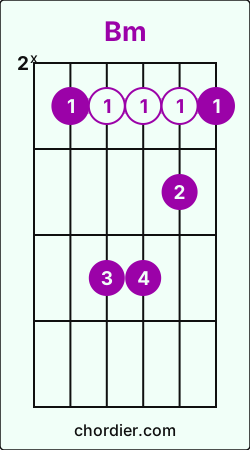 Guitar Bm chord diagram
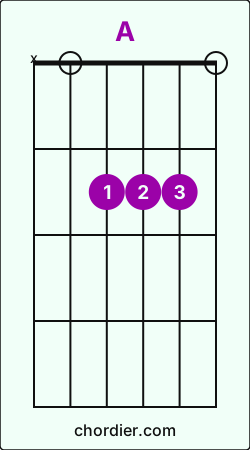 Guitar A chord diagram
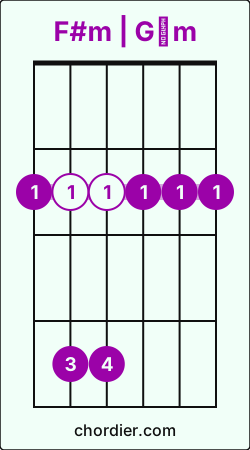 Guitar F#m | G♭m chord diagram
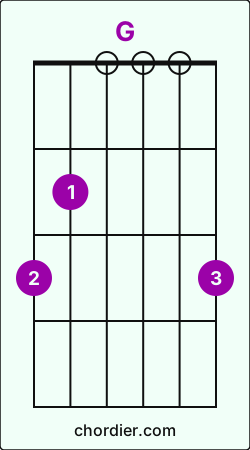 Guitar G chord diagram
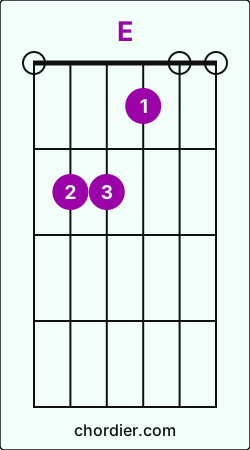 Guitar E chord diagram
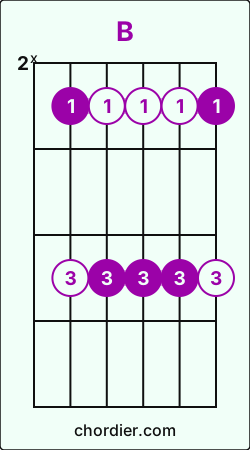 Guitar B chord diagram
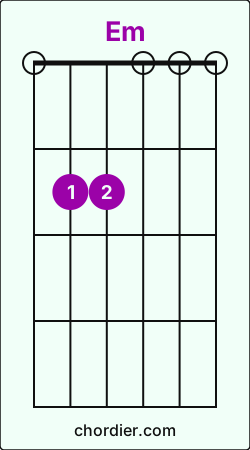 Guitar Em chord diagram
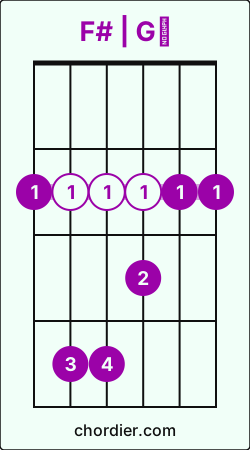 Guitar F# | G♭ chord diagram
[Opening]
[Bm]
Something happened [Bm]babe, [A]only [F#m]you can [G]make it right
[Bm]Clear my [A]heavy mind with your [F#m] [G]tricks, got that magic [Bm]baby [A]
‘Cause [F#m]everything I [G]fear, [Bm]slowly disappears [A]as [F#m]we kiss [G]
[chorus]
[E] [F#m]Baby I want [G]you close, I want [Bm]you close, give [A]me your love
[E] [F#m]Baby I want [G]some more, I want [Bm]some more, can’t [A]get enough
[E] [F#m]Baby wanna feel [G]your touch, [Bm]wanna feel your [A]touch, just give it up
And go [B]on [G]and on, [Em] [F#m]on and on
[chorus]
[B](Woo-[G]oh-oh[Em]-oh[F#m]-oh-oh-oh) Don’t leave me girl
[B](Woo-[G]oh-oh[Em]-oh[F#m]-oh-oh-oh) Please stay with me tonight
[B](Woo-[G]oh-oh[Em]-oh[F#m]-oh-oh-oh) Don’t leave me girl
[B](Woo-[G]oh-oh[Em]-oh[F#m]-oh-oh-oh) I know you’re down to give it up
[verse 2]
Are you happy [Bm]babe? [A]I [F#m]can make it [G]Valentine’s
[Bm]Every [A]single night, dim the [F#m]lights, [G]I’m ecstatic babe [Bm] [A]
You [F#m]got me on a [G]high, [Bm]join me in the [A]sky, [F#m] [G]paradise
[chorus]
[E] [F#m]Baby I want [G]you close, I want [Bm]you close, give [A]me your love
[E] [F#m]Baby I want [G]some more, I want [Bm]some more, can’t [A]get enough
[E] [F#m]Baby wanna feel [G]your touch, [Bm]wanna feel your [A]touch, just give it up
And go [B]on [G]and on, [Em] [F#m]on and on
[chorus]
[B](Woo-[G]oh-oh[Em]-oh[F#m]-oh-oh-oh) Don’t leave me girl
[B](Woo-[G]oh-oh[Em]-oh[F#m]-oh-oh-oh) Please stay with me tonight
[B](Woo-[G]oh-oh[Em]-oh[F#m]-oh-oh-oh) Don’t leave me girl
[B](Woo-[G]oh-oh[Em]-oh[F#m]-oh-oh-oh) I know you’re down to give it up
[verse 3]
Had a show in [A] [B]Sydney in [A] [B]front [B]of Aussies right?
And a show in [A] [B]London on [A]the [B]longest flight
Well it’s [E]been [F#]too [A] [B]long [A]and [B]you’re always right
Just tryna see you [G]after a hard days night
Listen, it’s between [A]us, [B] [B]our [A] [B]secret, don’t tell
It’s Beatles [A]Mania [B]when [A]I [B]leave the hotel
We don’t want [E]tabloids, [F#] [A] [B]cat [A]have [B]no chill
Tryna be with you [G]alone and [A]we can go ’til
[verse 4]
[Bm]The clock [A]hits morning, it’s a sure thing
[F#m]We snuck out [G]without paparazzi swarming
[Bm]I’m tryna [A]show you you’re the most important
[F#m]In town one [G]night, ain’t tryna be too forward
[Bm]But we got [A]one chance and I can’t wait ’til
[F#m]The next [G]time I see you, so you should stay ’til
[Bm]I leave to [A]the next city, disappear, so don’t leave, I need you here
I’m saying…
[chorus]
[B](Woo-[G]oh-oh[Em]-oh[F#m]-oh-oh-oh) Don’t leave me girl
[B](Woo-[G]oh-oh[Em]-oh[F#m]-oh-oh-oh) Please stay with me tonight
[B](Woo-[G]oh-oh[Em]-oh[F#m]-oh-oh-oh) Don’t leave me girl
[B](Woo-[G]oh-oh[Em]-oh[F#m]-oh-oh-oh) I know you’re down to give it up
[Closing]
[B] [G]Don’t [Em]leave, [F#m]hey, [B]please, [G] [Em]stay [F#m]with me tonight
[B]Don’t [G]leave [Em] [F#m]me baby, [B]oh, [G]you [Em]know [F#m]you got to give it up
Haha
How to play Give It Up on Guitar (Step-by-step)
Nathan Sykes - Give It Up on guitar requires 8 chords and 17 core chord transitions. You can find the full step-by-step guide below. Before you start, tune your instrument. The song uses the ↓-↓↑-↓↑-↓↑ pattern; practice it muted first, or simplify to downstrokes while you learn the changes.
Give It Up uses these transitions most often: B → G (20), Bm → A (18), and Em → F#m (18). These transitions may feel a little challenging at first, but with steady practice you can play this song quickly.When you are ready, begin with Bm - A chord transition.
1. Bm → A chord transition
To move from Bm to A;
- While playing Bm, lift your pinky from G string fret 4.
- Lift your index finger from E string fret 2 and place it on D string fret 2.
- Slide your middle finger from B string fret 3 to G string fret 2.
- Lift your ring finger from D string fret 4 and place it on B string fret 2.
2. A → F#m chord transition
To move from A to F#m;
- While playing A, lift your middle finger from G string fret 2.
- Lift your index finger from D string fret 2 and place it on E string fret 2.
- Slide your ring finger from B string fret 2 to A string fret 4.
- Place pinky on D string fret 4.
3. F#m → G chord transition
To move from F#m to G;
- While playing F#m, lift your pinky from D string fret 4.
- Lift your index finger from E string fret 2 and place it on A string fret 2.
- Slide your ring finger from A string fret 4 to E string fret 3.
- Place middle finger on E string fret 3.
4. G → Bm chord transition
To move from G to Bm;
- Lift your index finger from A string fret 2 and place it on E string fret 2.
- Slide your middle finger from E string fret 3 to B string fret 3.
- Lift your ring finger from E string fret 3 and place it on D string fret 4.
- Place pinky on G string fret 4.
5. G → E chord transition
To move from G to E;
- Lift your index finger from A string fret 2 and place it on G string fret 1.
- Slide your middle finger from E string fret 3 to A string fret 2.
- Lift your ring finger from E string fret 3 and place it on D string fret 2.
6. E → F#m chord transition
To move from E to F#m;
- While playing E, lift your middle finger from A string fret 2.
- Lift your index finger from G string fret 1 and place it on E string fret 2.
- Slide your ring finger from D string fret 2 to A string fret 4.
- Place pinky on D string fret 4.
7. A → E chord transition
To move from A to E;
- Lift your index finger from D string fret 2 and place it on G string fret 1.
- Slide your middle finger from G string fret 2 to A string fret 2.
- Lift your ring finger from B string fret 2 and place it on D string fret 2.
8. A → B chord transition
To move from A to B;
- Lift your index finger from D string fret 2 and place it on E string fret 2.
- Slide your middle finger from G string fret 2 to D string fret 4.
- Lift your ring finger from B string fret 2 and place it on G string fret 4.
- Place pinky on B string fret 4.
9. B → G chord transition
To move from B to G;
- While playing B, lift your pinky from B string fret 4.
- Lift your index finger from E string fret 2 and place it on A string fret 2.
- Slide your middle finger from D string fret 4 to E string fret 3.
- Lift your ring finger from G string fret 4 and place it on E string fret 3.
10. G → Em chord transition
To move from G to Em;
- While playing G, lift your index finger from A string fret 2.
- Lift your middle finger from E string fret 3 and place it on A string fret 2.
- Slide your ring finger from E string fret 3 to D string fret 2.
11. Em → F#m chord transition
To move from Em to F#m;
- While playing Em, lift your middle finger from A string fret 2.
- Lift your ring finger from D string fret 2 and place it on A string fret 4.
- Place index finger on E string fret 2.
- Place pinky on D string fret 4.
12. F#m → B chord transition
To move from F#m to B;
- Keep index finger on E string fret 2.
- Lift your ring finger from A string fret 4 and place it on G string fret 4.
- Slide your pinky from D string fret 4 to B string fret 4.
- Place middle finger on D string fret 4.
13. F#m → Bm chord transition
To move from F#m to Bm;
- Keep index finger on E string fret 2.
- Lift your ring finger from A string fret 4 and place it on D string fret 4.
- Slide your pinky from D string fret 4 to G string fret 4.
- Place middle finger on B string fret 3.
14. B → E chord transition
To move from B to E;
- While playing B, lift your pinky from B string fret 4.
- Lift your index finger from E string fret 2 and place it on G string fret 1.
- Slide your middle finger from D string fret 4 to A string fret 2.
- Lift your ring finger from G string fret 4 and place it on D string fret 2.
15. E → F# chord transition
To move from E to F#;
- Lift your index finger from G string fret 1 and place it on E string fret 2.
- Slide your middle finger from A string fret 2 to G string fret 3.
- Lift your ring finger from D string fret 2 and place it on A string fret 4.
- Place pinky on D string fret 4.
16. F# → A chord transition
To move from F# to A;
- While playing F#, lift your pinky from D string fret 4.
- Lift your index finger from E string fret 2 and place it on D string fret 2.
- Slide your middle finger on G string from fret 3 to fret 2.
- Lift your ring finger from A string fret 4 and place it on B string fret 2.
17. G → A chord transition
To move from G to A;
- Lift your index finger from A string fret 2 and place it on D string fret 2.
- Slide your middle finger from E string fret 3 to G string fret 2.
- Lift your ring finger from E string fret 3 and place it on B string fret 2.
Give It Up chord transition analysis
A short, data-driven summary of the chord flow in Give It Up.
- Give It Up includes 178 chord transitions, 17 of them unique.
- These transitions represent 0.05% of all chord transitions in Chordier.
- Give It Up contains 5 of the top 25 transitions across Chordier.
- These transition patterns show how Give It Up connects to the rest of Chordier. Mastering them helps you move to similar songs faster.After G, the most likely next chords across Chordier are C (25%), D (24%), and Am (13%).
- G → Em: 9%
- G → A: 6%
After F#m, the most likely next chords across Chordier are D (22%), A (19%), and E (14%).- F#m → A: 19%
- F#m → Bm: 10%