
Florida Georgia Line - Grow Old Chords
Before you play, tune your guitar and use the tools below to set up your view and flow. Using the Transpose tool, switch to D key to play this song with easier chords.
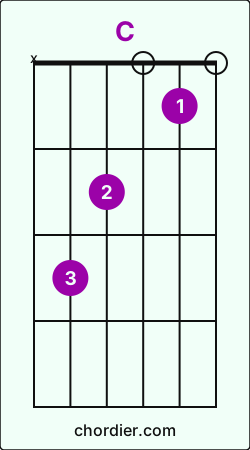 Guitar C chord diagram
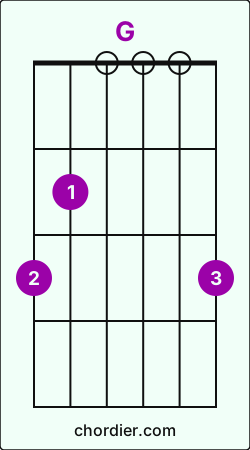 Guitar G chord diagram
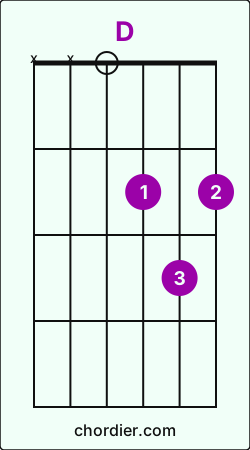 Guitar D chord diagram
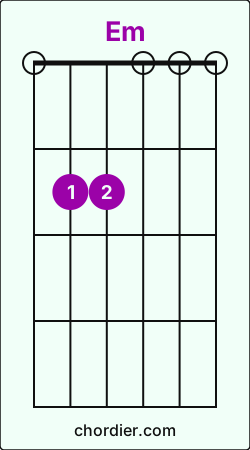 Guitar Em chord diagram
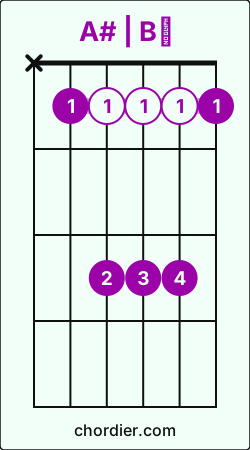 Guitar A# | B♭ chord diagram
[Opening]
[C] [G] [D]
[C]Tell me you that you love me, [G]say we’ll always work [D]it out
[C]I know it’s kinda scary, but [G]it’s only [D]temporary doubt
I’ve done a [C]lot of stupid [G]things
But [D]promise that you’re [Em]gonna stay long [C]enough, [D]to grow old [G]with me
[verse 2]
We’re [C]gonna see the good times, [G]love each other through the [D]bad
It’s [C]gonna hurt like hell, when [G]we lose our mom’s and [D]dad’s
So let my [C]shoulder hold [G]your tears, walk [D]beside me through the [Em]years
[C]Baby let’s see [D]where this [G]love can lead
[verse 3]
[C]Let’s hold hands [G]on your favorite beach
[D]Fix up a house that we [Em]found in the city limits, [C]tangled up in [G]a satin sheet
And [D]get a little loud when [Em]we’ve had too much to drink, [C]and learn to love from a [G]church pew
[D]Laugh about all the [Em]times we counted pennies, [C]buy some land with a [G]good view
To start a [Em] [D] [C]family, [D]baby grow old with me [C] [G] [D]
[verse 4]
It’s gonna [C]take a little time, we’ll have [G]to work at it [D]everyday
We’re [C]gonna lose a lot of sleep, and learn [G]to eat out of a [D]microwave
Know we’ll [C]probably never have it [G]all
But that’s part of [D]building up [Em]the walls, strong [C]enough [D]to stand up through the [G]rain
[verse 5]
[C]We’ll make some love [G]on your favorite beach, [D]add to the house that we [Em]found in the city limits
[C]Talk our babies [G]through the bad dreams, when they [D]get a little older we’ll [Em]tell them not to drink
[C]Book a church when [G]she finds a groom, [D]laugh about all the [Em]times they’ll count the pennies
[C]Give ’em land with a [G]good view, to start a [Em] [D] [C]family, [D]baby you know we might
[verse 6]
[C]Take a turn down a bad road, [G]maybe go where the wind blows baby
But [Bb]end up right where we were meant [D]to be, yeah
[Closing]
[C]Back and forth on [G]a porch swing, [D]hard not to smile thinking [Em]
How it don’t get much better, [C]our baby’s babies [G]turning 18
What a [Em] [D] [C]family, [D]baby grow old with me [C] [G]
[D]Baby grow old with me [C] [G] [D]baby grow old with [C]me, [G]yeah
[C]Tell me you that you love me, [G]say we’ll always work it [D]out
How to play Grow Old on Guitar (Step-by-step)
Florida Georgia Line - Grow Old on guitar requires 5 chords and 8 core chord transitions. You can find the full step-by-step guide below. Before you start, tune your instrument. The song uses the ↓-↓↑ pattern; practice it muted first, or simplify to downstrokes while you learn the changes.
Grow Old uses these transitions most often: C → G (26), G → D (21), and D → C (17). These transitions may feel a little challenging at first, but with steady practice you can play this song quickly.When you are ready, begin with C - G chord transition.
1. C → G chord transition
To move from C to G;
- Lift your index finger from B string fret 1 and place it on A string fret 2.
- Slide your middle finger from D string fret 2 to E string fret 3.
- Lift your ring finger from A string fret 3 and place it on E string fret 3.
2. G → D chord transition
To move from G to D;
- Lift your index finger from A string fret 2 and place it on G string fret 2.
- Slide your middle finger from E string fret 3 to E string fret 2.
- Lift your ring finger from E string fret 3 and place it on B string fret 3.
3. D → C chord transition
To move from D to C;
- Lift your index finger from G string fret 2 and place it on B string fret 1.
- Slide your middle finger from E string fret 2 to D string fret 2.
- Lift your ring finger from B string fret 3 and place it on A string fret 3.
4. D → Em chord transition
To move from D to Em;
- While playing D, lift your index finger from G string fret 2.
- Lift your middle finger from E string fret 2 and place it on A string fret 2.
- Slide your ring finger from B string fret 3 to D string fret 2.
5. Em → C chord transition
To move from Em to C;
- Lift your middle finger from A string fret 2 and place it on D string fret 2.
- Slide your ring finger from D string fret 2 to A string fret 3.
- Place index finger on B string fret 1.
6. G → Em chord transition
To move from G to Em;
- While playing G, lift your index finger from A string fret 2.
- Lift your middle finger from E string fret 3 and place it on A string fret 2.
- Slide your ring finger from E string fret 3 to D string fret 2.
7. G → Bb chord transition
To move from G to Bb;
- Slide your index finger on A string from fret 2 to fret 1.
- Slide your middle finger from E string fret 3 to D string fret 3.
- Lift your ring finger from E string fret 3 and place it on G string fret 3.
- Place pinky on B string fret 3.
8. Bb → D chord transition
To move from Bb to D;
- While playing Bb, lift your pinky from B string fret 3.
- Lift your index finger from A string fret 1 and place it on G string fret 2.
- Slide your middle finger from D string fret 3 to E string fret 2.
- Lift your ring finger from G string fret 3 and place it on B string fret 3.
Grow Old chord transition analysis
A short, data-driven summary of the chord flow in Grow Old.
- Grow Old includes 105 chord transitions, 8 of them unique.
- These transitions represent 0.03% of all chord transitions in Chordier.
- Grow Old contains 5 of the top 10 transitions across Chordier.
- These transition patterns show how Grow Old connects to the rest of Chordier. Mastering them helps you move to similar songs faster.After C, the most likely next chords across Chordier are G (35%), F (16%), and D (11%).
- C → G: 35%
- C → D: 11%
After D, the most likely next chords across Chordier are G (29%), A (17%), and Em (17%).- D → G: 29%
- D → Em: 17%