
Guitar F7 chord diagram
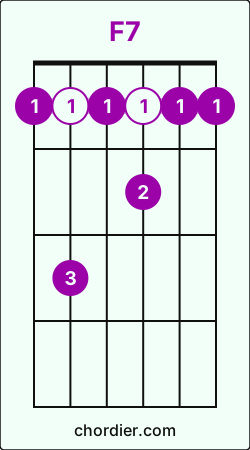
F7 is one of the essential Guitar chords. On Chordier, this chord appears in 59 different songs. On this page, you can find how to play F7, alternative positions, and core chord transitions.
To play F7, follow these steps: Place index finger on E string, D string, B string, and E string fret 1. Place middle finger on G string fret 2. Place ring finger on A string fret 3.
Tips
- Place E string with your index finger and D string with your index finger with a vertical finger angle so nearby strings ring clearly without buzz.
- On E string, press fret 1 with your index finger close to the fret wire (not on top) for a cleaner tone.
- Finger choices on F7 can be optimized for the next chord. For example, when moving from F7 to F, using on A string, use your pinky, on G string, use your ring finger, on E string, use your middle finger, on D string, use your middle finger, on B string, use your middle finger, and on E string, use your middle finger helps preserve hand position with minimal movement.
- Keep the barre firm so every string rings clearly.
Chord Theory
- Notes
- F - A - C - D#
- Intervals
- 1 - 3 - 5 - b7
- Chord Type
- Dominant 7 — blues and funk tone
- Difficulty
- Intermediate
- Barre chord
- Yes
- Voicings
- 7
Alternative Positions
Different ways to play F7 on the fretboard, from beginner-friendly to advanced voicings.
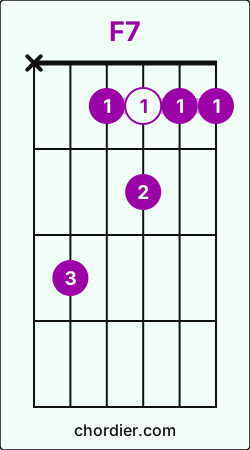 Guitar F7 chord diagramx-3-1-2-1-1
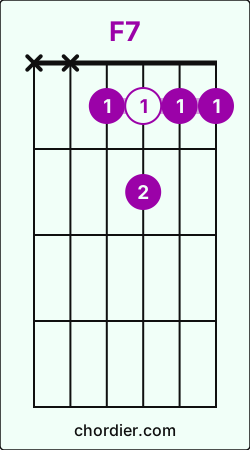 Guitar F7 chord diagramx-x-1-2-1-1
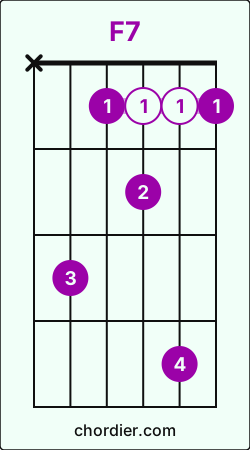 Guitar F7 chord diagramx-3-1-2-4-1
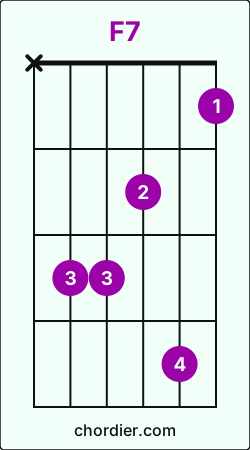 Guitar F7 chord diagramx-3-3-2-4-1
Easy Transition Chords
These chords have similar finger positions to F7, making them ideal for practice transitions.
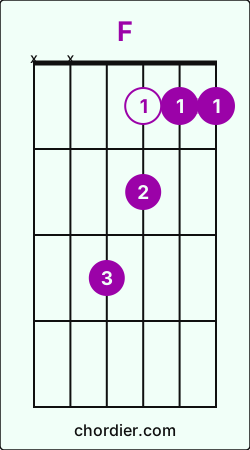
1. F7 → F chord transition
To move from F7 to F, follow these steps:
- Keep index finger on E string fret 1.
- Keep middle finger on G string fret 2.
- Keep ring finger on A string fret 3.
- Place pinky on D string fret 3.
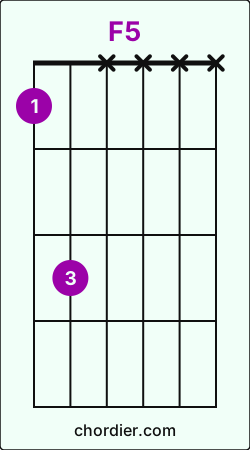
2. F7 → F5 chord transition
To move from F7 to F5, follow these steps:
- While playing F7, lift your middle finger from G string fret 2.
- Keep index finger on E string fret 1.
- Keep ring finger on A string fret 3.
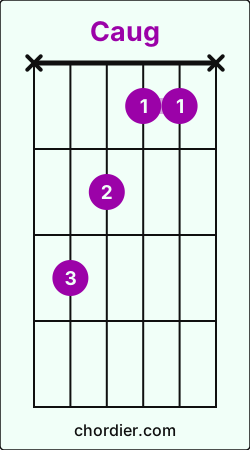
3. F7 → Caug chord transition
To move from F7 to Caug, follow these steps:
- Lift your index finger from E string fret 1 and place it on G string fret 1.
- Slide your middle finger from G string fret 2 to D string fret 2.
- Keep ring finger on A string fret 3.
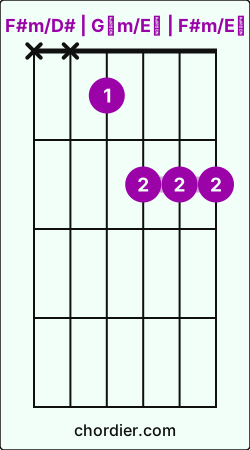
4. F7 → F#m/D# | G♭m/E♭ | F#m/E♭ chord transition
To move from F7 to F#m/D# | G♭m/E♭ | F#m/E♭, follow these steps:
- While playing F7, lift your ring finger from A string fret 3.
- Lift your index finger from E string fret 1 and place it on D string fret 1.
- Keep middle finger on G string fret 2.
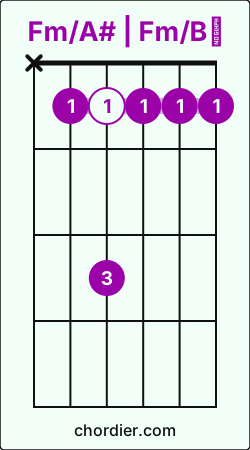
5. F7 → Fm/A# | Fm/B♭ chord transition
To move from F7 to Fm/A# | Fm/B♭, follow these steps:
- While playing F7, lift your middle finger from G string fret 2.
- Lift your index finger from E string fret 1 and place it on A string fret 1.
- Slide your ring finger from A string fret 3 to D string fret 3.
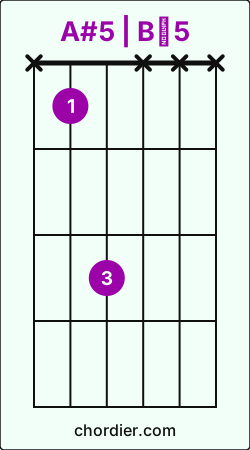
6. F7 → A#5 | B♭5 chord transition
To move from F7 to A#5 | B♭5, follow these steps:
- While playing F7, lift your middle finger from G string fret 2.
- Lift your index finger from E string fret 1 and place it on A string fret 1.
- Slide your ring finger from A string fret 3 to D string fret 3.
Most Common Transitions
The most frequent chord transitions from F7 across songs on this site.
1. F7 → Bb chord transition
To move from F7 to Bb, follow these steps:
On Chordier, songs containing F7 use the transition to Bb at 50.9%. You can practice this transition in 51 different songs.
2. F7 → C chord transition
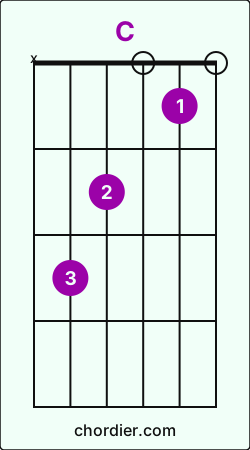
To move from F7 to C, follow these steps:
- Lift your index finger from E string fret 1 and place it on B string fret 1.
- Slide your middle finger from G string fret 2 to D string fret 2.
- Keep ring finger on A string fret 3.
On Chordier, songs containing F7 use the transition to C at 9.9%. You can practice this transition in 10 different songs.
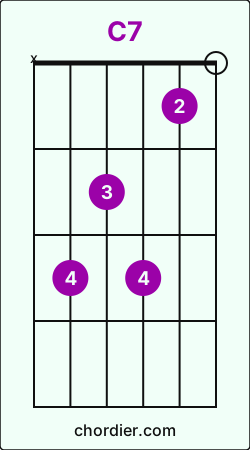
3. F7 → C7 chord transition
To move from F7 to C7, follow these steps:
- Lift your index finger from E string fret 1 and place it on B string fret 1.
- Slide your middle finger from G string fret 2 to D string fret 2.
- Keep ring finger on A string fret 3.
- Place pinky on G string fret 3.
On Chordier, songs containing F7 use the transition to C7 at 8.4%. You can practice this transition in 4 different songs.
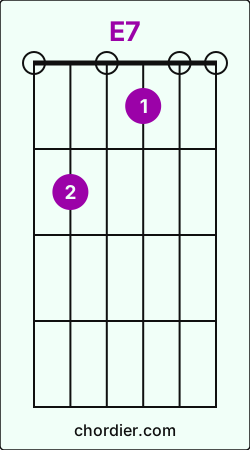
4. F7 → E7 chord transition
To move from F7 to E7, follow these steps:
- While playing F7, lift your ring finger from A string fret 3.
- Lift your index finger from E string fret 1 and place it on G string fret 1.
- Slide your middle finger from G string fret 2 to A string fret 2.
On Chordier, songs containing F7 use the transition to E7 at 8.1%. You can practice this transition in 9 different songs.
Songs Using F7 Chord
Popular songs that feature the F7 chord, perfect for practice.
Frequently Asked Questions
Is F7 suitable for beginners on Guitar?
F7 sits in the intermediate range for Guitar players. It uses a 3-fret span and includes a barre technique. Work on clean tone before pushing tempo.
Any beginner-friendly alternative for F7?
F7 has a more accessible version for Guitar players. The alternative voicing uses fingering x-3-3-2-4-1. It is a practical bridge between beginner and full voicings.
Which chords pair well with F7 on Guitar?
F7 works well with Bb and C on Guitar. Based on our catalog data, transitions from F7 to Bb account for 50.9% (200 total changes in 51 songs), and transitions to C account for 9.9% (39 total changes in 10 songs).
Which songs include F7?
Dave Van Ronk - Sporting Life Blues Chords is one of 8 songs featuring the F7 chord.