
Tom Walker - How Can You Sleep At Night Chords
Before you play, tune your guitar and use the tools below to set up your view and flow.
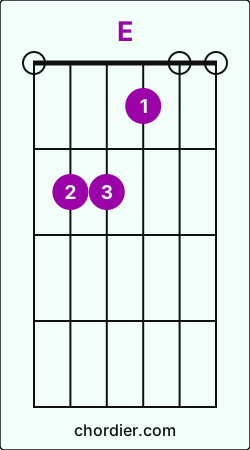 Guitar E chord diagram
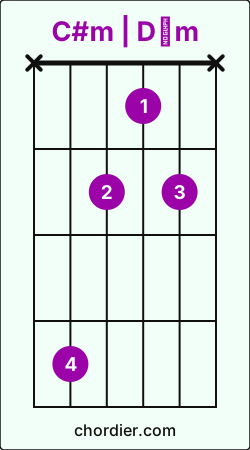 Guitar C#m | D♭m chord diagram
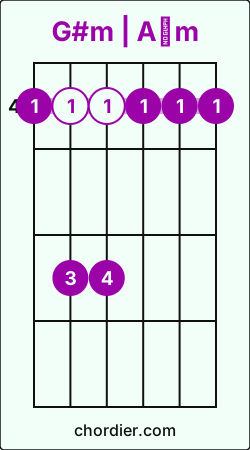 Guitar G#m | A♭m chord diagram
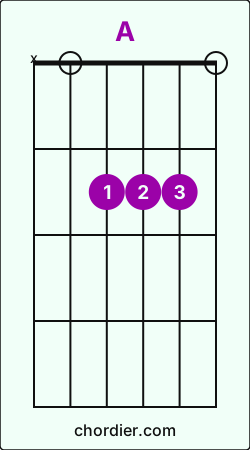 Guitar A chord diagram
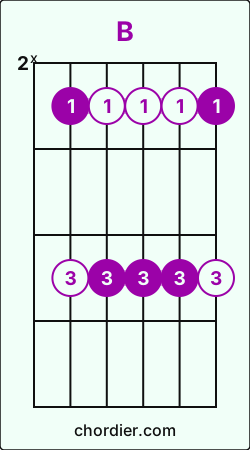 Guitar B chord diagram
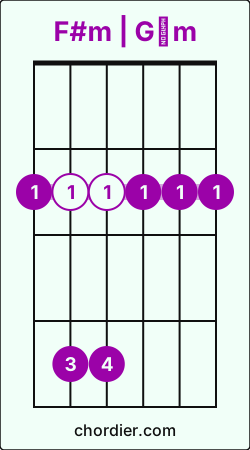 Guitar F#m | G♭m chord diagram
[Opening]
Tell me you [E]hate me, [C#m]just tell me [G#m]something, lay it [A]all on the [E]table
‘Cause [A]sooner or [C#m]later, it’s [B]back again
I know that I [E]messed up, [C#m]no [G#m]misunderstanding
But, darling, I [A]need ya to [E]blame me
‘Cause [A]your silence won’t [C#m]make me a [B]better man, you make me a [A]better man
[chorus]
So [A]how can you sleep at [C#m]night? Tell me you think I [B]deserve this
Tell me now, what should I [F#m]do? [G#m]’Cause [A]I’m standing [C#m]paralysed
You hide it so good on the [B]surface, but I know you’re hurting, [F#m]too [G#m]
[A]Talking at you and there’s no reply, [C#m]staring at me from the other side
[B]Feels like you’re gone, [F#m]feels like you’re gone [G#m]
So [A]how can you sleep at [C#m]night? Tell me if you think it’s [B]worthless
Tell me if I’m losing [B]you [E]
[verse 2]
I know that you’re [E]too proud [C#m]to let it go [G#m]easy, if you [A]got nothing to [E]say
We’re [A]just gonna [C#m]waste all of the [B]good days
So I keep on [E]asking, [C#m]though I’m getting [G#m]nothing, and darling, I’ve [A]made my [E]mistakes
And I’m [A]begging to [C#m]pay but you’re not [B]listening
I know you’re not [A]listening (I know you’re not listening)
[chorus]
So [A]how can you sleep at [C#m]night? Tell me you think I [B]deserve this
Tell me now, what should I [F#m]do? [G#m]’Cause [A]I’m standing [C#m]paralysed
You hide it so good on the [B]surface, but I know you’re hurting, [F#m]too [G#m]
[A]Talking at you and there’s no reply, [C#m]staring at me from the other side
[B]Feels like you’re gone, [F#m]feels like you’re gone [G#m]
So [A]how can you sleep at [C#m]night? Tell me if you think it’s [B]worthless
Tell me if I’m losing [B]you [E]
[verse 3]
[A] [C#m] [B] [F#m] [A] [C#m] [B] [F#m]
[A]Talking at you and there’s no reply, [C#m]staring at me from the other side
[B]Feels like you’re gone, [F#m]feels like you’re gone [G#m]
So [A]how can you sleep at [C#m]night? Tell me if you think it’s [B]worthless
Tell me if I’m losing [B]you
[Closing]
So [A]how can you sleep at [C#m]night? Tell me you think I [B]deserve this
Tell me now, what should I [F#m]do? [G#m]Well, [A]how can you sleep at [C#m]night?
Tell me if you think it’s [B]worthless, tell me if I’m losing [F#m]you
How to play How Can You Sleep At Night on Guitar (Step-by-step)
Tom Walker - How Can You Sleep At Night on guitar requires 6 chords and 11 core chord transitions. You can find the full step-by-step guide below. Before you start, tune your instrument. The song uses the ↓-↓↓↑ pattern; practice it muted first, or simplify to downstrokes while you learn the changes.
How Can You Sleep At Night uses these transitions most often: A → C#m (18), C#m → B (18), and G#m → A (12). These transitions may feel a little challenging at first, but with steady practice you can play this song quickly.When you are ready, begin with E - C#m chord transition.
1. E → C#m chord transition
To move from E to C#m;
- Keep index finger on G string fret 1.
- Lift your middle finger from A string fret 2 and place it on D string fret 2.
- Slide your ring finger from D string fret 2 to B string fret 2.
- Place pinky on A string fret 4.
2. C#m → G#m chord transition
To move from C#m to G#m;
- While playing C#m, lift your middle finger from D string fret 2.
- Lift your index finger from G string fret 1 and place it on E string fret 4.
- Slide your ring finger from B string fret 2 to A string fret 6.
- Lift your pinky from A string fret 4 and place it on D string fret 6.
3. G#m → A chord transition
To move from G#m to A;
- While playing G#m, lift your pinky from D string fret 6.
- Lift your index finger from E string fret 4 and place it on D string fret 2.
- Slide your ring finger from A string fret 6 to B string fret 2.
- Place middle finger on G string fret 2.
4. A → E chord transition
To move from A to E;
- Lift your index finger from D string fret 2 and place it on G string fret 1.
- Slide your middle finger from G string fret 2 to A string fret 2.
- Lift your ring finger from B string fret 2 and place it on D string fret 2.
5. A → C#m chord transition
To move from A to C#m;
- Lift your index finger from D string fret 2 and place it on G string fret 1.
- Slide your middle finger from G string fret 2 to D string fret 2.
- Keep ring finger on B string fret 2.
- Place pinky on A string fret 4.
6. C#m → B chord transition
To move from C#m to B;
- Lift your index finger from G string fret 1 and place it on E string fret 2.
- Slide your middle finger on D string from fret 2 to fret 4.
- Lift your ring finger from B string fret 2 and place it on G string fret 4.
- Slide your pinky from A string fret 4 to B string fret 4.
7. B → E chord transition
To move from B to E;
- While playing B, lift your pinky from B string fret 4.
- Lift your index finger from E string fret 2 and place it on G string fret 1.
- Slide your middle finger from D string fret 4 to A string fret 2.
- Lift your ring finger from G string fret 4 and place it on D string fret 2.
8. B → A chord transition
To move from B to A;
- While playing B, lift your pinky from B string fret 4.
- Lift your index finger from E string fret 2 and place it on D string fret 2.
- Slide your middle finger from D string fret 4 to G string fret 2.
- Lift your ring finger from G string fret 4 and place it on B string fret 2.
9. B → F#m chord transition
To move from B to F#m;
- While playing B, lift your middle finger from D string fret 4.
- Keep index finger on E string fret 2.
- Lift your ring finger from G string fret 4 and place it on A string fret 4.
- Slide your pinky from B string fret 4 to D string fret 4.
10. F#m → G#m chord transition
To move from F#m to G#m;
- Slide your index finger on E string from fret 2 to fret 4.
- Slide your ring finger on A string from fret 4 to fret 6.
- Slide your pinky on D string from fret 4 to fret 6.
11. F#m → A chord transition
To move from F#m to A;
- While playing F#m, lift your pinky from D string fret 4.
- Lift your index finger from E string fret 2 and place it on D string fret 2.
- Slide your ring finger from A string fret 4 to B string fret 2.
- Place middle finger on G string fret 2.
How Can You Sleep At Night chord transition analysis
A short, data-driven summary of the chord flow in How Can You Sleep At Night.
- How Can You Sleep At Night includes 93 chord transitions, 11 of them unique.
- These transitions represent 0.02% of all chord transitions in Chordier.
- How Can You Sleep At Night contains 1 of the top 25 transitions across Chordier.
- These transition patterns show how How Can You Sleep At Night connects to the rest of Chordier. Mastering them helps you move to similar songs faster.After A, the most likely next chords across Chordier are D (29%), G (13%), and E (12%).
- A → E: 12%
- A → C#m: 2%
After C#m, the most likely next chords across Chordier are A (27%), B (21%), and F#m (11%).- C#m → B: 21%
- C#m → G#m: 7%