
Stevie Wonder - I’ve Just Called To Say I Love You Chords
Before you play, tune your guitar and use the tools below to set up your view and flow.
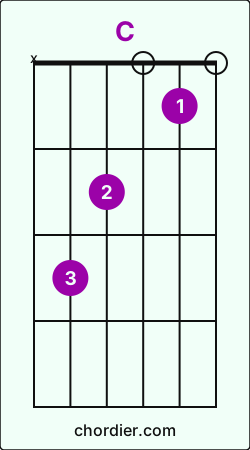 Guitar C chord diagram
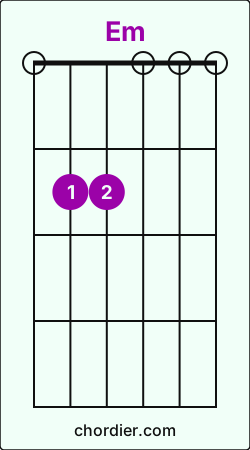 Guitar Em chord diagram
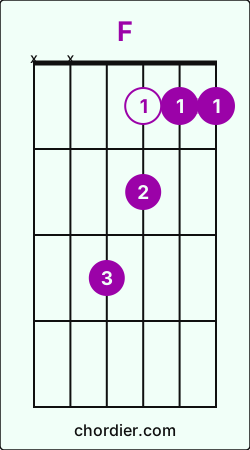 Guitar F chord diagram
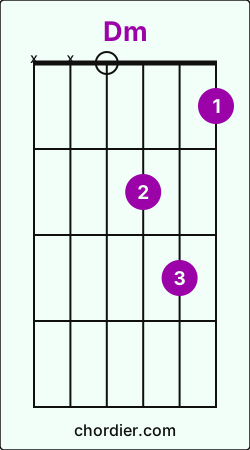 Guitar Dm chord diagram
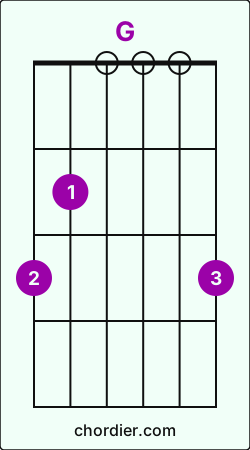 Guitar G chord diagram
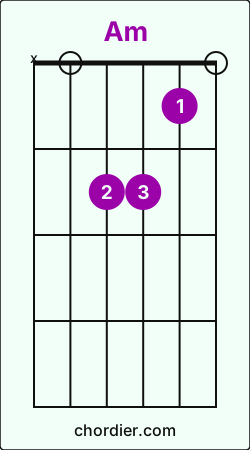 Guitar Am chord diagram
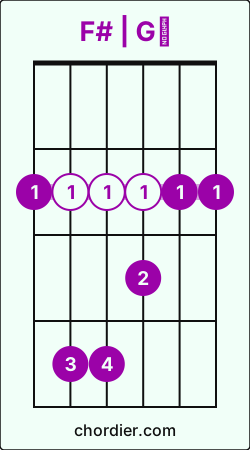 Guitar F# | G♭ chord diagram
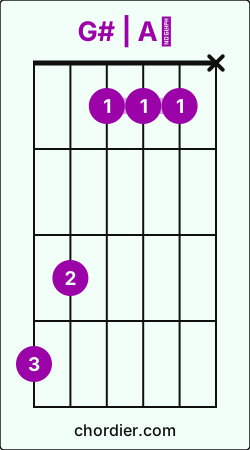 Guitar G# | A♭ chord diagram
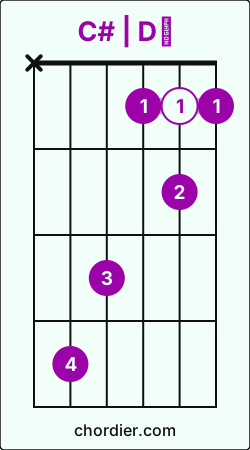 Guitar C# | D♭ chord diagram
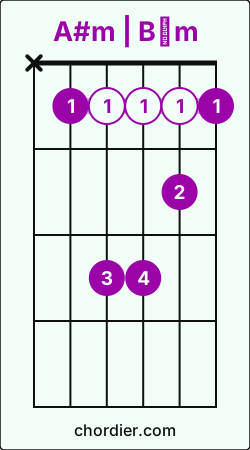 Guitar A#m | B♭m chord diagram
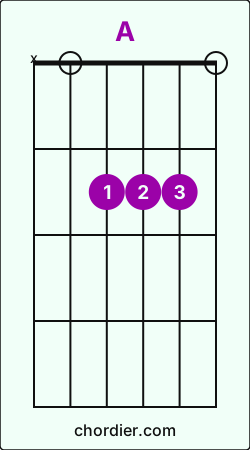 Guitar A chord diagram
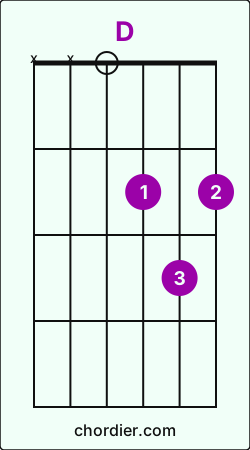 Guitar D chord diagram
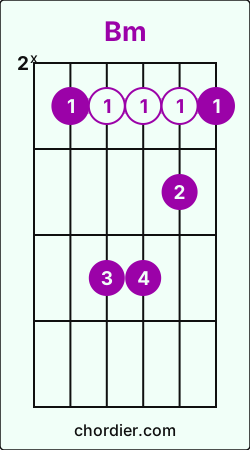 Guitar Bm chord diagram
[Opening]
No new years [C]day to [Em]cele[C]brate
No [Em]chocolate [C]covered candy hearts to give a [F]way
No [Dm]first of spring, no song to [Dm]sing
In fact heres [Dm]just another [G]ordinary [C]day
[verse 2]
No april [C]rain no [Em]flowers [C]bloom
No [Em]wedding [C]saturday within the month of [F]june
But what it [Dm]is, is something [Dm]true
Made up of [Dm]these three words that [G]I must say to [C]you
[chorus]
I just [F]called to [G]say I [C]love you
I just [F]called to [G]say how much I [Am]care
I just [F]called to [G]say I [Am]love you
And I [F]mean it from the [G]bottom of my [C]heart
[verse 3]
No summers [C]high no [Em]warm [C]July
No [Em]harvest [C]moon to light one tender August [F]night
No [Dm]autumn breeze no falling [Dm]leaves
No even [Dm]time for birds to [G]fly to southern [C]skies
[verse 4]
No libra [C]sun no [Em]hallo[C]ween
No [Em]giving [C]thanks to all the Christmas joy you [F]bring
But what it [Dm]is though old so [Dm]new
To fill your [Dm]heart like no three [G]words could ever [C]do
[chorus]
I just [F#]called to [Ab]say I [C#]love you
I just [F#]called to [Ab]say how much I [Bbm]care
I just [F#]called to [Ab]say I [Bbm]love you
And I [F#]mean it from the [Ab]bottom of my [C#]heart
[chorus]
I just [G]called to [A]say I [D]love you
I just [G]called to [A]say how much I [Bm]care
I just [G]called to [A]say I [Bm]love you
And I [G]mean it from the [A]bottom of my [D]heart.
[verse 5]
Aucune chan[C]son, au[Em]cune sai[C]son
Au[Em]cun vio[C]lon n’aurait le charme de cet in[F]stant
Au[Dm]cun souvenir, aucun dé[Dm]sir
Aucun plai[Dm]sir ne serait ja[G]mais assez [C]grand
[verse 6]
Que te re[C]voir [Em]dans mon histoi[C]re
Dans [Em]ce miroir ou [C]nous avons été a[F]mants
Nos [Dm]soirs de fêtes nos cœurs po[Dm]ètes
Etait fait [Dm]pour écrire les [G]page d’un ro[C]man
[chorus]
Pour te [F]dire je [G]t’aime comme [C]avant
Je pour[F]rais brû[G]ler un océ[Am]an
Pour te [F]dire je [G]t’aime à [C]présent
Je pour[F]rais marcher au [G]dessus du vol[C]can
[verse 7]
Je laisse No[C]ël au [Em]père No[C]ël
L’an[Em]née nou[Em]velle ne nous verra pas autre[F]ment
Que [Dm]déchirés que parta[Dm]gés
De sépara[Dm]tion en cris d’a[G]mour éton[C]nant
[Closing]
Aucun vo[C]yage, au[Em]cun vis[C]age
Au[Em]cun nu[C]age n’a pu me faire pleurer au[F]tant
Mais [Dm]je dois dire, qu’aucun sou[Dm]rire
N’a su me [Dm]faire souffrir d’a[G]mour si tendre[C]ment
[chorus]
Pour te [F#]dire je [Ab]t’aime comme [C#]avant
Je pour[F#]rais brû[Ab]ler un océ[Bbm]an
Pour te [F#]dire je [Ab]t’aime à [C#]présent
Je pour[F#]rais marcher au [Ab]dessus du vol[C#]can
[chorus]
Pour te [G]dire je [A]t’aime comme [D]avant
Je pour[G]rais brû[A]ler un océ[Bm]an
Pour te [G]dire je [A]t’aime à [D]présent
Je pour[G]rais marcher au [A]dessus du vol[D]can.
How to play I've Just Called To Say I Love You on Guitar (Step-by-step)
Stevie Wonder - I've Just Called To Say I Love You on guitar requires 13 chords and 22 core chord transitions. You can find the full step-by-step guide below. Before you start, tune your instrument. The song uses the ↓↑-↓↑-↓↑-↓↑ pattern; practice it muted first, or simplify to downstrokes while you learn the changes.
I've Just Called To Say I Love You uses these transitions most often: C → Em (16), Em → C (15), and G → C (13). These transitions may feel a little challenging at first, but with steady practice you can play this song quickly.When you are ready, begin with C - Em chord transition.
1. C → Em chord transition
To move from C to Em;
- While playing C, lift your index finger from B string fret 1.
- Lift your middle finger from D string fret 2 and place it on A string fret 2.
- Slide your ring finger from A string fret 3 to D string fret 2.
2. C → F chord transition
To move from C to F;
- Lift your index finger from B string fret 1 and place it on E string fret 1.
- Slide your middle finger from D string fret 2 to G string fret 2.
- Keep ring finger on A string fret 3.
- Place pinky on D string fret 3.
3. F → Dm chord transition
To move from F to Dm;
- While playing F, lift your pinky from D string fret 3.
- Lift your index finger from E string fret 1 and place it on E string fret 1.
- Keep middle finger on G string fret 2.
- Slide your ring finger from A string fret 3 to B string fret 3.
4. Dm → G chord transition
To move from Dm to G;
- Lift your index finger from E string fret 1 and place it on A string fret 2.
- Slide your middle finger from G string fret 2 to E string fret 3.
- Lift your ring finger from B string fret 3 and place it on E string fret 3.
5. G → C chord transition
To move from G to C;
- Lift your index finger from A string fret 2 and place it on B string fret 1.
- Slide your middle finger from E string fret 3 to D string fret 2.
- Lift your ring finger from E string fret 3 and place it on A string fret 3.
6. F → G chord transition
To move from F to G;
- While playing F, lift your pinky from D string fret 3.
- Lift your index finger from E string fret 1 and place it on A string fret 2.
- Slide your middle finger from G string fret 2 to E string fret 3.
- Lift your ring finger from A string fret 3 and place it on E string fret 3.
7. G → Am chord transition
To move from G to Am;
- Lift your index finger from A string fret 2 and place it on B string fret 1.
- Slide your middle finger from E string fret 3 to D string fret 2.
- Lift your ring finger from E string fret 3 and place it on G string fret 2.
8. Am → F chord transition
To move from Am to F;
- Lift your index finger from B string fret 1 and place it on E string fret 1.
- Slide your middle finger from D string fret 2 to G string fret 2.
- Lift your ring finger from G string fret 2 and place it on A string fret 3.
- Place pinky on D string fret 3.
9. C → F# chord transition
To move from C to F#;
- Lift your index finger from B string fret 1 and place it on E string fret 2.
- Slide your middle finger from D string fret 2 to G string fret 3.
- Slide your ring finger on A string from fret 3 to fret 4.
- Place pinky on D string fret 4.
10. F# → Ab chord transition
To move from F# to Ab;
- While playing F#, lift your pinky from D string fret 4.
- Lift your index finger from E string fret 2 and place it on D string fret 1.
- Slide your middle finger from G string fret 3 to A string fret 3.
- Lift your ring finger from A string fret 4 and place it on E string fret 4.
11. Ab → C# chord transition
To move from Ab to C#;
- Lift your index finger from D string fret 1 and place it on G string fret 1.
- Slide your middle finger from A string fret 3 to B string fret 2.
- Lift your ring finger from E string fret 4 and place it on D string fret 3.
- Place pinky on A string fret 4.
12. C# → F# chord transition
To move from C# to F#;
- Lift your index finger from G string fret 1 and place it on E string fret 2.
- Slide your middle finger from B string fret 2 to G string fret 3.
- Lift your ring finger from D string fret 3 and place it on A string fret 4.
- Slide your pinky from A string fret 4 to D string fret 4.
13. Ab → Bbm chord transition
To move from Ab to Bbm;
- Lift your index finger from D string fret 1 and place it on A string fret 1.
- Slide your middle finger from A string fret 3 to B string fret 2.
- Lift your ring finger from E string fret 4 and place it on D string fret 3.
- Place pinky on G string fret 3.
14. Bbm → F# chord transition
To move from Bbm to F#;
- Lift your index finger from A string fret 1 and place it on E string fret 2.
- Slide your middle finger from B string fret 2 to G string fret 3.
- Lift your ring finger from D string fret 3 and place it on A string fret 4.
- Slide your pinky from G string fret 3 to D string fret 4.
15. C# → G chord transition
To move from C# to G;
- While playing C#, lift your pinky from A string fret 4.
- Lift your index finger from G string fret 1 and place it on A string fret 2.
- Slide your middle finger from B string fret 2 to E string fret 3.
- Lift your ring finger from D string fret 3 and place it on E string fret 3.
16. G → A chord transition
To move from G to A;
- Lift your index finger from A string fret 2 and place it on D string fret 2.
- Slide your middle finger from E string fret 3 to G string fret 2.
- Lift your ring finger from E string fret 3 and place it on B string fret 2.
17. A → D chord transition
To move from A to D;
- Lift your index finger from D string fret 2 and place it on G string fret 2.
- Slide your middle finger from G string fret 2 to E string fret 2.
- Slide your ring finger on B string from fret 2 to fret 3.
18. D → G chord transition
To move from D to G;
- Lift your index finger from G string fret 2 and place it on A string fret 2.
- Slide your middle finger from E string fret 2 to E string fret 3.
- Lift your ring finger from B string fret 3 and place it on E string fret 3.
19. A → Bm chord transition
To move from A to Bm;
- Lift your index finger from D string fret 2 and place it on E string fret 2.
- Slide your middle finger from G string fret 2 to B string fret 3.
- Lift your ring finger from B string fret 2 and place it on D string fret 4.
- Place pinky on G string fret 4.
20. Bm → G chord transition
To move from Bm to G;
- While playing Bm, lift your pinky from G string fret 4.
- Lift your index finger from E string fret 2 and place it on A string fret 2.
- Slide your middle finger from B string fret 3 to E string fret 3.
- Lift your ring finger from D string fret 4 and place it on E string fret 3.
21. D → C chord transition
To move from D to C;
- Lift your index finger from G string fret 2 and place it on B string fret 1.
- Slide your middle finger from E string fret 2 to D string fret 2.
- Lift your ring finger from B string fret 3 and place it on A string fret 3.
22. Em → F chord transition
To move from Em to F;
- Lift your middle finger from A string fret 2 and place it on G string fret 2.
- Slide your ring finger from D string fret 2 to A string fret 3.
- Place index finger on E string fret 1.
- Place pinky on D string fret 3.
I've Just Called To Say I Love You chord transition analysis
A short, data-driven summary of the chord flow in I've Just Called To Say I Love You.
- I've Just Called To Say I Love You includes 136 chord transitions, 22 of them unique.
- These transitions represent 0.04% of all chord transitions in Chordier.
- I've Just Called To Say I Love You contains 9 of the top 10 transitions across Chordier.
- These transition patterns show how I've Just Called To Say I Love You connects to the rest of Chordier. Mastering them helps you move to similar songs faster.After C, the most likely next chords across Chordier are G (35%), F (16%), and D (11%).
- C → F: 16%
- C → Em: 8%
After Dm, the most likely next chords across Chordier are C (18%), G (16%), and Am (14%).- Dm → G: 16%