
BTS - IDOL Chords
Before you play, tune your guitar and use the tools below to set up your view and flow. Using the Transpose tool, switch to A key to play this song with easier chords.
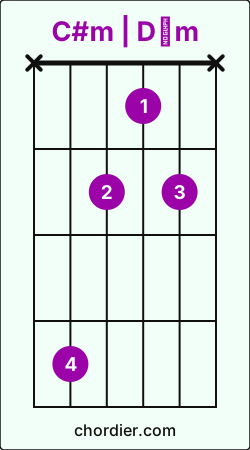 Guitar C#m | D♭m chord diagram
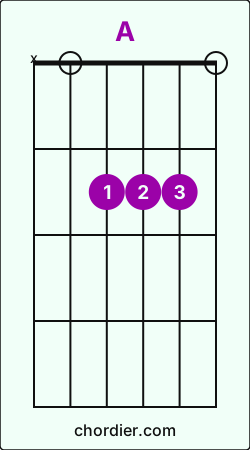 Guitar A chord diagram
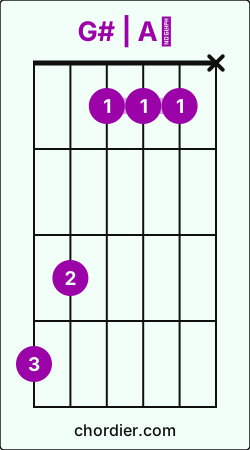 Guitar G# | A♭ chord diagram
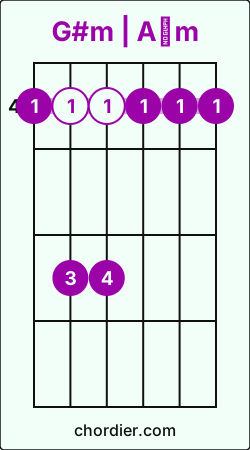 Guitar G#m | A♭m chord diagram
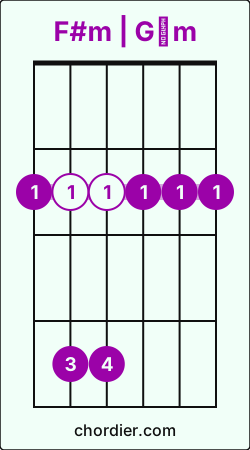 Guitar F#m | G♭m chord diagram
[Opening]
You can call me [C#m]artist. You can call me idol
Anim eotteon dareun mwora haedoI don’t care.
I’m proud of it. Nan jayuropne. No more irony
Naneun hangsang [A]nayeossgie
[verse 2]
Songarakjil [C#m]hae naneun jeonhyeo singyeong sseuji anhne
Nareul yokhaneun neoui geu [A]iyuga mwodeun gane
I know what I am. I know what I want
I never gon’ [G#]change. I never gon’ [C#m]trade
Trade off
[chorus]
[G#m]Mwol eojjeo[C#m]go jeojjeo[A]go tteodeu[F#m]reodaesyeo [C#m]
I [G#m]do what I [C#m]do geunikka [A]neon neona [F#m]jalha[C#m]syeo
You can’t [G#m]stop me lovin’ myself
[chorus]
Eolssu [C#m]johda. You can’t stop me lovin’ myself
Jihwaja [C#m]johda. You can’t stop me lovin’ myself
[chorus]
[C#m]Oh oh oh oh [G#m]Oh oh oh oh oh oh
[C#m]Oh oh oh oh [G#m]Deonggideok kungdeoreoreo Eolssu
[C#m]Oh oh oh oh [G#m]Oh oh oh oh oh oh
[C#m]oh oh oh oh [G#m]Deonggideok kungdeoreoreo. Eolssu
[verse 3]
[C#m]Face off machi ousam ay
Top star with that spotlight ay
Ttaeron syupeohieoroga dwae
[A]Dollyeodae neoui Anpanman
[C#m]24sigani jeokji
Hesgallim naegen sachi
I do my thang
I love [A]myself
[verse 4]
I love [C#m]myself I love my fans love my dance and my what
Nae soganen myeot sip myeot baekmyeongui naega isseo
Oneul tto dareun nal majihae
Eochapi jeonbu da naigie
Gominbodaneun gyang dalline
Runnin’ man Runnin’ man Runnin’ man
[chorus]
[G#m]Mwol eojjeo[C#m]go jeojjeo[A]go tteodeu[F#m]reodaesyeo [C#m]
I [G#m]do what I [C#m]do geunikka [A]neon neona [F#m]jalha[C#m]syeo
You can’t [G#m]stop me lovin’ myself
[chorus]
Eolssu [C#m]johda. You can’t stop me lovin’ myself
Jihwaja [C#m]johda. You can’t stop me lovin’ myself
[chorus]
[C#m]Oh oh oh oh [G#m]Oh oh oh oh oh oh
[C#m]Oh oh oh oh [G#m]Deonggideok kungdeoreoreo Eolssu
[C#m]Oh oh oh oh [G#m]Oh oh oh oh oh oh
[C#m]oh oh oh oh [G#m]Deonggideok kungdeoreoreo. Eolssu
[Closing]
[C#m]I’m so fine wherever I [A]go [G#]
[C#m]Gakkeum meolli doraga[A]do [G#m]
It’s o[C#m]kay. I’m in [A]love with my-my my[G#m]self
It’s o[F#m]kay. Nan i [C#m]sungan haengbokhae
[chorus]
Eolssu [C#m]johda. You can’t stop me lovin’ myself
Jihwaja [C#m]johda. You can’t stop me lovin’ myself
[chorus]
[C#m]Oh oh oh oh oh oh oh oh oh oh
[G#m]Oh oh oh oh Deonggideok kungdeoreoreo Eolssu
[C#m]Oh oh oh oh oh oh oh oh oh oh
[G#m]Oh oh oh oh Deonggideok kungdeoreoreo. Eolssu
How to play IDOL on Guitar (Step-by-step)
BTS - IDOL on guitar requires 5 chords and 8 core chord transitions. You can find the full step-by-step guide below. Before you start, tune your instrument. The song uses the ↓-↓↑-↑↓↑ pattern; practice it muted first, or simplify to downstrokes while you learn the changes.
IDOL uses these transitions most often: C#m → G#m (16), G#m → C#m (16), and C#m → A (11). These transitions may feel a little challenging at first, but with steady practice you can play this song quickly.When you are ready, begin with C#m - A chord transition.
1. C#m → A chord transition
To move from C#m to A;
- While playing C#m, lift your pinky from A string fret 4.
- Lift your index finger from G string fret 1 and place it on D string fret 2.
- Slide your middle finger from D string fret 2 to G string fret 2.
- Keep ring finger on B string fret 2.
2. A → G# chord transition
To move from A to G#;
- Slide your index finger on D string from fret 2 to fret 1.
- Slide your middle finger from G string fret 2 to A string fret 3.
- Lift your ring finger from B string fret 2 and place it on E string fret 4.
3. G# → C#m chord transition
To move from G# to C#m;
- Lift your index finger from D string fret 1 and place it on G string fret 1.
- Slide your middle finger from A string fret 3 to D string fret 2.
- Lift your ring finger from E string fret 4 and place it on B string fret 2.
- Place pinky on A string fret 4.
4. C#m → G#m chord transition
To move from C#m to G#m;
- While playing C#m, lift your middle finger from D string fret 2.
- Lift your index finger from G string fret 1 and place it on E string fret 4.
- Slide your ring finger from B string fret 2 to A string fret 6.
- Lift your pinky from A string fret 4 and place it on D string fret 6.
5. A → F#m chord transition
To move from A to F#m;
- While playing A, lift your middle finger from G string fret 2.
- Lift your index finger from D string fret 2 and place it on E string fret 2.
- Slide your ring finger from B string fret 2 to A string fret 4.
- Place pinky on D string fret 4.
6. F#m → C#m chord transition
To move from F#m to C#m;
- Lift your index finger from E string fret 2 and place it on G string fret 1.
- Slide your ring finger from A string fret 4 to B string fret 2.
- Lift your pinky from D string fret 4 and place it on A string fret 4.
- Place middle finger on D string fret 2.
7. A → G#m chord transition
To move from A to G#m;
- While playing A, lift your middle finger from G string fret 2.
- Lift your index finger from D string fret 2 and place it on E string fret 4.
- Slide your ring finger from B string fret 2 to A string fret 6.
- Place pinky on D string fret 6.
8. G#m → F#m chord transition
To move from G#m to F#m;
- Slide your index finger on E string from fret 4 to fret 2.
- Slide your ring finger on A string from fret 6 to fret 4.
- Slide your pinky on D string from fret 6 to fret 4.
IDOL chord transition analysis
A short, data-driven summary of the chord flow in IDOL.
- IDOL includes 62 chord transitions, 8 of them unique.
- These transitions represent 0.02% of all chord transitions in Chordier.
- These transition patterns show how IDOL connects to the rest of Chordier. Mastering them helps you move to similar songs faster.After C#m, the most likely next chords across Chordier are A (27%), B (21%), and F#m (11%).
- C#m → A: 27%
- C#m → G#m: 7%
After G#m, the most likely next chords across Chordier are A (26%), E (23%), and F# (19%).- G#m → C#m: 9%
- G#m → F#m: 4%