
Rodriguez - Inner City Blues Chords
Before you play, tune your guitar and use the tools below to set up your view and flow.
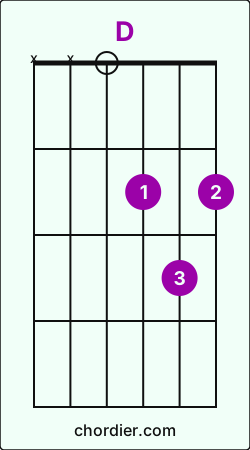 Guitar D chord diagram
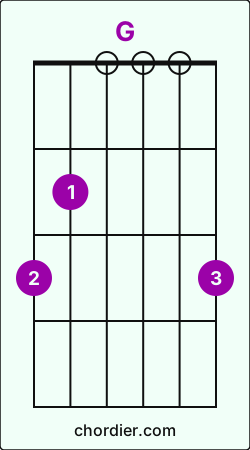 Guitar G chord diagram
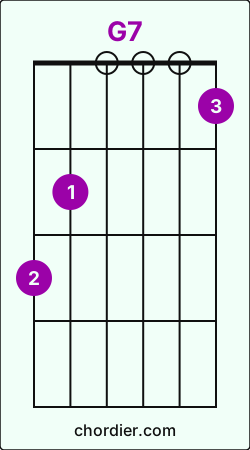 Guitar G7 chord diagram
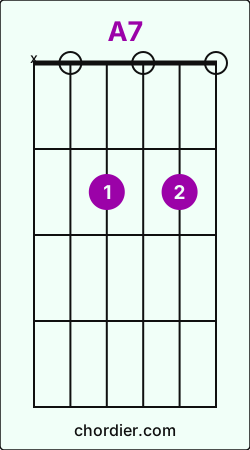 Guitar A7 chord diagram
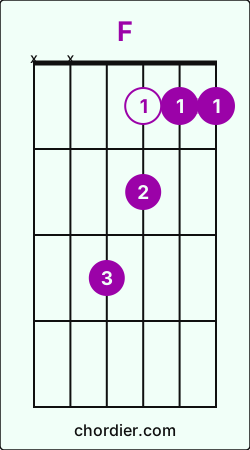 Guitar F chord diagram
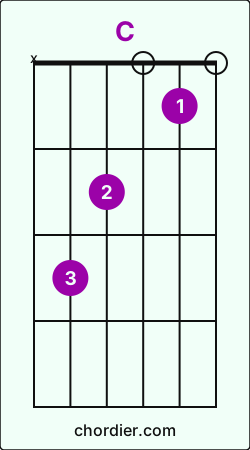 Guitar C chord diagram
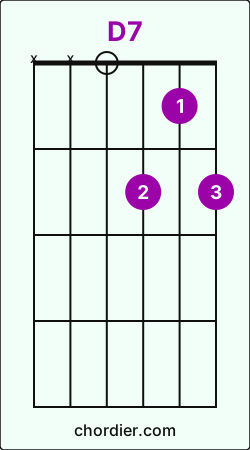 Guitar D7 chord diagram
[Opening]
[D] [D] [D] [D] [G] [G7]
[D]Going down dirty inner city side road I [G7]plotted
[D]Madness passed me by, she smiled hi, I [G7]nodded
[D]Looked up as the sky [A7]began to cry, [D]she shot it
[verse 2]
[D]Met a girl from Dearborn, [G7]early six o’clock this morn, [D]A cold fact
[G]Asked about her bag, [A7]suburbia’s such a drag, [D]won’t go back
[verse 3]
[F]’Cos Papa don’t allow [C]no new [G]ideas [D]here
[F]And now he sees the news, but the [C]picture’s [G]not too [D]clear.
[G]Mama, Papa, stop, treasure [G]what you got,
Soon you may be caught [D]without it
[G]The curfew’s set for eight, will it ever all be straight [D]I doubt it
[verse 4]
[D]Seven jealous fools playing [D]by her rules, can’t [G7]believe her
[D]He feels so in between, can’t [D]break the scene, it would [G7]grieve her
[D]And that’s the reason why [A7]he must cry, [D]he’ll never leave her
[verse 5]
[D]Crooked children, yellow chalk, [G7]writing on the concrete walk
[D]Their king died
[G7]Drinking from a Judas cup, looking down but seeing up, [D7]Sweet Red Wine
[verse 6]
[F]’Cos Papa don’t allow no [C]new [G]ideas [D]here [D]
And [F]now hear the music, but the [C]words don’t [G]sound too [D]clear [D]
[G]Mama, Papa, stop, treasure [G]what you got,
Soon you may be caught [D]without it
[G]The curfew’s set for eight, will it [G]ever all be straight [D]I doubt it
[Closing]
[D]Going down a dusty, Georgian side road I [G7]wonder
[D]The wind splashed in my face, [A7]can smell a trace Of thunder [D]
How to play Inner City Blues on Guitar (Step-by-step)
Rodriguez - Inner City Blues on guitar requires 7 chords and 10 core chord transitions. You can find the full step-by-step guide below. Before you start, tune your instrument. The song uses the ↓-↓↑-↑↓↑ pattern; practice it muted first, or simplify to downstrokes while you learn the changes.
Inner City Blues uses these transitions most often: D → G7 (8), G → D (8), and G7 → D (8). These transitions may feel a little challenging at first, but with steady practice you can play this song quickly.When you are ready, begin with D - G chord transition.
1. D → G chord transition
To move from D to G;
- Lift your index finger from G string fret 2 and place it on A string fret 2.
- Slide your middle finger from E string fret 2 to E string fret 3.
- Lift your ring finger from B string fret 3 and place it on E string fret 3.
2. G → G7 chord transition
To move from G to G7;
- Keep index finger on A string fret 2.
- Keep middle finger on E string fret 3.
- Slide your ring finger on E string from fret 3 to fret 1.
3. G7 → D chord transition
To move from G7 to D;
- Lift your index finger from A string fret 2 and place it on G string fret 2.
- Slide your middle finger from E string fret 3 to E string fret 2.
- Lift your ring finger from E string fret 1 and place it on B string fret 3.
4. D → A7 chord transition
To move from D to A7;
- While playing D, lift your ring finger from B string fret 3.
- Lift your index finger from G string fret 2 and place it on D string fret 2.
- Slide your middle finger from E string fret 2 to B string fret 2.
5. G → A7 chord transition
To move from G to A7;
- While playing G, lift your ring finger from E string fret 3.
- Lift your index finger from A string fret 2 and place it on D string fret 2.
- Slide your middle finger from E string fret 3 to B string fret 2.
6. D → F chord transition
To move from D to F;
- Lift your index finger from G string fret 2 and place it on E string fret 1.
- Slide your middle finger from E string fret 2 to G string fret 2.
- Lift your ring finger from B string fret 3 and place it on A string fret 3.
- Place pinky on D string fret 3.
7. F → C chord transition
To move from F to C;
- While playing F, lift your pinky from D string fret 3.
- Lift your index finger from E string fret 1 and place it on B string fret 1.
- Slide your middle finger from G string fret 2 to D string fret 2.
- Keep ring finger on A string fret 3.
8. C → G chord transition
To move from C to G;
- Lift your index finger from B string fret 1 and place it on A string fret 2.
- Slide your middle finger from D string fret 2 to E string fret 3.
- Lift your ring finger from A string fret 3 and place it on E string fret 3.
9. G7 → D7 chord transition
To move from G7 to D7;
- Lift your index finger from A string fret 2 and place it on B string fret 1.
- Slide your middle finger from E string fret 3 to G string fret 2.
- Slide your ring finger on E string from fret 1 to fret 2.
10. D7 → F chord transition
To move from D7 to F;
- Lift your index finger from B string fret 1 and place it on E string fret 1.
- Keep middle finger on G string fret 2.
- Slide your ring finger from E string fret 2 to A string fret 3.
- Place pinky on D string fret 3.
Inner City Blues chord transition analysis
A short, data-driven summary of the chord flow in Inner City Blues.
- Inner City Blues includes 52 chord transitions, 10 of them unique.
- These transitions represent 0.01% of all chord transitions in Chordier.
- Inner City Blues contains 3 of the top 10 transitions across Chordier.
- These transition patterns show how Inner City Blues connects to the rest of Chordier. Mastering them helps you move to similar songs faster.After D, the most likely next chords across Chordier are G (29%), A (17%), and Em (17%).
- D → G: 29%
- D → F: 2%
After G, the most likely next chords across Chordier are C (25%), D (24%), and Am (13%).- G → D: 24%
- G → G7: 2%