
Keerthi Pasquel - Kandula Ithin Samaweyan Chords
Before you play, tune your guitar and use the tools below to set up your view and flow. Using the Transpose tool, switch to A,D keys to play this song with easier chords.
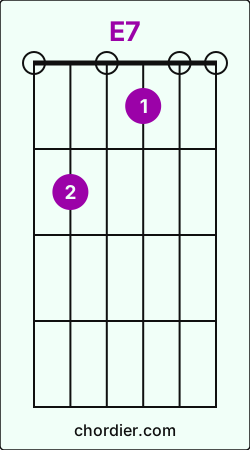 Guitar E7 chord diagram
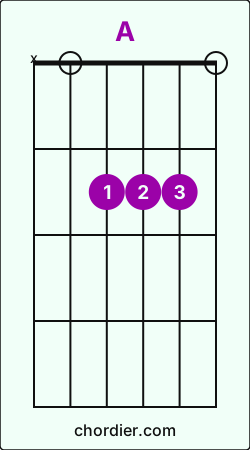 Guitar A chord diagram
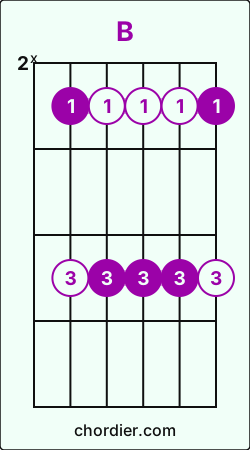 Guitar B chord diagram
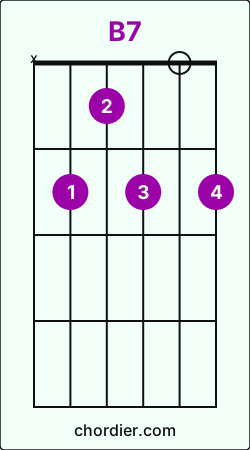 Guitar B7 chord diagram
[Opening]
[E7] [A] [E7] [A] [E7] [A] [E7]
[E7]Kadula ethin sama weyan
Api wen wamu [B]ada hawasata
Mage gepalata [A]a enawa
[B]Siri yahane [E7]thani rakinna.
[verse 2]
[E7] [A] [E7] [A] [E7] [A] [E7] [B7]
[E7] [A] [B] [E7]
[E7]Kalu walawa [A]nagennepa
Gagata udin [E7]handawata
Mudun leeya [B]yatin polawe
[B7]goma hedai [E7]aluth pitama
Kanda kapa [A]handa paya
Sada ras yaha[E7]nata wadinna
Sada aliyen [B]age gathe
[B7]Pipi gomara [E7]mal dakinna
[Closing]
[E7] [A] [E7] [A] [E7] [A] [E7] [A]
[E7] [E7]
[E7]Mal dewate [A]wathu sudu mal
Pipewi a [E7]piligannata
Kopul thala [B]omari seena
[B7]Mathu wei mal [E7]paradannata
Bilidu gena [A]kiri suwadak
Gepale dorin [E7]hama enna
Eda de yan [B]walakule
[B7]Mage sihinaye [E7]mal pipenna
How to play Kandula Ithin Samaweyan on Guitar (Step-by-step)
Keerthi Pasquel - Kandula Ithin Samaweyan on guitar requires 4 chords and 5 core chord transitions. You can find the full step-by-step guide below. Before you start, tune your instrument. The song uses the ↓-↓↑-↓↑-↓↑ pattern; practice it muted first, or simplify to downstrokes while you learn the changes.
Kandula Ithin Samaweyan uses these transitions most often: E7 → A (15), A → E7 (14), and B7 → E7 (5). These transitions may feel a little challenging at first, but with steady practice you can play this song quickly.When you are ready, begin with E7 - A chord transition.
1. E7 → A chord transition
To move from E7 to A;
- Lift your index finger from G string fret 1 and place it on D string fret 2.
- Slide your middle finger from A string fret 2 to G string fret 2.
- Place ring finger on B string fret 2.
2. E7 → B chord transition
To move from E7 to B;
- Lift your index finger from G string fret 1 and place it on E string fret 2.
- Slide your middle finger from A string fret 2 to D string fret 4.
- Place ring finger on G string fret 4.
- Place pinky on B string fret 4.
3. B → A chord transition
To move from B to A;
- While playing B, lift your pinky from B string fret 4.
- Lift your index finger from E string fret 2 and place it on D string fret 2.
- Slide your middle finger from D string fret 4 to G string fret 2.
- Lift your ring finger from G string fret 4 and place it on B string fret 2.
4. E7 → B7 chord transition
To move from E7 to B7;
- Lift your index finger from G string fret 1 and place it on D string fret 1.
- Keep middle finger on A string fret 2.
- Place ring finger on G string fret 2.
- Place pinky on E string fret 2.
5. B → B7 chord transition
To move from B to B7;
- Lift your index finger from E string fret 2 and place it on D string fret 1.
- Slide your middle finger from D string fret 4 to A string fret 2.
- Slide your ring finger on G string from fret 4 to fret 2.
- Slide your pinky from B string fret 4 to E string fret 2.
Kandula Ithin Samaweyan chord transition analysis
A short, data-driven summary of the chord flow in Kandula Ithin Samaweyan.
- Kandula Ithin Samaweyan includes 49 chord transitions, 5 of them unique.
- These transitions represent 0.01% of all chord transitions in Chordier.
- These transition patterns show how Kandula Ithin Samaweyan connects to the rest of Chordier. Mastering them helps you move to similar songs faster.After E7, the most likely next chords across Chordier are A (31%), Am (28%), and A7 (7%).
- E7 → A: 31%
- E7 → B: 3%
After A, the most likely next chords across Chordier are D (29%), G (13%), and E (12%).- A → E7: 4%
- A → B: 4%