
Taylor Swift - ME! Chords
Before you play, tune your guitar and use the tools below to set up your view and flow. Using the Transpose tool, switch to G key to play this song with easier chords.
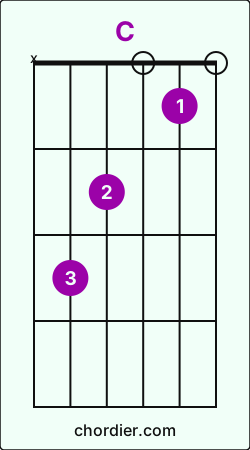 Guitar C chord diagram
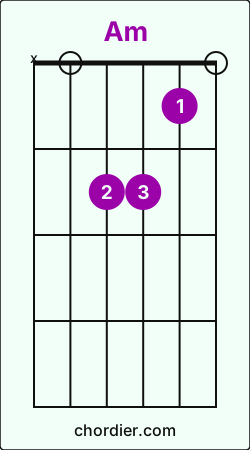 Guitar Am chord diagram
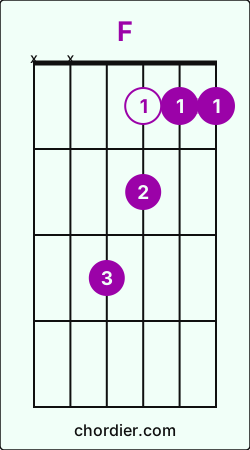 Guitar F chord diagram
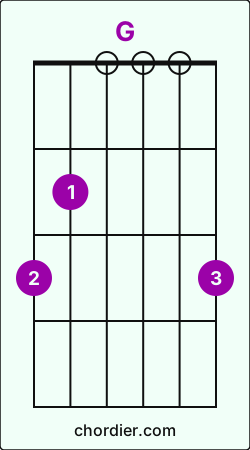 Guitar G chord diagram
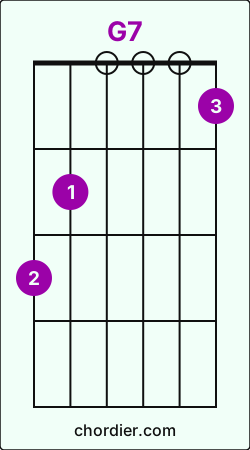 Guitar G7 chord diagram
[Opening]
I [C]promise that you’ll never find another like me
[C]I know that I’m a handful baby, [Am]uh
I know I never think before I [F]jump
And you’re the kind of guy the ladies [G]want
(And there’s a lot of cool chicks out [C]there)
[verse 2]
I know that I went psycho on the [Am]phone
I never leave well enough a[F]lone
And trouble’s gonna follow where I [G]go
(And there’s a lot of cool chicks out there)
[verse 3]
But [C]one of these things is not like the others
Like a rainbow with all of the colors
Baby doll when it comes to a lover
I [G7]promise that you’ll never find another like
[chorus]
Me [C], ooh ooh [Am]ooh ooh
[F]I’m the only one of me. [G]Baby that’s the fun of me
Me [C], ooh ooh [Am]ooh ooh
[F]You’re the only one of you. [G]Baby that’s the fun of you
And I [G7]promise that nobody’s gonna love you like me [C]
[verse 4]
I know I tend to make it about [Am]me
I know you never get just what you [F]see
But I will never bore you [G]baby
(And there’s a lot of lame guys out [C]there)
And when we had that fight out in the [Am]rain
You ran after me and called my [F]name
I never want to see you walk a[G]way
(And there’s a lot of lame guys out [C]there)
[verse 5]
‘Cause [C]one of these things is not like the others
Living in winter, I am your summer
Baby doll when it comes to a lover
I [G7]promise that you’ll never find another like
[verse 6]
Me [C], ooh ooh [Am]ooh ooh
[F]I’m the only one of me. [G]Let me keep you company
Me [C], ooh ooh [Am]ooh ooh
[F]You’re the only one of you. [G]Baby that’s the fun of you
And I [G7]promise that nobody’s gonna love you like me [C]
[verse 7]
Hey kids. Spelling is fun
[Am]Girl there ain’t no “I” in team
But you know there is a “Me”
Strike the band up 1, 2, 3
I [G7]promise that you’ll never find another like me
[Am]Girl there ain’t no “I” in team
But you know there is a “Me”
And you can’t spell awesome without me
I [G7]promise that you’ll never find another like
[chorus]
Me [C], ooh ooh [Am]ooh ooh
[F]I’m the only one of me. [G]Baby that’s the fun of me
Me [C], ooh ooh [Am]ooh ooh
[F]You’re the only one of you. [G]Baby that’s the fun of you
And I [G7]promise that nobody’s gonna love you like me [C]
[Closing]
[C]Girl there ain’t no “I” in team. [Am]But you know there is a “Me”
[F]I’m the only one of me. [G]Baby that’s the fun of me
[C]Strike the band up 1, 2, 3. You [Am]can’t spell awesome without me
[F]You’re the only one of you. [G]Baby that’s the fun of you
And I [G7]promise that nobody’s gonna love you like me [C]
How to play ME! on Guitar (Step-by-step)
Taylor Swift - ME! on guitar requires 5 chords and 7 core chord transitions. You can find the full step-by-step guide below. Before you start, tune your instrument. The song uses the ↓↑-↓↑-↓↑-↓↑ pattern; practice it muted first, or simplify to downstrokes while you learn the changes.
ME! uses these transitions most often: C → Am (13), Am → F (12), and F → G (12). These transitions may feel a little challenging at first, but with steady practice you can play this song quickly.When you are ready, begin with C - Am chord transition.
1. C → Am chord transition
To move from C to Am;
- Keep index finger on B string fret 1.
- Keep middle finger on D string fret 2.
- Lift your ring finger from A string fret 3 and place it on G string fret 2.
2. Am → F chord transition
To move from Am to F;
- Lift your index finger from B string fret 1 and place it on E string fret 1.
- Slide your middle finger from D string fret 2 to G string fret 2.
- Lift your ring finger from G string fret 2 and place it on A string fret 3.
- Place pinky on D string fret 3.
3. F → G chord transition
To move from F to G;
- While playing F, lift your pinky from D string fret 3.
- Lift your index finger from E string fret 1 and place it on A string fret 2.
- Slide your middle finger from G string fret 2 to E string fret 3.
- Lift your ring finger from A string fret 3 and place it on E string fret 3.
4. G → C chord transition
To move from G to C;
- Lift your index finger from A string fret 2 and place it on B string fret 1.
- Slide your middle finger from E string fret 3 to D string fret 2.
- Lift your ring finger from E string fret 3 and place it on A string fret 3.
5. C → G7 chord transition
To move from C to G7;
- Lift your index finger from B string fret 1 and place it on A string fret 2.
- Slide your middle finger from D string fret 2 to E string fret 3.
- Lift your ring finger from A string fret 3 and place it on E string fret 1.
6. G → G7 chord transition
To move from G to G7;
- Keep index finger on A string fret 2.
- Keep middle finger on E string fret 3.
- Slide your ring finger on E string from fret 3 to fret 1.
7. Am → G7 chord transition
To move from Am to G7;
- Lift your index finger from B string fret 1 and place it on A string fret 2.
- Slide your middle finger from D string fret 2 to E string fret 3.
- Lift your ring finger from G string fret 2 and place it on E string fret 1.
ME! chord transition analysis
A short, data-driven summary of the chord flow in ME!.
- ME! includes 61 chord transitions, 7 of them unique.
- These transitions represent 0.02% of all chord transitions in Chordier.
- ME! contains 3 of the top 10 transitions across Chordier.
- These transition patterns show how ME! connects to the rest of Chordier. Mastering them helps you move to similar songs faster.After C, the most likely next chords across Chordier are G (35%), F (16%), and D (11%).
- C → Am: 10%
- C → G7: 2%
After Am, the most likely next chords across Chordier are F (26%), G (21%), and C (16%).- Am → F: 26%
- Am → G7: 0%