
Johnny Cash - My Grandfather’s Clock Chords
Before you play, tune your guitar and use the tools below to set up your view and flow.
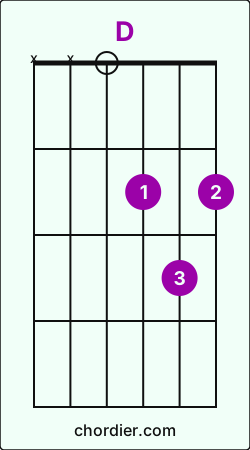 Guitar D chord diagram
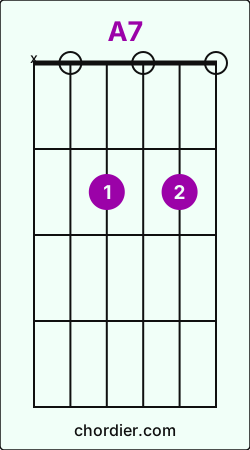 Guitar A7 chord diagram
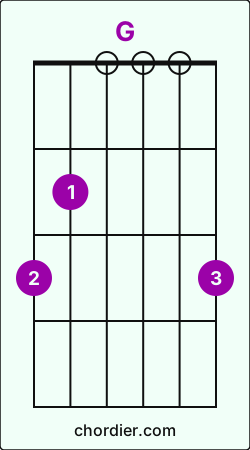 Guitar G chord diagram
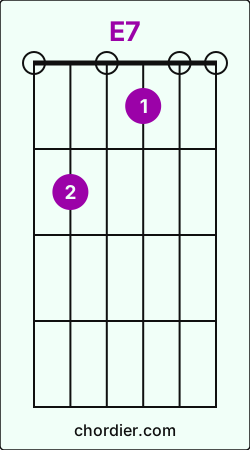 Guitar E7 chord diagram
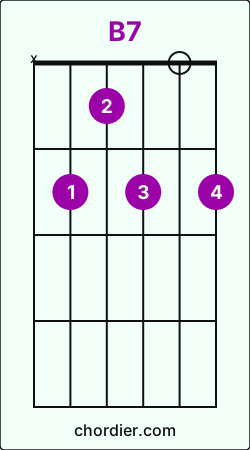 Guitar B7 chord diagram
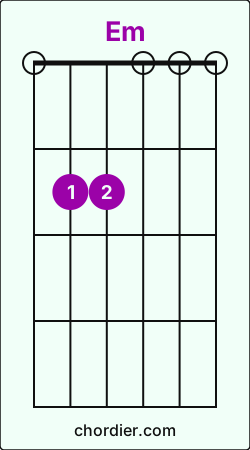 Guitar Em chord diagram
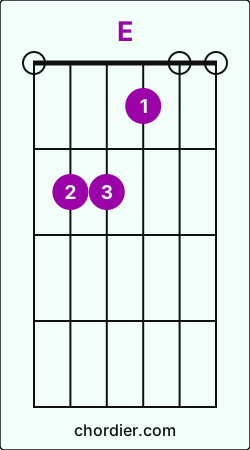 Guitar E chord diagram
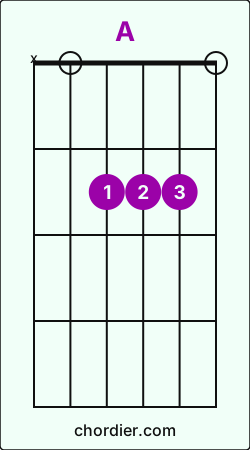 Guitar A chord diagram
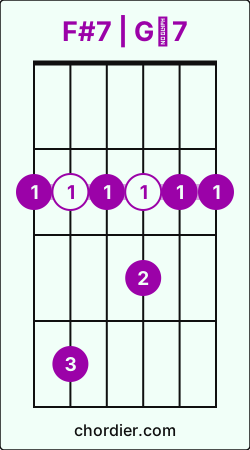 Guitar F#7 | G♭7 chord diagram
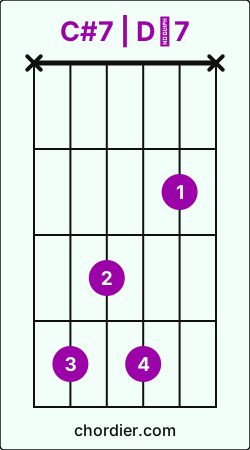 Guitar C#7 | D♭7 chord diagram
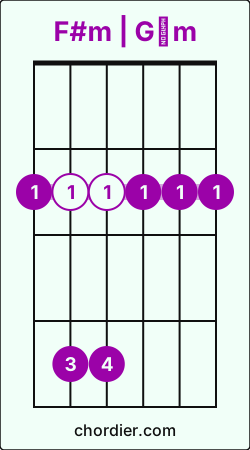 Guitar F#m | G♭m chord diagram
[Opening]
[D]Tick, [D]Tock, [D]Tick, [D]Tock, [D]Tick, [D]Tock, [D]Tick, [D]Tock
[verse 2]
[D]My grandfather’s [A7]clock was too [D]large for the [G]shelf
So it [D]stood ninety [A7]years on the [D]floor
It was taller by [A7]half, than the [D]old man him[G]self
Though it [D]weighed not a [A7]penny-weight [D]more.
It was [D]bought on the morn of the [G]day that he was [D]born
And was [D]always his [E7]treasure and [A7]pride
But it [D]stopped [A7]short [D]never to [B7]go a[Em]gain
When the [D]old [A7]man [D]died.
[verse 3]
My [D]grandfather [A7]said that of [D]those he could hire
Not a [D]servant so faith[A7]ful he [D]found
For it wasted no [A7]time and had [D]but one de[G]sire
At the [D]close of each [A7]week to be [D]wound
And it kept in its’ place not a [G]frown upon its’ [D]face
And its’ hands never [E7]hung by its [A7]side
But it [D]stopped [A7]short [D]never to [B7]go a[Em]gain
When the [D]old [A7]man [D]died.
[verse 4]
For it [D]struck twenty four when he [G]enter’d at the [D]door
With a [D]blooming and [E7]beau[A7]tiful bride
But it [D]stopped [A7]short [D]never to [B7]go a[Em]gain
When the [D]old [A7]man [D]died.
[verse 5]
It [E]rang an a[B7]larm in the [E]dead of the [A]night
An a[E]larm that for [B7]years had been [E]dumb
And we knew that his [B7]spirit was [E]pluming for [A]flight,
That his [E]hour for de[B7]parture had [E]come.
[verse 6]
Still the [E]clock kept the [E]time, with its’ [A]soft and muffled [E]chimes
As we [E]proudly [F#7]stood by his [B7]side
But it [E]stopped [B7]short [E]never to [C#7]go a[F#m]gain
When the [E]old [B7]man [E]died.
[Closing]
[E]Ninety years without slumbering, [E](Dah dah dah dah, dah dah dah!)
[E]His life seconds numbering, [E](Dah dah dah dah, dah dah dah!)
It [E]stopped [B7]short [E]never to [C#7]go a[F#m]gain
When the [E]old [B7]man [E]died.
When the [E]old [B7]man [E]died.
How to play My Grandfather's Clock on Guitar (Step-by-step)
Johnny Cash - My Grandfather's Clock on guitar requires 11 chords and 15 core chord transitions. You can find the full step-by-step guide below. Before you start, tune your instrument. The song uses the ↓-↓↑ pattern; practice it muted first, or simplify to downstrokes while you learn the changes.
My Grandfather's Clock uses these transitions most often: A7 → D (17), D → A7 (14), and B7 → E (10). These transitions may feel a little challenging at first, but with steady practice you can play this song quickly.When you are ready, begin with D - A7 chord transition.
1. D → A7 chord transition
To move from D to A7;
- While playing D, lift your ring finger from B string fret 3.
- Lift your index finger from G string fret 2 and place it on D string fret 2.
- Slide your middle finger from E string fret 2 to B string fret 2.
2. D → G chord transition
To move from D to G;
- Lift your index finger from G string fret 2 and place it on A string fret 2.
- Slide your middle finger from E string fret 2 to E string fret 3.
- Lift your ring finger from B string fret 3 and place it on E string fret 3.
3. D → E7 chord transition
To move from D to E7;
- While playing D, lift your ring finger from B string fret 3.
- Slide your index finger on G string from fret 2 to fret 1.
- Slide your middle finger from E string fret 2 to A string fret 2.
4. E7 → A7 chord transition
To move from E7 to A7;
- Lift your index finger from G string fret 1 and place it on D string fret 2.
- Slide your middle finger from A string fret 2 to B string fret 2.
5. D → B7 chord transition
To move from D to B7;
- Lift your index finger from G string fret 2 and place it on D string fret 1.
- Slide your middle finger from E string fret 2 to A string fret 2.
- Lift your ring finger from B string fret 3 and place it on G string fret 2.
- Place pinky on E string fret 2.
6. B7 → Em chord transition
To move from B7 to Em;
- While playing B7, first lift your index finger and pinky.
- Keep middle finger on A string fret 2.
- Lift your ring finger from G string fret 2 and place it on D string fret 2.
7. Em → D chord transition
To move from Em to D;
- Lift your middle finger from A string fret 2 and place it on E string fret 2.
- Slide your ring finger from D string fret 2 to B string fret 3.
- Place index finger on G string fret 2.
8. D → E chord transition
To move from D to E;
- Slide your index finger on G string from fret 2 to fret 1.
- Slide your middle finger from E string fret 2 to A string fret 2.
- Lift your ring finger from B string fret 3 and place it on D string fret 2.
9. E → B7 chord transition
To move from E to B7;
- Lift your index finger from G string fret 1 and place it on D string fret 1.
- Keep middle finger on A string fret 2.
- Slide your ring finger from D string fret 2 to G string fret 2.
- Place pinky on E string fret 2.
10. E → A chord transition
To move from E to A;
- Lift your index finger from G string fret 1 and place it on D string fret 2.
- Slide your middle finger from A string fret 2 to G string fret 2.
- Lift your ring finger from D string fret 2 and place it on B string fret 2.
11. E → F#7 chord transition
To move from E to F#7;
- Lift your index finger from G string fret 1 and place it on E string fret 2.
- Slide your middle finger from A string fret 2 to G string fret 3.
- Lift your ring finger from D string fret 2 and place it on A string fret 4.
12. F#7 → B7 chord transition
To move from F#7 to B7;
- Lift your index finger from E string fret 2 and place it on D string fret 1.
- Slide your middle finger from G string fret 3 to A string fret 2.
- Lift your ring finger from A string fret 4 and place it on G string fret 2.
- Place pinky on E string fret 2.
13. E → C#7 chord transition
To move from E to C#7;
- Lift your index finger from G string fret 1 and place it on B string fret 2.
- Slide your middle finger from A string fret 2 to D string fret 3.
- Lift your ring finger from D string fret 2 and place it on A string fret 4.
- Place pinky on G string fret 4.
14. C#7 → F#m chord transition
To move from C#7 to F#m;
- While playing C#7, lift your middle finger from D string fret 3.
- Lift your index finger from B string fret 2 and place it on E string fret 2.
- Keep ring finger on A string fret 4.
- Slide your pinky from G string fret 4 to D string fret 4.
15. F#m → E chord transition
To move from F#m to E;
- While playing F#m, lift your pinky from D string fret 4.
- Lift your index finger from E string fret 2 and place it on G string fret 1.
- Slide your ring finger from A string fret 4 to D string fret 2.
- Place middle finger on A string fret 2.
My Grandfather's Clock chord transition analysis
A short, data-driven summary of the chord flow in My Grandfather's Clock.
- My Grandfather's Clock includes 92 chord transitions, 15 of them unique.
- These transitions represent 0.02% of all chord transitions in Chordier.
- My Grandfather's Clock contains 2 of the top 10 transitions across Chordier.
- These transition patterns show how My Grandfather's Clock connects to the rest of Chordier. Mastering them helps you move to similar songs faster.After D, the most likely next chords across Chordier are G (29%), A (17%), and Em (17%).
- D → G: 29%
- D → E: 3%
After E, the most likely next chords across Chordier are A (25%), D (14%), and B (11%).- E → A: 25%
- E → B7: 0%