
Paul McCartney - My Very Good Friend the Milkman Chords
Before you play, tune your guitar and use the tools below to set up your view and flow.
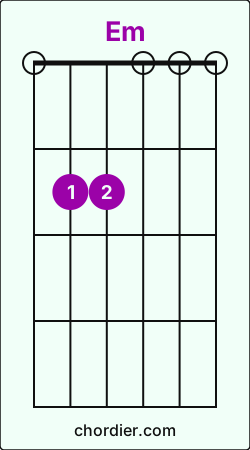 Guitar Em chord diagram
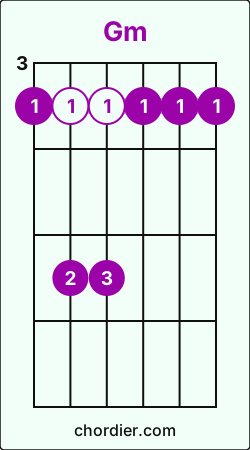 Guitar Gm chord diagram
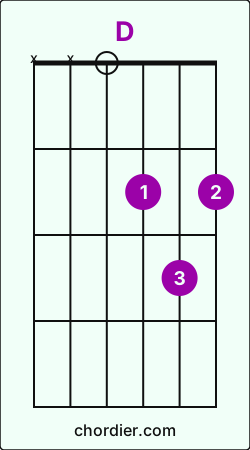 Guitar D chord diagram
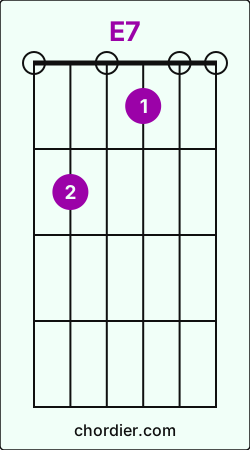 Guitar E7 chord diagram
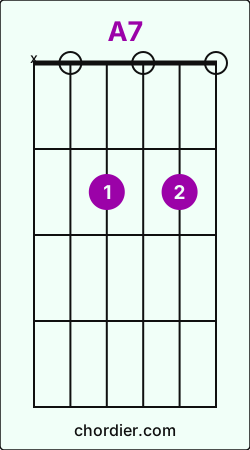 Guitar A7 chord diagram
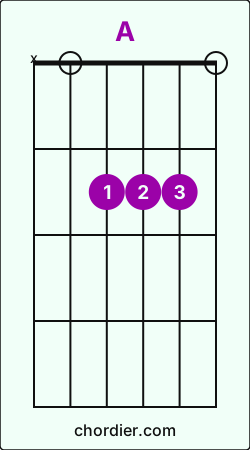 Guitar A chord diagram
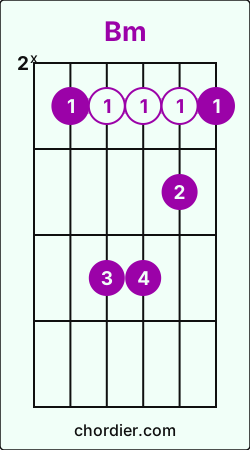 Guitar Bm chord diagram
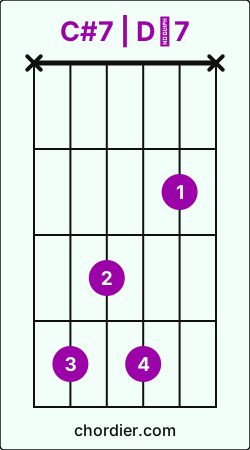 Guitar C#7 | D♭7 chord diagram
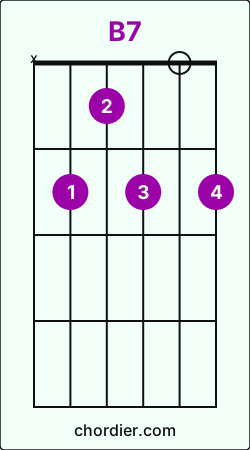 Guitar B7 chord diagram
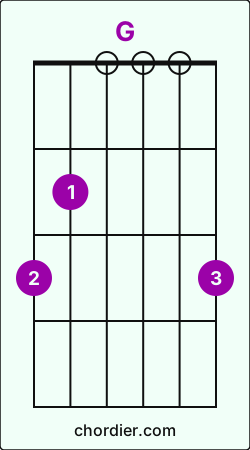 Guitar G chord diagram
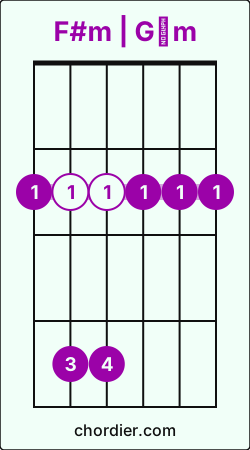 Guitar F#m | G♭m chord diagram
[Opening]
[Em]Certain people of [Gm]my acquaintance,
[D]seem very concerned about [E7]you and me,
They’re [A7]trying [A]to be [D]nice
[E7]they’re [A7]going [A]out of their [D]way
They’re [A7]giving [A]me ad[Bm]vice
There must be [E7]something in [C#7]what they [D]say
[verse 2]
[D]Oh my very good friend the [B7]milkman says
That [G]I’ve been losing [B7]too much sleep
He [G]doesn’t like the [B7]hours I keep
And he [Em]suggests that [A7]you should marry [D]me
[verse 3]
My [D]very good friend the [B7]mailman says
That [G]it would make his [B7]burden less
If we [G]both had the same [B7]address
And he [Em]suggests that [A7]you should marry [D]me
[verse 4]
And then [G]there’s a very friendly [B7]fellow who prints
[G]All the latest real estate [B7]news
And [G]every day he sends me [B7]blueprints
Of [F#m]cottages with country [A7]views
[Closing]
Oh my [D]very good friends the [B7]neighbors say
That [G]they’ve been watching little [B7]things I do
And [G]they perceive that I [B7]love you
So I [Em]suggest that [A7]you should marry [D]me
How to play My Very Good Friend the Milkman on Guitar (Step-by-step)
Paul McCartney - My Very Good Friend the Milkman on guitar requires 11 chords and 18 core chord transitions. You can find the full step-by-step guide below. Before you start, tune your instrument. The song uses the ↓-↓↑-↓↑-↓↑ pattern; practice it muted first, or simplify to downstrokes while you learn the changes.
My Very Good Friend the Milkman uses these transitions most often: G → B7 (9), B7 → G (8), and A7 → D (4). These transitions may feel a little challenging at first, but with steady practice you can play this song quickly.When you are ready, begin with Em - Gm chord transition.
1. Em → Gm chord transition
To move from Em to Gm;
- Lift your middle finger from A string fret 2 and place it on E string fret 3.
- Slide your ring finger from D string fret 2 to B string fret 3.
- Place index finger on A string fret 1.
- Place pinky on E string fret 3.
2. Gm → D chord transition
To move from Gm to D;
- While playing Gm, lift your pinky from E string fret 3.
- Lift your index finger from A string fret 1 and place it on G string fret 2.
- Slide your middle finger from E string fret 3 to E string fret 2.
- Keep ring finger on B string fret 3.
3. D → E7 chord transition
To move from D to E7;
- While playing D, lift your ring finger from B string fret 3.
- Slide your index finger on G string from fret 2 to fret 1.
- Slide your middle finger from E string fret 2 to A string fret 2.
4. E7 → A7 chord transition
To move from E7 to A7;
- Lift your index finger from G string fret 1 and place it on D string fret 2.
- Slide your middle finger from A string fret 2 to B string fret 2.
5. A7 → A chord transition
To move from A7 to A;
- Keep index finger on D string fret 2.
- Lift your middle finger from B string fret 2 and place it on G string fret 2.
- Place ring finger on B string fret 2.
6. A → D chord transition
To move from A to D;
- Lift your index finger from D string fret 2 and place it on G string fret 2.
- Slide your middle finger from G string fret 2 to E string fret 2.
- Slide your ring finger on B string from fret 2 to fret 3.
7. D → A7 chord transition
To move from D to A7;
- While playing D, lift your ring finger from B string fret 3.
- Lift your index finger from G string fret 2 and place it on D string fret 2.
- Slide your middle finger from E string fret 2 to B string fret 2.
8. A → Bm chord transition
To move from A to Bm;
- Lift your index finger from D string fret 2 and place it on E string fret 2.
- Slide your middle finger from G string fret 2 to B string fret 3.
- Lift your ring finger from B string fret 2 and place it on D string fret 4.
- Place pinky on G string fret 4.
9. Bm → E7 chord transition
To move from Bm to E7;
- While playing Bm, first lift your ring finger and pinky.
- Lift your index finger from E string fret 2 and place it on G string fret 1.
- Slide your middle finger from B string fret 3 to A string fret 2.
10. E7 → C#7 chord transition
To move from E7 to C#7;
- Lift your index finger from G string fret 1 and place it on B string fret 2.
- Slide your middle finger from A string fret 2 to D string fret 3.
- Place ring finger on A string fret 4.
- Place pinky on G string fret 4.
11. C#7 → D chord transition
To move from C#7 to D;
- While playing C#7, lift your pinky from G string fret 4.
- Lift your index finger from B string fret 2 and place it on G string fret 2.
- Slide your middle finger from D string fret 3 to E string fret 2.
- Lift your ring finger from A string fret 4 and place it on B string fret 3.
12. D → B7 chord transition
To move from D to B7;
- Lift your index finger from G string fret 2 and place it on D string fret 1.
- Slide your middle finger from E string fret 2 to A string fret 2.
- Lift your ring finger from B string fret 3 and place it on G string fret 2.
- Place pinky on E string fret 2.
13. B7 → G chord transition
To move from B7 to G;
- While playing B7, lift your pinky from E string fret 2.
- Lift your index finger from D string fret 1 and place it on A string fret 2.
- Slide your middle finger from A string fret 2 to E string fret 3.
- Lift your ring finger from G string fret 2 and place it on E string fret 3.
14. B7 → Em chord transition
To move from B7 to Em;
- While playing B7, first lift your index finger and pinky.
- Keep middle finger on A string fret 2.
- Lift your ring finger from G string fret 2 and place it on D string fret 2.
15. Em → A7 chord transition
To move from Em to A7;
- While playing Em, lift your ring finger from D string fret 2.
- Lift your middle finger from A string fret 2 and place it on B string fret 2.
- Place index finger on D string fret 2.
16. D → G chord transition
To move from D to G;
- Lift your index finger from G string fret 2 and place it on A string fret 2.
- Slide your middle finger from E string fret 2 to E string fret 3.
- Lift your ring finger from B string fret 3 and place it on E string fret 3.
17. B7 → F#m chord transition
To move from B7 to F#m;
- While playing B7, lift your middle finger from A string fret 2.
- Lift your index finger from D string fret 1 and place it on E string fret 2.
- Slide your ring finger from G string fret 2 to A string fret 4.
- Lift your pinky from E string fret 2 and place it on D string fret 4.
18. F#m → A7 chord transition
To move from F#m to A7;
- While playing F#m, first lift your ring finger and pinky.
- Lift your index finger from E string fret 2 and place it on D string fret 2.
- Place middle finger on B string fret 2.
My Very Good Friend the Milkman chord transition analysis
A short, data-driven summary of the chord flow in My Very Good Friend the Milkman.
- My Very Good Friend the Milkman includes 49 chord transitions, 18 of them unique.
- These transitions represent 0.01% of all chord transitions in Chordier.
- My Very Good Friend the Milkman contains 2 of the top 10 transitions across Chordier.
- These transition patterns show how My Very Good Friend the Milkman connects to the rest of Chordier. Mastering them helps you move to similar songs faster.After B7, the most likely next chords across Chordier are Em (58%), E7 (10%), and C (8%).
- B7 → Em: 58%
- B7 → G: 4%
After D, the most likely next chords across Chordier are G (29%), A (17%), and Em (17%).- D → G: 29%
- D → A7: 1%