
Bruno Major - Nothing Chords
Before you play, tune your guitar and use the tools below to set up your view and flow.
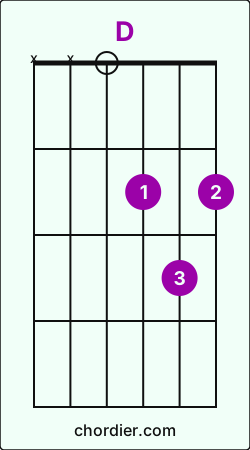 Guitar D chord diagram
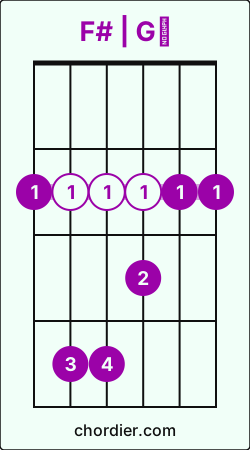 Guitar F# | G♭ chord diagram
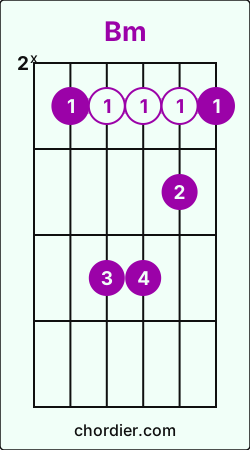 Guitar Bm chord diagram
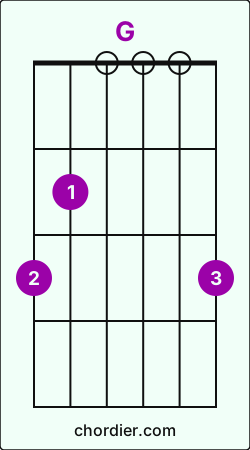 Guitar G chord diagram
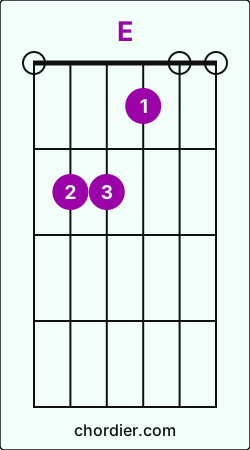 Guitar E chord diagram
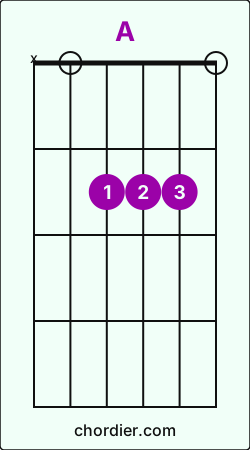 Guitar A chord diagram
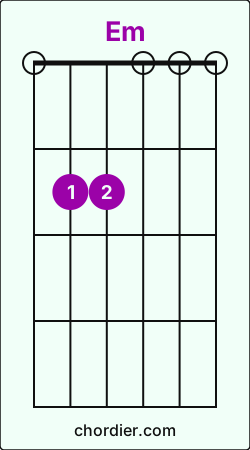 Guitar Em chord diagram
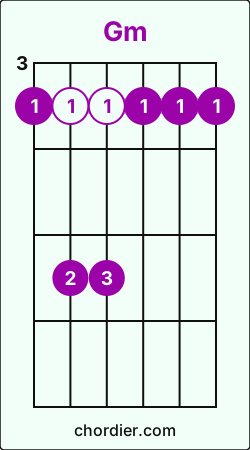 Guitar Gm chord diagram
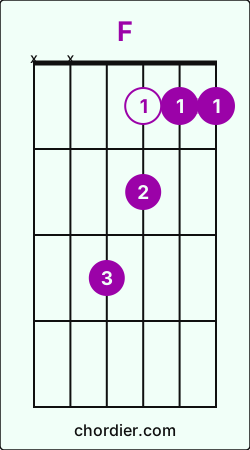 Guitar F chord diagram
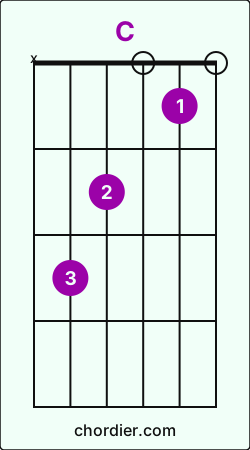 Guitar C chord diagram
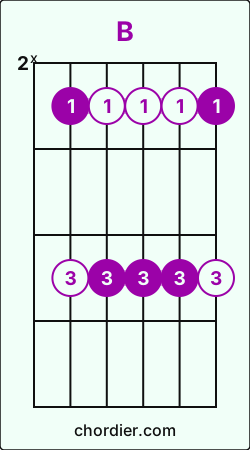 Guitar B chord diagram
[Opening]
[D]Track suits and [F#]red wine, [Bm]movies for [D]two
We’ll [G]turn off our [D]phones, and we’ll [E]take off our [A]shoes
[D]We’ll play [F#]Nintendo, and [Bm]I’ll always [D]lose
Cause [G]you’ll watch the [D]TV, whilst [E]I’m watching [A]you
[verse 2]
Though we [D]might not be [F#]dancing, by the [Bm]light of the [D]moon, [G][E]mmm
But there’s [Em]nothing, like doing [Gm]nothing, with [D]you
[verse 3]
[D]Dumb [F#]conversations, we [Bm]lose track of [D]time
Have [G]I told you [D]lately, I’m [E]grateful you’re [A]mine
[D]We’ll watch the [F#]Notebook, for the [Bm]seventeenth [D]time
[G]I’ll say “It’s [D]stupid”, then [E]you’ll catch me [A]crying
[verse 4]
Though we’re [D]not making [F#]out, on a [Bm]boat in the [D]rain
Or in a [G]house I’ve painted [E]blue, there’s [Em]nothing
Like doing [Gm]nothing, with [D]you
[verse 5]
So [Bm]shut all the windows, and [F#]lock all the doors
We’re not [D]looking for no one, we don’t [E]need nothing more
[Bm]You’ll bite my lip and, [F#]I’ll want you more
[D]Until we end up, in a [E]heap in the floor
[F][C]Mmm [F#] [B] [Em] [A]
[Closing]
You could be [D]dancing on [F#]table tops, [Bm]wearing [D]high-heels
[G]Drinking [D]until the world, [E]spins like a [A]wheel
But [D]tonight my [F#]apartment, had [Bm]so much [D]appeal, [G][E]mmm
And there’s [Em]nothing, like doing [Gm]nothing, with [Bm]you, [E]mmm
No, there’s [G]nothing, like doing [A]nothing, with [D]you
How to play Nothing on Guitar (Step-by-step)
Bruno Major - Nothing on guitar requires 11 chords and 20 core chord transitions. You can find the full step-by-step guide below. Before you start, tune your instrument. The song uses the ↓-↓↑-↓↑-↓↑ pattern; practice it muted first, or simplify to downstrokes while you learn the changes.
Nothing uses these transitions most often: Bm → D (8), D → F# (8), and D → G (8). These transitions may feel a little challenging at first, but with steady practice you can play this song quickly.When you are ready, begin with D - F# chord transition.
1. D → F# chord transition
To move from D to F#;
- Lift your index finger from G string fret 2 and place it on E string fret 2.
- Slide your middle finger from E string fret 2 to G string fret 3.
- Lift your ring finger from B string fret 3 and place it on A string fret 4.
- Place pinky on D string fret 4.
2. F# → Bm chord transition
To move from F# to Bm;
- Keep index finger on E string fret 2.
- Lift your middle finger from G string fret 3 and place it on B string fret 3.
- Slide your ring finger from A string fret 4 to D string fret 4.
- Lift your pinky from D string fret 4 and place it on G string fret 4.
3. Bm → D chord transition
To move from Bm to D;
- While playing Bm, lift your pinky from G string fret 4.
- Lift your index finger from E string fret 2 and place it on G string fret 2.
- Slide your middle finger from B string fret 3 to E string fret 2.
- Lift your ring finger from D string fret 4 and place it on B string fret 3.
4. D → G chord transition
To move from D to G;
- Lift your index finger from G string fret 2 and place it on A string fret 2.
- Slide your middle finger from E string fret 2 to E string fret 3.
- Lift your ring finger from B string fret 3 and place it on E string fret 3.
5. D → E chord transition
To move from D to E;
- Slide your index finger on G string from fret 2 to fret 1.
- Slide your middle finger from E string fret 2 to A string fret 2.
- Lift your ring finger from B string fret 3 and place it on D string fret 2.
6. E → A chord transition
To move from E to A;
- Lift your index finger from G string fret 1 and place it on D string fret 2.
- Slide your middle finger from A string fret 2 to G string fret 2.
- Lift your ring finger from D string fret 2 and place it on B string fret 2.
7. A → D chord transition
To move from A to D;
- Lift your index finger from D string fret 2 and place it on G string fret 2.
- Slide your middle finger from G string fret 2 to E string fret 2.
- Slide your ring finger on B string from fret 2 to fret 3.
8. G → E chord transition
To move from G to E;
- Lift your index finger from A string fret 2 and place it on G string fret 1.
- Slide your middle finger from E string fret 3 to A string fret 2.
- Lift your ring finger from E string fret 3 and place it on D string fret 2.
9. E → Em chord transition
To move from E to Em;
- While playing E, lift your index finger from G string fret 1.
- Keep middle finger on A string fret 2.
- Keep ring finger on D string fret 2.
10. Em → Gm chord transition
To move from Em to Gm;
- Lift your middle finger from A string fret 2 and place it on E string fret 3.
- Slide your ring finger from D string fret 2 to B string fret 3.
- Place index finger on A string fret 1.
- Place pinky on E string fret 3.
11. Gm → D chord transition
To move from Gm to D;
- While playing Gm, lift your pinky from E string fret 3.
- Lift your index finger from A string fret 1 and place it on G string fret 2.
- Slide your middle finger from E string fret 3 to E string fret 2.
- Keep ring finger on B string fret 3.
12. E → Bm chord transition
To move from E to Bm;
- Lift your index finger from G string fret 1 and place it on E string fret 2.
- Slide your middle finger from A string fret 2 to B string fret 3.
- Slide your ring finger on D string from fret 2 to fret 4.
- Place pinky on G string fret 4.
13. E → F chord transition
To move from E to F;
- Lift your index finger from G string fret 1 and place it on E string fret 1.
- Slide your middle finger from A string fret 2 to G string fret 2.
- Lift your ring finger from D string fret 2 and place it on A string fret 3.
- Place pinky on D string fret 3.
14. F → C chord transition
To move from F to C;
- While playing F, lift your pinky from D string fret 3.
- Lift your index finger from E string fret 1 and place it on B string fret 1.
- Slide your middle finger from G string fret 2 to D string fret 2.
- Keep ring finger on A string fret 3.
15. C → F# chord transition
To move from C to F#;
- Lift your index finger from B string fret 1 and place it on E string fret 2.
- Slide your middle finger from D string fret 2 to G string fret 3.
- Slide your ring finger on A string from fret 3 to fret 4.
- Place pinky on D string fret 4.
16. F# → B chord transition
To move from F# to B;
- Keep index finger on E string fret 2.
- Lift your middle finger from G string fret 3 and place it on D string fret 4.
- Slide your ring finger from A string fret 4 to G string fret 4.
- Lift your pinky from D string fret 4 and place it on B string fret 4.
17. B → Em chord transition
To move from B to Em;
- While playing B, first lift your index finger and pinky.
- Lift your middle finger from D string fret 4 and place it on A string fret 2.
- Slide your ring finger from G string fret 4 to D string fret 2.
18. Em → A chord transition
To move from Em to A;
- Lift your middle finger from A string fret 2 and place it on G string fret 2.
- Slide your ring finger from D string fret 2 to B string fret 2.
- Place index finger on D string fret 2.
19. Gm → Bm chord transition
To move from Gm to Bm;
- Lift your index finger from A string fret 1 and place it on E string fret 2.
- Slide your middle finger from E string fret 3 to B string fret 3.
- Lift your ring finger from B string fret 3 and place it on D string fret 4.
- Slide your pinky from E string fret 3 to G string fret 4.
20. G → A chord transition
To move from G to A;
- Lift your index finger from A string fret 2 and place it on D string fret 2.
- Slide your middle finger from E string fret 3 to G string fret 2.
- Lift your ring finger from E string fret 3 and place it on B string fret 2.
Nothing chord transition analysis
A short, data-driven summary of the chord flow in Nothing.
- Nothing includes 83 chord transitions, 20 of them unique.
- These transitions represent 0.02% of all chord transitions in Chordier.
- Nothing contains 3 of the top 10 transitions across Chordier.
- These transition patterns show how Nothing connects to the rest of Chordier. Mastering them helps you move to similar songs faster.After D, the most likely next chords across Chordier are G (29%), A (17%), and Em (17%).
- D → G: 29%
- D → Bm: 5%
After F#, the most likely next chords across Chordier are B (19%), Bm (15%), and E (13%).- F# → B: 19%
- F# → Bm: 15%