
Taylor Swift - Nothing New Chords
Before you play, tune your guitar and use the tools below to set up your view and flow.
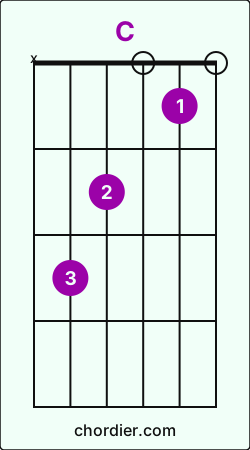 Guitar C chord diagram
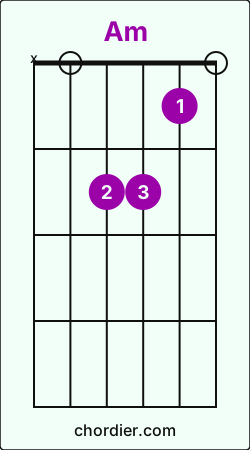 Guitar Am chord diagram
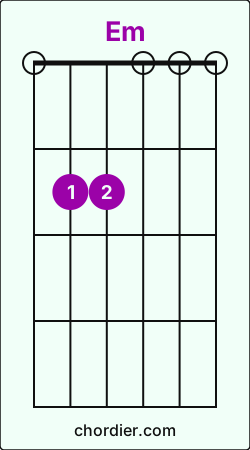 Guitar Em chord diagram
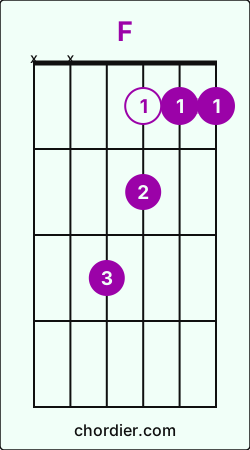 Guitar F chord diagram
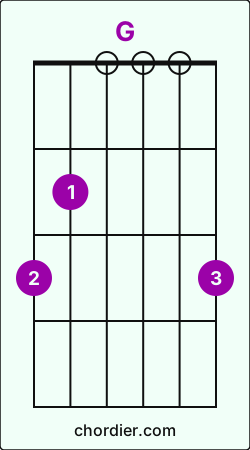 Guitar G chord diagram
[Opening]
They tell you while you’re [C]young, girls, go out and have your [Am]fun
Then they hunt and slay the [Em]ones, who [F]actually do [G]it
Criticize the way you [C]fly, when you’re soaring through the [Am]sky
Shoot you down and then they [Em]sigh, and say, “She [F]looks like she’s been [G]through it”
[verse 2]
Lord what will become of [F]me, once I’ve lost my [G]novelty
[chorus]
[F]I’ve had [G]too much to [C]drink tonight,
And I [G]know it’s sad but [Am]this is what I think about
And I [F]wake up [G]in the middle of the [C]night, it’s like [G]I can [Am]feel time moving
[F]How can a person know [G]everything at 18, but [C]nothing [G]at [Am]22?
And will you [F]still want me, [G]when I’m nothing new?
[verse 3]
[C]How long will it be cute, all this crying in my [Am]room
When you can’t blame it on my [Em]youth, and roll your [F]eyes with [G]affection
And my cheeks are growing [C]tired, from turning red and faking [Am]smiles
Are we only biding [Em]time till I [F]lose your [G]attention?
[verse 4]
And someone else lights up the [F]room, people love an [G]ingénue
[chorus]
[F]I’ve had [G]too much to [C]drink tonight,
And I [G]know it’s sad but [Am]this is what I think about
And I [F]wake up [G]in the middle of the [C]night, it’s like [G]I can [Am]feel time moving
[F]How can a person know [G]everything at 18, but [C]nothing [G]at [Am]22?
And will you [F]still want me, [G]when I’m nothing new?
[verse 5]
[C]
I [F]know someday I’m gonna meet her, it’s a [G]fever dream
[F]The kind of radiance you only have at [G]seventeen
[F]She’ll know the way and then she’ll say she got the [G]map from me
[F]I’ll say I’m happy for her then I’ll cry [G]myself to [C]sleep
[verse 6]
[Am]Ooh, [Em]ooh, [F]ooh, [C]ooh, [Am]ooh, [Em]ooh, [F]ooh
[Closing]
I’ve had [G]too much to [C]drink tonight,
But I [G]wonder if they’ll [Am]miss me once they drive me [F]out
I wake up (wake up) [G]in the middle of the [C]night, and I can [G]feel time [Am]moving
[F]How can a person know [G]everything at 18, but [C]nothing [G]at [Am]22?
And will you [F]still want [G]me, will you [C]still want [Am]me
Will you [F]still want me, [G]when I’m nothing new?
How to play Nothing New on Guitar (Step-by-step)
Taylor Swift - Nothing New on guitar requires 5 chords and 8 core chord transitions. You can find the full step-by-step guide below. Before you start, tune your instrument. The song uses the ↓-↓↑-↑↓↑ pattern; practice it muted first, or simplify to downstrokes while you learn the changes.
Nothing New uses these transitions most often: F → G (23), G → C (15), and Am → F (10). These transitions may feel a little challenging at first, but with steady practice you can play this song quickly.When you are ready, begin with C - Am chord transition.
1. C → Am chord transition
To move from C to Am;
- Keep index finger on B string fret 1.
- Keep middle finger on D string fret 2.
- Lift your ring finger from A string fret 3 and place it on G string fret 2.
2. Am → Em chord transition
To move from Am to Em;
- While playing Am, lift your index finger from B string fret 1.
- Lift your middle finger from D string fret 2 and place it on A string fret 2.
- Slide your ring finger from G string fret 2 to D string fret 2.
3. Em → F chord transition
To move from Em to F;
- Lift your middle finger from A string fret 2 and place it on G string fret 2.
- Slide your ring finger from D string fret 2 to A string fret 3.
- Place index finger on E string fret 1.
- Place pinky on D string fret 3.
4. F → G chord transition
To move from F to G;
- While playing F, lift your pinky from D string fret 3.
- Lift your index finger from E string fret 1 and place it on A string fret 2.
- Slide your middle finger from G string fret 2 to E string fret 3.
- Lift your ring finger from A string fret 3 and place it on E string fret 3.
5. G → C chord transition
To move from G to C;
- Lift your index finger from A string fret 2 and place it on B string fret 1.
- Slide your middle finger from E string fret 3 to D string fret 2.
- Lift your ring finger from E string fret 3 and place it on A string fret 3.
6. G → Am chord transition
To move from G to Am;
- Lift your index finger from A string fret 2 and place it on B string fret 1.
- Slide your middle finger from E string fret 3 to D string fret 2.
- Lift your ring finger from E string fret 3 and place it on G string fret 2.
7. Am → F chord transition
To move from Am to F;
- Lift your index finger from B string fret 1 and place it on E string fret 1.
- Slide your middle finger from D string fret 2 to G string fret 2.
- Lift your ring finger from G string fret 2 and place it on A string fret 3.
- Place pinky on D string fret 3.
8. C → F chord transition
To move from C to F;
- Lift your index finger from B string fret 1 and place it on E string fret 1.
- Slide your middle finger from D string fret 2 to G string fret 2.
- Keep ring finger on A string fret 3.
- Place pinky on D string fret 3.
Nothing New chord transition analysis
A short, data-driven summary of the chord flow in Nothing New.
- Nothing New includes 94 chord transitions, 8 of them unique.
- These transitions represent 0.03% of all chord transitions in Chordier.
- Nothing New contains 5 of the top 10 transitions across Chordier.
- These transition patterns show how Nothing New connects to the rest of Chordier. Mastering them helps you move to similar songs faster.After G, the most likely next chords across Chordier are C (25%), D (24%), and Am (13%).
- G → C: 25%
- G → Am: 13%
After F, the most likely next chords across Chordier are C (40%), G (21%), and Am (11%).- F → C: 40%
- F → G: 21%