
Moonstar88 - Panalangin Chords
Before you play, tune your guitar and use the tools below to set up your view and flow.
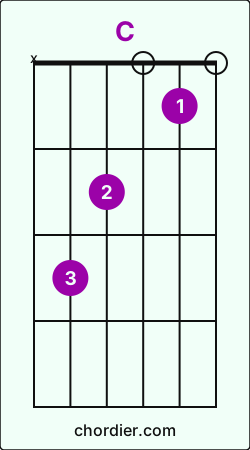 Guitar C chord diagram
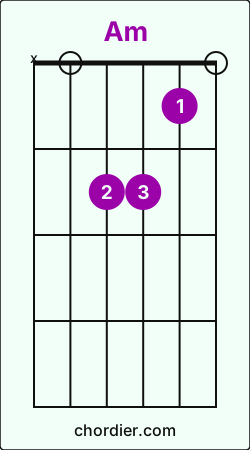 Guitar Am chord diagram
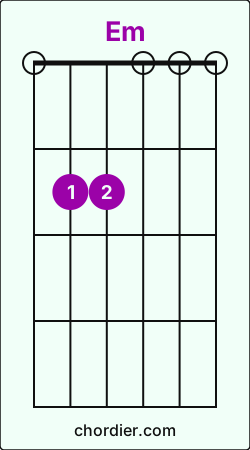 Guitar Em chord diagram
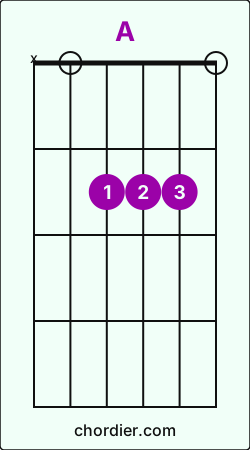 Guitar A chord diagram
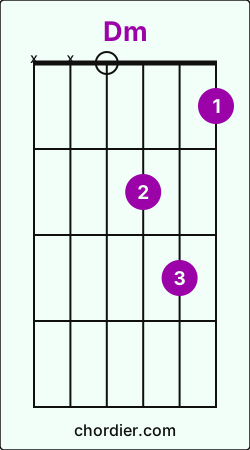 Guitar Dm chord diagram
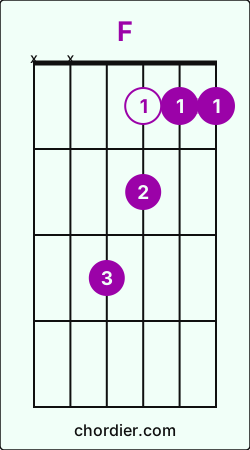 Guitar F chord diagram
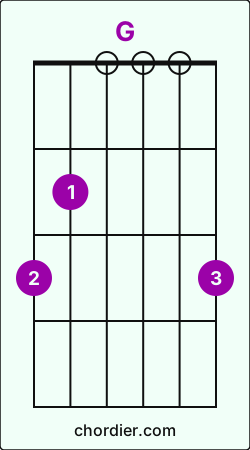 Guitar G chord diagram
[Opening]
[C]Pana[Am]langin ko sa [Em]habang [A]buhay.
[Dm]Makapiling ka [Em]Makasama ka.
[F]Yan ang panalangin [G]ko.
[C]At hin[Am]di papayag [Em]ang pusong [A]itong.
[Dm]Mawala ka sa [Em]’king piling.
[F]Mahal ko iyong ding[G]gin.
[Closing]
[F]Wala nang iba pang [Em]mas mahala[Am]ga.
[Dm]Sa tamis na dulot [Em]ng pag-ibig [F]natin dal’wa.
[F]At sana nama’y [Em]makikinig [Am]ka.
[Dm]Kapag aking sabi[Em]hing minama[F]hal kita. [G]
How to play Panalangin on Guitar (Step-by-step)
Moonstar88 - Panalangin on guitar requires 7 chords and 9 core chord transitions. You can find the full step-by-step guide below. Before you start, tune your instrument. The song uses the ↓-↓↑-↑↓↑ pattern; practice it muted first, or simplify to downstrokes while you learn the changes.
Panalangin uses these transitions most often: Dm → Em (4), Em → F (4), and F → G (3). These transitions may feel a little challenging at first, but with steady practice you can play this song quickly.When you are ready, begin with C - Am chord transition.
1. C → Am chord transition
To move from C to Am;
- Keep index finger on B string fret 1.
- Keep middle finger on D string fret 2.
- Lift your ring finger from A string fret 3 and place it on G string fret 2.
2. Am → Em chord transition
To move from Am to Em;
- While playing Am, lift your index finger from B string fret 1.
- Lift your middle finger from D string fret 2 and place it on A string fret 2.
- Slide your ring finger from G string fret 2 to D string fret 2.
3. Em → A chord transition
To move from Em to A;
- Lift your middle finger from A string fret 2 and place it on G string fret 2.
- Slide your ring finger from D string fret 2 to B string fret 2.
- Place index finger on D string fret 2.
4. A → Dm chord transition
To move from A to Dm;
- Lift your index finger from D string fret 2 and place it on E string fret 1.
- Keep middle finger on G string fret 2.
- Slide your ring finger on B string from fret 2 to fret 3.
5. Dm → Em chord transition
To move from Dm to Em;
- While playing Dm, lift your index finger from E string fret 1.
- Lift your middle finger from G string fret 2 and place it on A string fret 2.
- Slide your ring finger from B string fret 3 to D string fret 2.
6. Em → F chord transition
To move from Em to F;
- Lift your middle finger from A string fret 2 and place it on G string fret 2.
- Slide your ring finger from D string fret 2 to A string fret 3.
- Place index finger on E string fret 1.
- Place pinky on D string fret 3.
7. F → G chord transition
To move from F to G;
- While playing F, lift your pinky from D string fret 3.
- Lift your index finger from E string fret 1 and place it on A string fret 2.
- Slide your middle finger from G string fret 2 to E string fret 3.
- Lift your ring finger from A string fret 3 and place it on E string fret 3.
8. G → C chord transition
To move from G to C;
- Lift your index finger from A string fret 2 and place it on B string fret 1.
- Slide your middle finger from E string fret 3 to D string fret 2.
- Lift your ring finger from E string fret 3 and place it on A string fret 3.
9. Am → Dm chord transition
To move from Am to Dm;
- Lift your index finger from B string fret 1 and place it on E string fret 1.
- Slide your middle finger from D string fret 2 to G string fret 2.
- Lift your ring finger from G string fret 2 and place it on B string fret 3.
Panalangin chord transition analysis
A short, data-driven summary of the chord flow in Panalangin.
- Panalangin includes 27 chord transitions, 9 of them unique.
- These transitions represent 0.01% of all chord transitions in Chordier.
- Panalangin contains 2 of the top 10 transitions across Chordier.
- These transition patterns show how Panalangin connects to the rest of Chordier. Mastering them helps you move to similar songs faster.After Em, the most likely next chords across Chordier are C (26%), G (18%), and D (17%).
- Em → Am: 12%
- Em → F: 8%
After F, the most likely next chords across Chordier are C (40%), G (21%), and Am (11%).- F → G: 21%
- F → Em: 3%