
Green Day - Restless Heart Syndrome Chords
Before you play, tune your guitar and use the tools below to set up your view and flow.
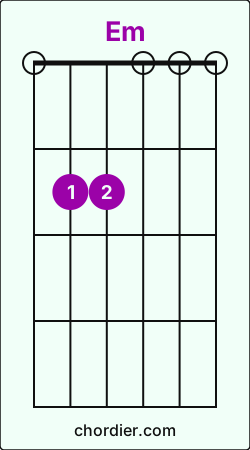 Guitar Em chord diagram
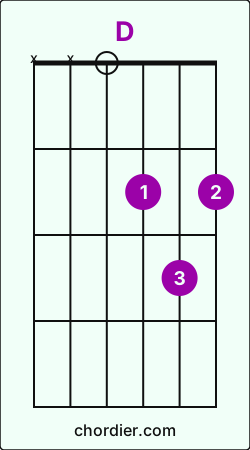 Guitar D chord diagram
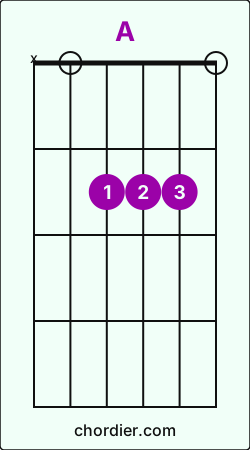 Guitar A chord diagram
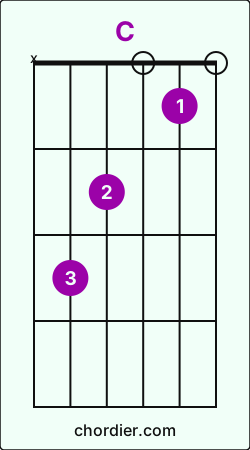 Guitar C chord diagram
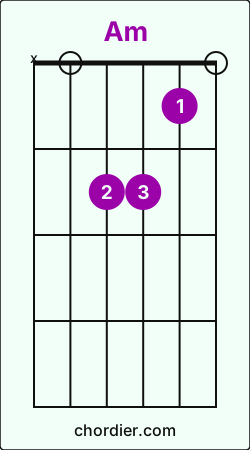 Guitar Am chord diagram
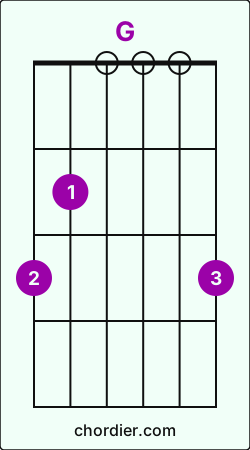 Guitar G chord diagram
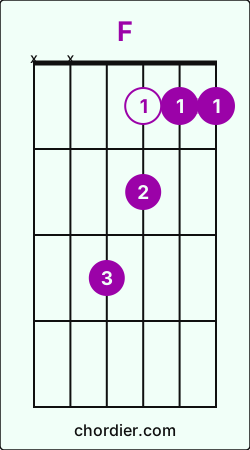 Guitar F chord diagram
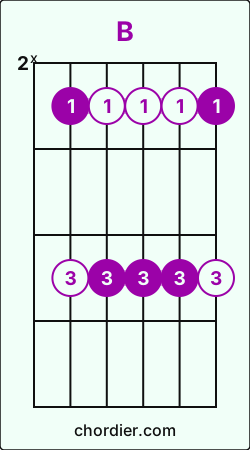 Guitar B chord diagram
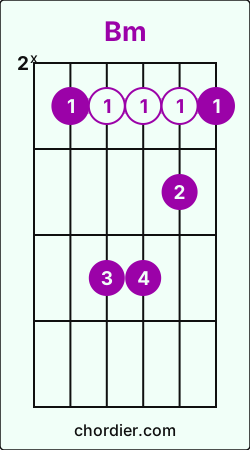 Guitar Bm chord diagram
[Opening]
[Em]I’ve got a [D]really bad [A][C]disease
[Em]It’s got me [D]begging on my [A]hands and [C]knees
So [Em]take me [D]to [A][C]emergency
[Em]Cause something [D]seems to be [A]missing [C]
[verse 2]
[Em]Somebody [D]take the pain [A]away [C]
[Em]It’s like an [D]ulcer bleeding [A]in my [C]brain
So [Em]send me [D]to the [A] [C]pharmacy
[Em]So I can [D]lose my [A]memory [C]
[verse 3]
[Am]I’m [G]elated [D] [F]Medicated
[Am]Lord knows I [G]tried to find a [D]way [F]to run [B]away
[verse 4]
[Em]I think they [D]found another [A]cure [C]
[Em]For broken [D]hearts and feeling [A] [C]insecure
You’d [Em]be [D]surprised what [A]I [C]endure
[Em]What makes you [D]feel so [A]self-as[C]sured?
[verse 5]
[Em]I need to [D]find a place to [A]hide [C]
[Em]You never [D]know what could be [A]waiting [C]outside
The [Em] [D]accidents that [A]you could [C]find
[Em]It’s like some [D]kind of [A]suicide [C]
[verse 6]
[Am]So what [G]ails you [D]is what [F]impales you
[Am]I feel like [G]I’ve been [D]crucified [F]to be [B]satisfied
[verse 7]
[Em]I’m a victim [D]of my symptom
[A]I am my [Am]own worst [D]enemy [B]
[Em]You’re a victim [D]of your symptom
[A]You are your [Am]own worst [D]enemy [B]Know your enemy
[verse 8]
[Em]I’m elated [D]Medicated
[A]I am my [Am]own worst [D]enemy [B]
[Em]So what ails you, [D]is what impales you
[A]You are your [Am]own worst [D]enemy [B]
[Closing]
[Em]You’re a victim [D]of the system
[A]You are your [Am]own worst [D]enemy [B]
[Em]You’re a victim [D]of the system
[A]You are your [Am]own worst [D]enemy [B]
[outro]
[Em] [Em] [C] [C] [Bm] [Em] [Em] [Em] [Em] [Em]
How to play Restless Heart Syndrome on Guitar (Step-by-step)
Green Day - Restless Heart Syndrome on guitar requires 9 chords and 16 core chord transitions. You can find the full step-by-step guide below. Before you start, tune your instrument. The song uses the ↓-↓↑-↓↑-↓↑ pattern; practice it muted first, or simplify to downstrokes while you learn the changes.
Restless Heart Syndrome uses these transitions most often: D → A (22), Em → D (22), and A → C (16). These transitions may feel a little challenging at first, but with steady practice you can play this song quickly.When you are ready, begin with Em - D chord transition.
1. Em → D chord transition
To move from Em to D;
- Lift your middle finger from A string fret 2 and place it on E string fret 2.
- Slide your ring finger from D string fret 2 to B string fret 3.
- Place index finger on G string fret 2.
2. D → A chord transition
To move from D to A;
- Lift your index finger from G string fret 2 and place it on D string fret 2.
- Slide your middle finger from E string fret 2 to G string fret 2.
- Slide your ring finger on B string from fret 3 to fret 2.
3. A → C chord transition
To move from A to C;
- Lift your index finger from D string fret 2 and place it on B string fret 1.
- Slide your middle finger from G string fret 2 to D string fret 2.
- Lift your ring finger from B string fret 2 and place it on A string fret 3.
4. C → Em chord transition
To move from C to Em;
- While playing C, lift your index finger from B string fret 1.
- Lift your middle finger from D string fret 2 and place it on A string fret 2.
- Slide your ring finger from A string fret 3 to D string fret 2.
5. C → Am chord transition
To move from C to Am;
- Keep index finger on B string fret 1.
- Keep middle finger on D string fret 2.
- Lift your ring finger from A string fret 3 and place it on G string fret 2.
6. Am → G chord transition
To move from Am to G;
- Lift your index finger from B string fret 1 and place it on A string fret 2.
- Slide your middle finger from D string fret 2 to E string fret 3.
- Lift your ring finger from G string fret 2 and place it on E string fret 3.
7. G → D chord transition
To move from G to D;
- Lift your index finger from A string fret 2 and place it on G string fret 2.
- Slide your middle finger from E string fret 3 to E string fret 2.
- Lift your ring finger from E string fret 3 and place it on B string fret 3.
8. D → F chord transition
To move from D to F;
- Lift your index finger from G string fret 2 and place it on E string fret 1.
- Slide your middle finger from E string fret 2 to G string fret 2.
- Lift your ring finger from B string fret 3 and place it on A string fret 3.
- Place pinky on D string fret 3.
9. F → Am chord transition
To move from F to Am;
- While playing F, lift your pinky from D string fret 3.
- Lift your index finger from E string fret 1 and place it on B string fret 1.
- Slide your middle finger from G string fret 2 to D string fret 2.
- Lift your ring finger from A string fret 3 and place it on G string fret 2.
10. F → B chord transition
To move from F to B;
- Slide your index finger on E string from fret 1 to fret 2.
- Slide your middle finger from G string fret 2 to D string fret 4.
- Lift your ring finger from A string fret 3 and place it on G string fret 4.
- Slide your pinky from D string fret 3 to B string fret 4.
11. B → Em chord transition
To move from B to Em;
- While playing B, first lift your index finger and pinky.
- Lift your middle finger from D string fret 4 and place it on A string fret 2.
- Slide your ring finger from G string fret 4 to D string fret 2.
12. A → Am chord transition
To move from A to Am;
- Lift your index finger from D string fret 2 and place it on B string fret 1.
- Slide your middle finger from G string fret 2 to D string fret 2.
- Lift your ring finger from B string fret 2 and place it on G string fret 2.
13. Am → D chord transition
To move from Am to D;
- Lift your index finger from B string fret 1 and place it on G string fret 2.
- Slide your middle finger from D string fret 2 to E string fret 2.
- Lift your ring finger from G string fret 2 and place it on B string fret 3.
14. D → B chord transition
To move from D to B;
- Lift your index finger from G string fret 2 and place it on E string fret 2.
- Slide your middle finger from E string fret 2 to D string fret 4.
- Lift your ring finger from B string fret 3 and place it on G string fret 4.
- Place pinky on B string fret 4.
15. C → Bm chord transition
To move from C to Bm;
- Lift your index finger from B string fret 1 and place it on E string fret 2.
- Slide your middle finger from D string fret 2 to B string fret 3.
- Lift your ring finger from A string fret 3 and place it on D string fret 4.
- Place pinky on G string fret 4.
16. Bm → Em chord transition
To move from Bm to Em;
- While playing Bm, first lift your index finger and pinky.
- Lift your middle finger from B string fret 3 and place it on A string fret 2.
- Slide your ring finger on D string from fret 4 to fret 2.
Restless Heart Syndrome chord transition analysis
A short, data-driven summary of the chord flow in Restless Heart Syndrome.
- Restless Heart Syndrome includes 121 chord transitions, 16 of them unique.
- These transitions represent 0.03% of all chord transitions in Chordier.
- Restless Heart Syndrome contains 6 of the top 10 transitions across Chordier.
- These transition patterns show how Restless Heart Syndrome connects to the rest of Chordier. Mastering them helps you move to similar songs faster.After D, the most likely next chords across Chordier are G (29%), A (17%), and Em (17%).
- D → A: 17%
- D → F: 2%
After Em, the most likely next chords across Chordier are C (26%), G (18%), and D (17%).- Em → C: 26%
- Em → D: 17%