
Lewis Capaldi - Rush Chords
Before you play, tune your guitar and use the tools below to set up your view and flow. Using the Transpose tool, switch to E key to play this song with easier chords.
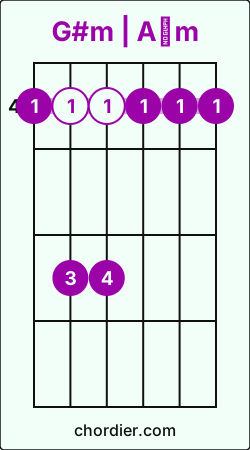 Guitar G#m | A♭m chord diagram
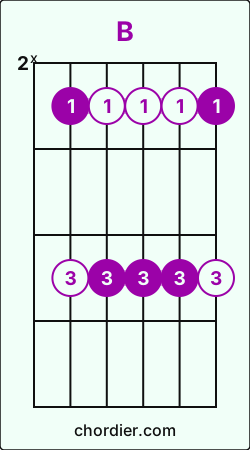 Guitar B chord diagram
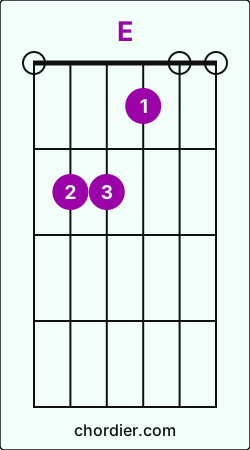 Guitar E chord diagram
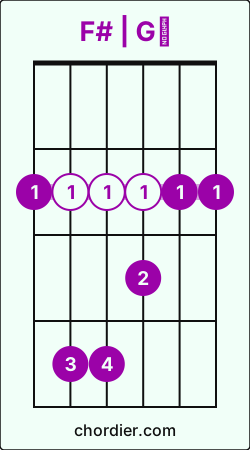 Guitar F# | G♭ chord diagram
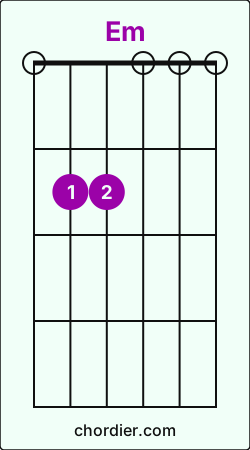 Guitar Em chord diagram
[Opening]
[G#m]The space between where our [B]ends meet
[E]has grown too much for me to block it out
[G#m]I’ll miss the tone of your [B]heartbeat
[E]it’s such a warming and familiar sound
[G#m]I hope you’re [F#]finding the [B]power
[E]to help you make it through the darker days
[G#m]For now I’ll wait by the [B]hour
[E]if you wanna take somebody’s [F#]breath away
[chorus]
[B]I hope you’re lonely hope you’re lost [F#]’cause I’ve been
and I’d hate to think you’re better off [G#m]without me
I know we tried to hold on, but [E]where do you go
[chorus]
when love, it just ain’t enough?
[B]Now does it kill you when you think [F#]about me?
Were you as close to giving up as [G#m]I’ve been?
I know we kept losing touch, got [E]lost in the rush
but I [Em]pray you don’t hurt too [B]much
[Closing]
[G#m]I don’t come close to [B]an angel
[E]and you ain’t never been no kind of saint
[G#m]When we both [B]came together
[E]hell to heaven you were my escape
[G#m]But fires don’t [F#]burn [B]forever
[E]and all these ashes crumble when we touch
[G#m]We danced to death in the [B]fire
[E]What can we do now that the [F#]music’s done, my love
[chorus]
[B]I hope you’re lonely hope you’re lost [F#]’cause I’ve been
and I’d hate to think you’re better off [G#m]without me
I know we tried to hold on, but [E]where do you go
[chorus]
when love, it just ain’t enough?
[B]Now does it kill you when you think [F#]about me?
Were you as close to giving up as [G#m]I’ve been?
I know we kept losing touch, got [E]lost in the rush
but I [Em]pray you don’t hurt too much
[chorus]
[F#]Oh we had it [G#m]all, but we let it fall
[E]but I hope you find whatever you were looking for
[F#]Well we had it [G#m]all, but we let it fall
[E]lost in the rush, but I [Em]pray you don’t hurt too much
[chorus]
[B]I hope you’re lonely hope you’re lost [F#]’cause I’ve been
and I’d hate to think you’re better off [G#m]without me
I know we tried to hold on, but [E]where do you go
[chorus]
when love, it just ain’t enough?
[B]Now does it kill you when you think [F#]about me?
Were you as close to giving up as [G#m]I’ve been?
I know we kept losing touch, got [E]lost in the rush
but I [Em]pray you don’t hurt too much
[chorus]
[F#]Oh we had it [G#m]all, but we let it fall
[E]but I hope you find whatever you were looking for
[F#]Well we had it [G#m]all, but we let it fall
[E]lost in the rush, but I pray [Em]you don’t hurt too [B]much
How to play Rush on Guitar (Step-by-step)
Lewis Capaldi - Rush on guitar requires 5 chords and 9 core chord transitions. You can find the full step-by-step guide below. Before you start, tune your instrument. The song uses the ↓-↓↑-↓↑-↓↑ pattern; practice it muted first, or simplify to downstrokes while you learn the changes.
Rush uses these transitions most often: F# → G#m (10), G#m → E (10), and B → E (8). These transitions may feel a little challenging at first, but with steady practice you can play this song quickly.When you are ready, begin with G#m - B chord transition.
1. G#m → B chord transition
To move from G#m to B;
- Slide your index finger on E string from fret 4 to fret 2.
- Slide your ring finger from A string fret 6 to G string fret 4.
- Lift your pinky from D string fret 6 and place it on B string fret 4.
- Place middle finger on D string fret 4.
2. B → E chord transition
To move from B to E;
- While playing B, lift your pinky from B string fret 4.
- Lift your index finger from E string fret 2 and place it on G string fret 1.
- Slide your middle finger from D string fret 4 to A string fret 2.
- Lift your ring finger from G string fret 4 and place it on D string fret 2.
3. E → G#m chord transition
To move from E to G#m;
- While playing E, lift your middle finger from A string fret 2.
- Lift your index finger from G string fret 1 and place it on E string fret 4.
- Slide your ring finger from D string fret 2 to A string fret 6.
- Place pinky on D string fret 6.
4. G#m → F# chord transition
To move from G#m to F#;
- Slide your index finger on E string from fret 4 to fret 2.
- Slide your ring finger on A string from fret 6 to fret 4.
- Slide your pinky on D string from fret 6 to fret 4.
- Place middle finger on G string fret 3.
5. F# → B chord transition
To move from F# to B;
- Keep index finger on E string fret 2.
- Lift your middle finger from G string fret 3 and place it on D string fret 4.
- Slide your ring finger from A string fret 4 to G string fret 4.
- Lift your pinky from D string fret 4 and place it on B string fret 4.
6. E → F# chord transition
To move from E to F#;
- Lift your index finger from G string fret 1 and place it on E string fret 2.
- Slide your middle finger from A string fret 2 to G string fret 3.
- Lift your ring finger from D string fret 2 and place it on A string fret 4.
- Place pinky on D string fret 4.
7. E → Em chord transition
To move from E to Em;
- While playing E, lift your index finger from G string fret 1.
- Keep middle finger on A string fret 2.
- Keep ring finger on D string fret 2.
8. Em → B chord transition
To move from Em to B;
- Lift your middle finger from A string fret 2 and place it on D string fret 4.
- Slide your ring finger from D string fret 2 to G string fret 4.
- Place index finger on E string fret 2.
- Place pinky on B string fret 4.
9. Em → F# chord transition
To move from Em to F#;
- Lift your middle finger from A string fret 2 and place it on G string fret 3.
- Slide your ring finger from D string fret 2 to A string fret 4.
- Place index finger on E string fret 2.
- Place pinky on D string fret 4.
Rush chord transition analysis
A short, data-driven summary of the chord flow in Rush.
- Rush includes 70 chord transitions, 9 of them unique.
- These transitions represent 0.02% of all chord transitions in Chordier.
- These transition patterns show how Rush connects to the rest of Chordier. Mastering them helps you move to similar songs faster.After G#m, the most likely next chords across Chordier are A (26%), E (23%), and F# (19%).
- G#m → E: 23%
- G#m → F#: 19%
After E, the most likely next chords across Chordier are A (25%), D (14%), and B (11%).- E → B: 11%
- E → F#: 3%