
Leonard Cohen - So Long, Marianne Chords
Before you play, tune your guitar and use the tools below to set up your view and flow.
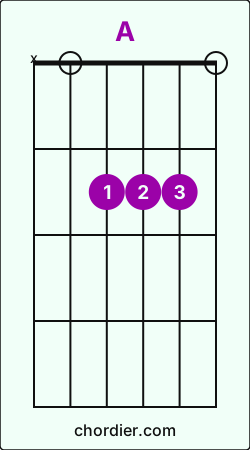 Guitar A chord diagram
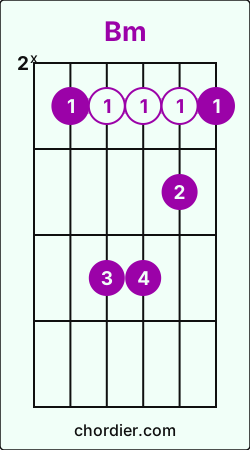 Guitar Bm chord diagram
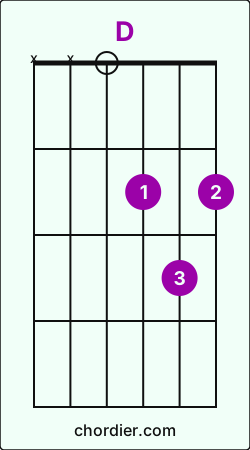 Guitar D chord diagram
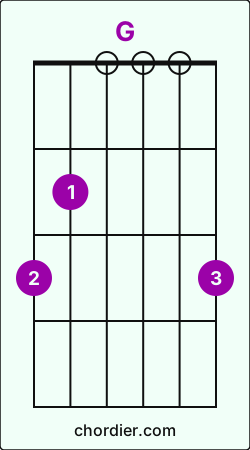 Guitar G chord diagram
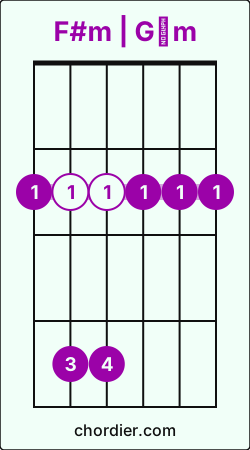 Guitar F#m | G♭m chord diagram
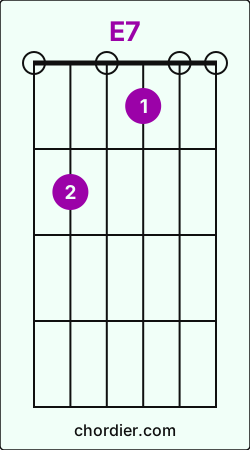 Guitar E7 chord diagram
[Opening]
Come [A]over to the window my little [Bm]darling
[D]I’d like to try to read your [A]palm
[G]I used to think I was some kind of [D]gypsy boy
[F#m]Before I let you take me [E7]home
[chorus]
Now [A]so long Marianne [F#m]it’s time we began
To [E7]laugh and cry and cry and laugh about it [A]all again [A]
[verse 2]
[A]Well you know that I love to [Bm]live with you
[D]But you make me forget so very [A]much
[G]I forget to pray for the [D]angels
And then the [F#m]angels forget to pray for [E7]us
[chorus]
Now [A]so long Marianne [F#m]it’s time we began
To [E7]laugh and cry and cry and laugh about it [A]all again [A]
[verse 3]
[A]We met when we were [Bm]almost young
[D]Deep in the green lilac [A]park
[G]You held on to me like I was a [D]crucifix
[F#m]As we went kneeling through the [E7]dark
[chorus]
Now [A]so long Marianne [F#m]it’s time we began
To [E7]laugh and cry and cry and laugh about it [A]all again [A]
[verse 4]
[A]Your letters they all say that you’re be[Bm]side me now
[D]Then why do I feel a[A]lone
[G]I’m standing on a ledge and your [D]fine spider web
Is [F#m]fastening my ankle to a [E7]stone
[chorus]
Now [A]so long Marianne [F#m]it’s time we began
To [E7]laugh and cry and cry and laugh about it [A]all again [A]
[verse 5]
[A]For now I need your [Bm]hidden love
[D]I’m cold as a new razor [A]blade
[G]You left when I told you I was [D]curious
[F#m]I never said that I was [E7]brave
[chorus]
Now [A]so long Marianne [F#m]it’s time we began
To [E7]laugh and cry and cry and laugh about it [A]all again [A]
[Closing]
[A]Oh you are really such a [Bm]pretty one
[D]I see you’ve gone and changed your [A]name again
[G]And just when I climbed this whole [D]mountainside
[F#m]To wash my eye[E7]lids in the rain
[chorus]
Now [A]so long Marianne [F#m]it’s time we began
To [E7]laugh and cry and cry and laugh about it [A]all again [A]
How to play So Long, Marianne on Guitar (Step-by-step)
Leonard Cohen - So Long, Marianne on guitar requires 6 chords and 9 core chord transitions. You can find the full step-by-step guide below. Before you start, tune your instrument. The song uses the ↓-↓↑-↓↑-↓↑ pattern; practice it muted first, or simplify to downstrokes while you learn the changes.
So Long, Marianne uses these transitions most often: E7 → A (12), F#m → E7 (12), and A → Bm (6). These transitions may feel a little challenging at first, but with steady practice you can play this song quickly.When you are ready, begin with A - Bm chord transition.
1. A → Bm chord transition
To move from A to Bm;
- Lift your index finger from D string fret 2 and place it on E string fret 2.
- Slide your middle finger from G string fret 2 to B string fret 3.
- Lift your ring finger from B string fret 2 and place it on D string fret 4.
- Place pinky on G string fret 4.
2. Bm → D chord transition
To move from Bm to D;
- While playing Bm, lift your pinky from G string fret 4.
- Lift your index finger from E string fret 2 and place it on G string fret 2.
- Slide your middle finger from B string fret 3 to E string fret 2.
- Lift your ring finger from D string fret 4 and place it on B string fret 3.
3. D → A chord transition
To move from D to A;
- Lift your index finger from G string fret 2 and place it on D string fret 2.
- Slide your middle finger from E string fret 2 to G string fret 2.
- Slide your ring finger on B string from fret 3 to fret 2.
4. A → G chord transition
To move from A to G;
- Lift your index finger from D string fret 2 and place it on A string fret 2.
- Slide your middle finger from G string fret 2 to E string fret 3.
- Lift your ring finger from B string fret 2 and place it on E string fret 3.
5. G → D chord transition
To move from G to D;
- Lift your index finger from A string fret 2 and place it on G string fret 2.
- Slide your middle finger from E string fret 3 to E string fret 2.
- Lift your ring finger from E string fret 3 and place it on B string fret 3.
6. D → F#m chord transition
To move from D to F#m;
- While playing D, lift your middle finger from E string fret 2.
- Lift your index finger from G string fret 2 and place it on E string fret 2.
- Slide your ring finger from B string fret 3 to A string fret 4.
- Place pinky on D string fret 4.
7. F#m → E7 chord transition
To move from F#m to E7;
- While playing F#m, first lift your ring finger and pinky.
- Lift your index finger from E string fret 2 and place it on G string fret 1.
- Place middle finger on A string fret 2.
8. E7 → A chord transition
To move from E7 to A;
- Lift your index finger from G string fret 1 and place it on D string fret 2.
- Slide your middle finger from A string fret 2 to G string fret 2.
- Place ring finger on B string fret 2.
9. A → F#m chord transition
To move from A to F#m;
- While playing A, lift your middle finger from G string fret 2.
- Lift your index finger from D string fret 2 and place it on E string fret 2.
- Slide your ring finger from B string fret 2 to A string fret 4.
- Place pinky on D string fret 4.
So Long, Marianne chord transition analysis
A short, data-driven summary of the chord flow in So Long, Marianne.
- So Long, Marianne includes 66 chord transitions, 9 of them unique.
- These transitions represent 0.02% of all chord transitions in Chordier.
- So Long, Marianne contains 2 of the top 10 transitions across Chordier.
- These transition patterns show how So Long, Marianne connects to the rest of Chordier. Mastering them helps you move to similar songs faster.After A, the most likely next chords across Chordier are D (29%), G (13%), and E (12%).
- A → G: 13%
- A → Bm: 8%
After D, the most likely next chords across Chordier are G (29%), A (17%), and Em (17%).- D → A: 17%
- D → F#m: 2%