
Natalie Cole - Starting Over Again Chords
Before you play, tune your guitar and use the tools below to set up your view and flow.
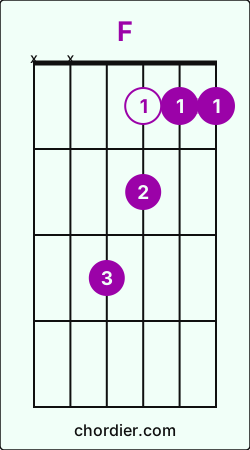 Guitar F chord diagram
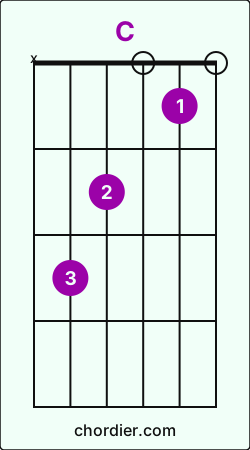 Guitar C chord diagram
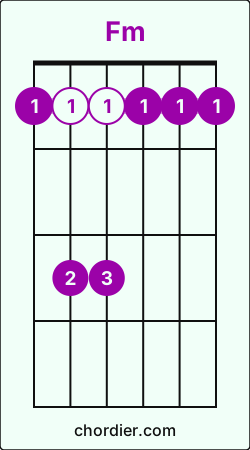 Guitar Fm chord diagram
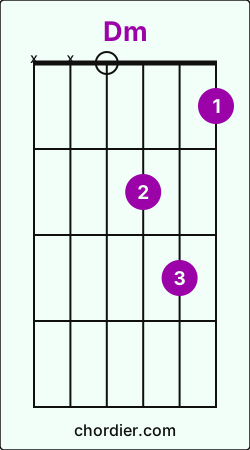 Guitar Dm chord diagram
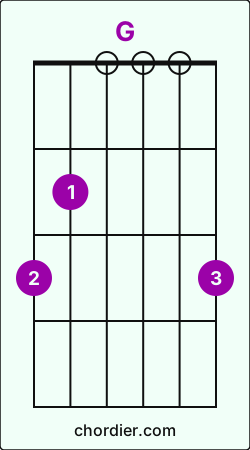 Guitar G chord diagram
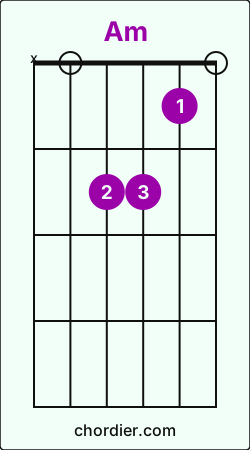 Guitar Am chord diagram
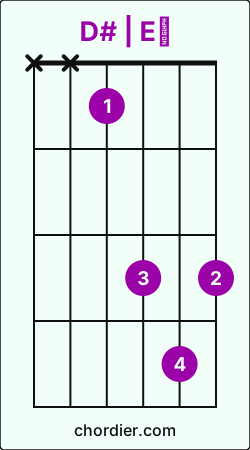 Guitar D# | E♭ chord diagram
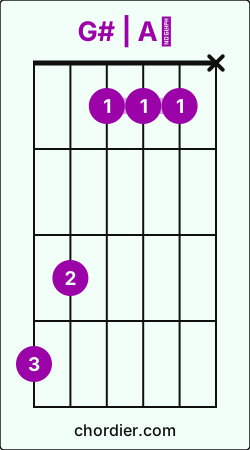 Guitar G# | A♭ chord diagram
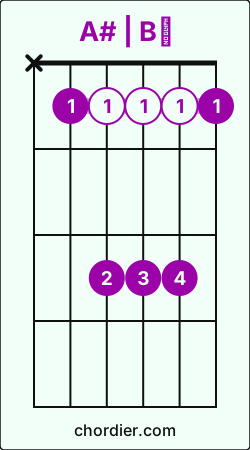 Guitar A# | B♭ chord diagram
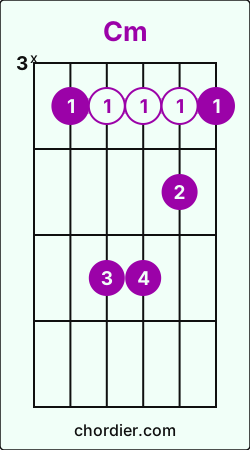 Guitar Cm chord diagram
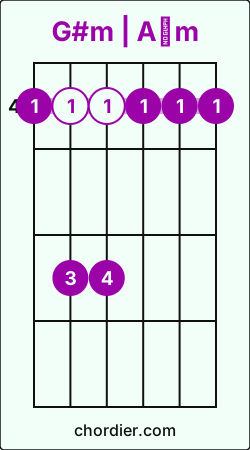 Guitar G#m | A♭m chord diagram
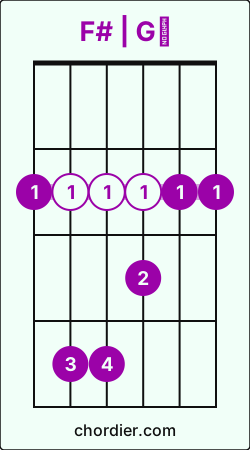 Guitar F# | G♭ chord diagram
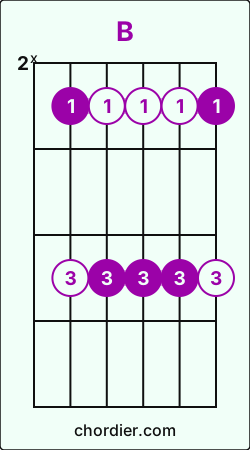 Guitar B chord diagram
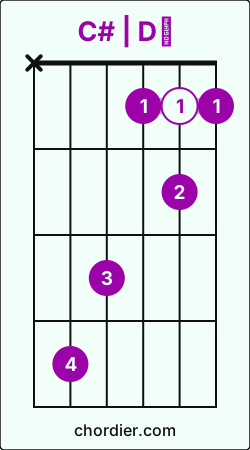 Guitar C# | D♭ chord diagram
[Opening]
And when I [F]hold you in [C]my arms I promise you.
You’re gonna [F]feel a love that’s [C]beautiful and new
This time I’ll [F]love you even [Fm]better than I [C]ever did be[F]fore
And you’ll be [Dm]in my heart [G]forevermore…
[verse 2]
[C]We, we’re just too [F]young to know we [Dm]fell in love and [G]let it go.
So [Am]easy to say the [F]words goodbye, so [Dm]hard to let the [G]feelings die.
[verse 3]
I [C]know how much I [F]need you now, the [Dm]time is turning [G]back somehow.
As [Am]soon as our hearts and [F]souls unite.
I [Dm]know for sure we’ll [G]get the feeling [C]right [D#]
[chorus]
And [D#]now we’re starting [G#]over again, [A#]it’s not the [D#]easiest thing to do.
[Cm]I’m feeling in[F]side again, ’cause [G#]every time I [A#]looked at you.
I [D#]know we’re starting [G#]over again, [A#]this time we’ll [D#]love all the pain away.
[Cm]Welcome home my [F]lover and friend, [G#]we are starting [A#]over, over [D#]again.
[verse 4]
[C]If we never [F]leave alone, and [Dm]then we might have [G]never known.
[Am]All the times we [F]spent apart, [Dm]all we did was [G]break each other’s [C]heart.
[Closing]
[F] [C] [F] [C]
And when I [G#]hold you in my arms I promise [D#]you.
You’re gonna [G#]feel the love that’s beautiful and [D#]new.
This time I’ll [G#]love you even bet[G#m]ter, than I [Cm]ever did be[F]fore.
And you’ll be [G#]in my heart [A#]forever [D#]more. [F#]
[chorus]
And [D#]now we’re starting [G#]over again, [A#]it’s not the [D#]easiest thing to do.
[Cm]I’m feeling in[F]side again, ’cause [G#]every time I [A#]looked at you.
I [D#]know we’re starting [G#]over again, [A#]this time we’ll [D#]love all the pain away.
[Cm]Welcome home my [F]lover and friend, [G#]we are starting [A#]over, over [D#]again. [G#]
[B]We are starting [C#]over, over [F#]again
How to play Starting Over Again on Guitar (Step-by-step)
Natalie Cole - Starting Over Again on guitar requires 14 chords and 22 core chord transitions. You can find the full step-by-step guide below. Before you start, tune your instrument. The song uses the ↓-↓↑-↑↓↑ pattern; practice it muted first, or simplify to downstrokes while you learn the changes.
Starting Over Again uses these transitions most often: A# → D# (9), G# → A# (9), and C → F (8). These transitions may feel a little challenging at first, but with steady practice you can play this song quickly.When you are ready, begin with F - C chord transition.
1. F → C chord transition
To move from F to C;
- While playing F, lift your pinky from D string fret 3.
- Lift your index finger from E string fret 1 and place it on B string fret 1.
- Slide your middle finger from G string fret 2 to D string fret 2.
- Keep ring finger on A string fret 3.
2. F → Fm chord transition
To move from F to Fm;
- While playing F, lift your middle finger from G string fret 2.
- Keep index finger on E string fret 1.
- Keep ring finger on A string fret 3.
- Keep pinky on D string fret 3.
3. Fm → C chord transition
To move from Fm to C;
- While playing Fm, lift your pinky from D string fret 3.
- Lift your index finger from E string fret 1 and place it on B string fret 1.
- Keep ring finger on A string fret 3.
- Place middle finger on D string fret 2.
4. F → Dm chord transition
To move from F to Dm;
- While playing F, lift your pinky from D string fret 3.
- Lift your index finger from E string fret 1 and place it on E string fret 1.
- Keep middle finger on G string fret 2.
- Slide your ring finger from A string fret 3 to B string fret 3.
5. Dm → G chord transition
To move from Dm to G;
- Lift your index finger from E string fret 1 and place it on A string fret 2.
- Slide your middle finger from G string fret 2 to E string fret 3.
- Lift your ring finger from B string fret 3 and place it on E string fret 3.
6. G → C chord transition
To move from G to C;
- Lift your index finger from A string fret 2 and place it on B string fret 1.
- Slide your middle finger from E string fret 3 to D string fret 2.
- Lift your ring finger from E string fret 3 and place it on A string fret 3.
7. G → Am chord transition
To move from G to Am;
- Lift your index finger from A string fret 2 and place it on B string fret 1.
- Slide your middle finger from E string fret 3 to D string fret 2.
- Lift your ring finger from E string fret 3 and place it on G string fret 2.
8. Am → F chord transition
To move from Am to F;
- Lift your index finger from B string fret 1 and place it on E string fret 1.
- Slide your middle finger from D string fret 2 to G string fret 2.
- Lift your ring finger from G string fret 2 and place it on A string fret 3.
- Place pinky on D string fret 3.
9. C → D# chord transition
To move from C to D#;
- Lift your index finger from B string fret 1 and place it on D string fret 1.
- Slide your middle finger from D string fret 2 to E string fret 3.
- Lift your ring finger from A string fret 3 and place it on G string fret 3.
- Place pinky on B string fret 4.
10. D# → G# chord transition
To move from D# to G#;
- While playing D#, lift your pinky from B string fret 4.
- Keep index finger on D string fret 1.
- Lift your middle finger from E string fret 3 and place it on A string fret 3.
- Slide your ring finger from G string fret 3 to E string fret 4.
11. G# → A# chord transition
To move from G# to A#;
- Lift your index finger from D string fret 1 and place it on A string fret 1.
- Slide your middle finger from A string fret 3 to D string fret 3.
- Lift your ring finger from E string fret 4 and place it on G string fret 3.
- Place pinky on B string fret 3.
12. A# → D# chord transition
To move from A# to D#;
- Lift your index finger from A string fret 1 and place it on D string fret 1.
- Slide your middle finger from D string fret 3 to E string fret 3.
- Keep ring finger on G string fret 3.
- Slide your pinky on B string from fret 3 to fret 4.
13. D# → Cm chord transition
To move from D# to Cm;
- Lift your index finger from D string fret 1 and place it on B string fret 1.
- Slide your middle finger from E string fret 3 to D string fret 1.
- Lift your ring finger from G string fret 3 and place it on A string fret 3.
- Slide your pinky from B string fret 4 to E string fret 3.
14. Cm → F chord transition
To move from Cm to F;
- Lift your index finger from B string fret 1 and place it on E string fret 1.
- Slide your middle finger from D string fret 1 to G string fret 2.
- Keep ring finger on A string fret 3.
- Lift your pinky from E string fret 3 and place it on D string fret 3.
15. F → G# chord transition
To move from F to G#;
- While playing F, lift your pinky from D string fret 3.
- Lift your index finger from E string fret 1 and place it on D string fret 1.
- Slide your middle finger from G string fret 2 to A string fret 3.
- Lift your ring finger from A string fret 3 and place it on E string fret 4.
16. C → G# chord transition
To move from C to G#;
- Lift your index finger from B string fret 1 and place it on D string fret 1.
- Slide your middle finger from D string fret 2 to A string fret 3.
- Lift your ring finger from A string fret 3 and place it on E string fret 4.
17. G# → G#m chord transition
To move from G# to G#m;
- While playing G#, lift your middle finger from A string fret 3.
- Lift your index finger from D string fret 1 and place it on E string fret 4.
- Slide your ring finger from E string fret 4 to A string fret 6.
- Place pinky on D string fret 6.
18. G#m → Cm chord transition
To move from G#m to Cm;
- Lift your index finger from E string fret 4 and place it on B string fret 1.
- Slide your ring finger on A string from fret 6 to fret 3.
- Lift your pinky from D string fret 6 and place it on E string fret 3.
- Place middle finger on D string fret 1.
19. D# → F# chord transition
To move from D# to F#;
- Lift your index finger from D string fret 1 and place it on E string fret 2.
- Slide your middle finger from E string fret 3 to G string fret 3.
- Lift your ring finger from G string fret 3 and place it on A string fret 4.
- Slide your pinky from B string fret 4 to D string fret 4.
20. G# → B chord transition
To move from G# to B;
- Lift your index finger from D string fret 1 and place it on E string fret 2.
- Slide your middle finger from A string fret 3 to D string fret 4.
- Lift your ring finger from E string fret 4 and place it on G string fret 4.
- Place pinky on B string fret 4.
21. B → C# chord transition
To move from B to C#;
- Lift your index finger from E string fret 2 and place it on G string fret 1.
- Slide your middle finger from D string fret 4 to B string fret 2.
- Lift your ring finger from G string fret 4 and place it on D string fret 3.
- Slide your pinky from B string fret 4 to A string fret 4.
22. C# → F# chord transition
To move from C# to F#;
- Lift your index finger from G string fret 1 and place it on E string fret 2.
- Slide your middle finger from B string fret 2 to G string fret 3.
- Lift your ring finger from D string fret 3 and place it on A string fret 4.
- Slide your pinky from A string fret 4 to D string fret 4.
Starting Over Again chord transition analysis
A short, data-driven summary of the chord flow in Starting Over Again.
- Starting Over Again includes 89 chord transitions, 22 of them unique.
- These transitions represent 0.02% of all chord transitions in Chordier.
- Starting Over Again contains 4 of the top 10 transitions across Chordier.
- These transition patterns show how Starting Over Again connects to the rest of Chordier. Mastering them helps you move to similar songs faster.After F, the most likely next chords across Chordier are C (40%), G (21%), and Am (11%).
- F → C: 40%
- F → Dm: 5%
After D#, the most likely next chords across Chordier are A# (15%), G# (15%), and D (10%).- D# → G#: 15%
- D# → Cm: 7%