
Ralph McTell - Streets of London Chords
Before you play, tune your guitar and use the tools below to set up your view and flow.
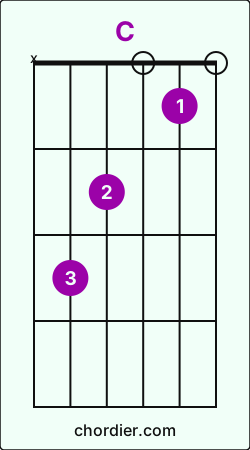 Guitar C chord diagram
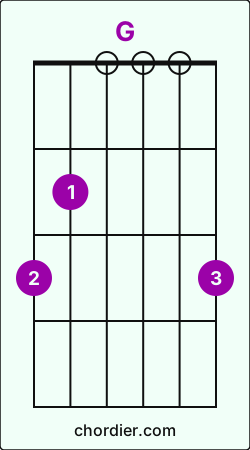 Guitar G chord diagram
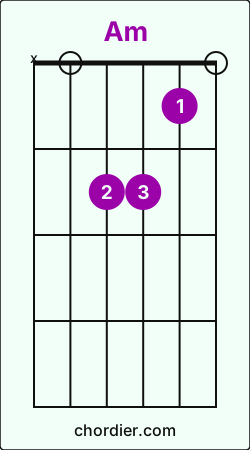 Guitar Am chord diagram
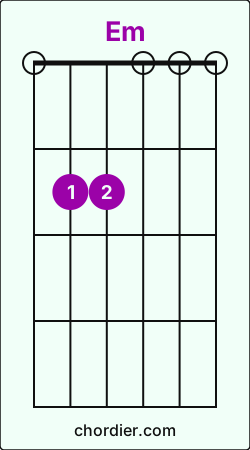 Guitar Em chord diagram
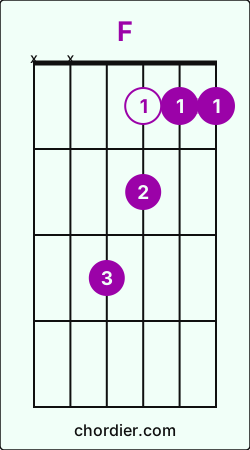 Guitar F chord diagram
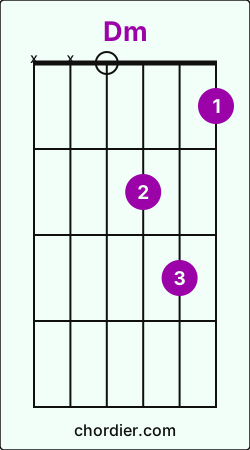 Guitar Dm chord diagram
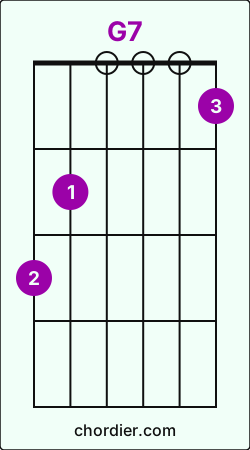 Guitar G7 chord diagram
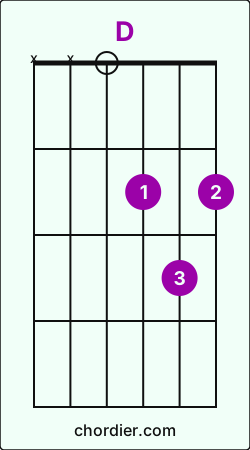 Guitar D chord diagram
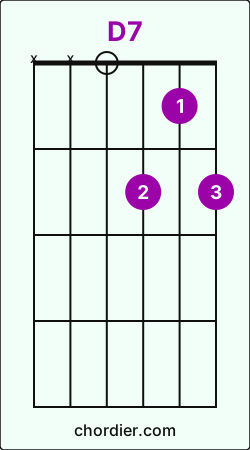 Guitar D7 chord diagram
[Opening]
[C]Have you seen the [G]old man in the [Am]closed down [Em]market
[F]Kicking up the [C]paper with his [Dm]worn out [G]shoes?
[C]In his eyes you [G]see no pride, [Am]and held loosely [Em]by his side
[F]Yesterday’s [C]paper telling [G7]yesterday’s [C]news
[chorus]
So [F]how can you [Em]tell me you’re [C]lone[Am]ly,
[D]And say for [D7]you that the sun don’t [G]shine? [G7]
[C]Let me take you [G]by the hand and
[Am]Lead you through [Em]the streets of London
[F]I’ll show you [C]something to [G]make you change your [C]mind
[verse 2]
[C]Have you seen the [G]old girl who [Am]walks the streets of [Em]London
[F]Dirt in her [C]hair and her [Dm]clothes in [G]rags?
[C]She’s no time for [G]talking, she [Am]just keeps right on [Em]walking
[F]Carrying her [C]home in [G7]two carrier [C]bags.
[chorus]
So [F]how can you [Em]tell me you’re [C]lone[Am]ly,
[D]And say for [D7]you that the sun don’t [G]shine? [G7]
[C]Let me take you [G]by the hand and
[Am]Lead you through [Em]the streets of London
[F]I’ll show you [C]something to [G]make you change your [C]mind
[verse 3]
[C]In the all night [G]café, at a [Am]quarter past [Em]eleven,
[F]Same old [C]man is sitting [Dm]there on his [G]own
[C]Looking at the [G]world over the [Am]rim of his [Em]tea cup,
[F]each tea last an [C]hour then he [G7]wanders home a[C]lone
[chorus]
So [F]how can you [Em]tell me you’re [C]lone[Am]ly,
[D]And say for [D7]you that the sun don’t [G]shine? [G7]
[C]Let me take you [G]by the hand and
[Am]Lead you through [Em]the streets of London
[F]I’ll show you [C]something to [G]make you change your [C]mind
[verse 4]
[C]And have you seen the [G]old man, out[Am]side the seaman’s [Em]mission
[F]Memory fading [C]with the medal [Dm]ribbons that he [G]wears.
[C]In our winter [G]city, the [Am]rain cries a little [Em]pity
For [F]one more forgotten [C]hero and a [G7]world that doesn’t [C]care
[chorus]
So [F]how can you [Em]tell me you’re [C]lone[Am]ly,
[D]And say for [D7]you that the sun don’t [G]shine? [G7]
[C]Let me take you [G]by the hand and
[Am]Lead you through [Em]the streets of London
[F]I’ll show you [C]something to [G]make you change your [C]mind
[Closing]
[F]I’ll show you [C]something to [G]make you change your [C]mind
How to play Streets of London on Guitar (Step-by-step)
Ralph McTell - Streets of London on guitar requires 9 chords and 14 core chord transitions. You can find the full step-by-step guide below. Before you start, tune your instrument. The song uses the ↓-↓↑-↓↑-↓↑ pattern; practice it muted first, or simplify to downstrokes while you learn the changes.
Streets of London uses these transitions most often: C → G (17), F → C (13), and Am → Em (12). These transitions may feel a little challenging at first, but with steady practice you can play this song quickly.When you are ready, begin with C - G chord transition.
1. C → G chord transition
To move from C to G;
- Lift your index finger from B string fret 1 and place it on A string fret 2.
- Slide your middle finger from D string fret 2 to E string fret 3.
- Lift your ring finger from A string fret 3 and place it on E string fret 3.
2. G → Am chord transition
To move from G to Am;
- Lift your index finger from A string fret 2 and place it on B string fret 1.
- Slide your middle finger from E string fret 3 to D string fret 2.
- Lift your ring finger from E string fret 3 and place it on G string fret 2.
3. Am → Em chord transition
To move from Am to Em;
- While playing Am, lift your index finger from B string fret 1.
- Lift your middle finger from D string fret 2 and place it on A string fret 2.
- Slide your ring finger from G string fret 2 to D string fret 2.
4. Em → F chord transition
To move from Em to F;
- Lift your middle finger from A string fret 2 and place it on G string fret 2.
- Slide your ring finger from D string fret 2 to A string fret 3.
- Place index finger on E string fret 1.
- Place pinky on D string fret 3.
5. F → C chord transition
To move from F to C;
- While playing F, lift your pinky from D string fret 3.
- Lift your index finger from E string fret 1 and place it on B string fret 1.
- Slide your middle finger from G string fret 2 to D string fret 2.
- Keep ring finger on A string fret 3.
6. C → Dm chord transition
To move from C to Dm;
- Lift your index finger from B string fret 1 and place it on E string fret 1.
- Slide your middle finger from D string fret 2 to G string fret 2.
- Lift your ring finger from A string fret 3 and place it on B string fret 3.
7. Dm → G chord transition
To move from Dm to G;
- Lift your index finger from E string fret 1 and place it on A string fret 2.
- Slide your middle finger from G string fret 2 to E string fret 3.
- Lift your ring finger from B string fret 3 and place it on E string fret 3.
8. C → G7 chord transition
To move from C to G7;
- Lift your index finger from B string fret 1 and place it on A string fret 2.
- Slide your middle finger from D string fret 2 to E string fret 3.
- Lift your ring finger from A string fret 3 and place it on E string fret 1.
9. Em → C chord transition
To move from Em to C;
- Lift your middle finger from A string fret 2 and place it on D string fret 2.
- Slide your ring finger from D string fret 2 to A string fret 3.
- Place index finger on B string fret 1.
10. C → Am chord transition
To move from C to Am;
- Keep index finger on B string fret 1.
- Keep middle finger on D string fret 2.
- Lift your ring finger from A string fret 3 and place it on G string fret 2.
11. Am → D chord transition
To move from Am to D;
- Lift your index finger from B string fret 1 and place it on G string fret 2.
- Slide your middle finger from D string fret 2 to E string fret 2.
- Lift your ring finger from G string fret 2 and place it on B string fret 3.
12. D → D7 chord transition
To move from D to D7;
- Lift your index finger from G string fret 2 and place it on B string fret 1.
- Slide your middle finger from E string fret 2 to G string fret 2.
- Lift your ring finger from B string fret 3 and place it on E string fret 2.
13. D7 → G chord transition
To move from D7 to G;
- Lift your index finger from B string fret 1 and place it on A string fret 2.
- Slide your middle finger from G string fret 2 to E string fret 3.
- Slide your ring finger on E string from fret 2 to fret 3.
14. G → G7 chord transition
To move from G to G7;
- Keep index finger on A string fret 2.
- Keep middle finger on E string fret 3.
- Slide your ring finger on E string from fret 3 to fret 1.
Streets of London chord transition analysis
A short, data-driven summary of the chord flow in Streets of London.
- Streets of London includes 128 chord transitions, 14 of them unique.
- These transitions represent 0.03% of all chord transitions in Chordier.
- Streets of London contains 4 of the top 10 transitions across Chordier.
- These transition patterns show how Streets of London connects to the rest of Chordier. Mastering them helps you move to similar songs faster.After C, the most likely next chords across Chordier are G (35%), F (16%), and D (11%).
- C → G: 35%
- C → F: 16%
After G, the most likely next chords across Chordier are C (25%), D (24%), and Am (13%).- G → C: 25%
- G → Am: 13%