
Taylor Swift - Afterglow Chords
Before you play, tune your guitar and use the tools below to set up your view and flow. Using the Transpose tool, switch to D,G keys to play this song with easier chords.
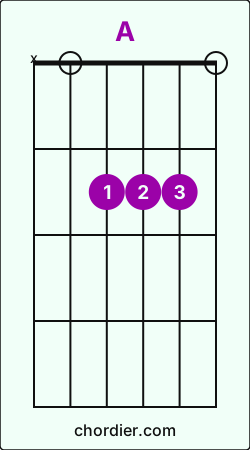 Guitar A chord diagram
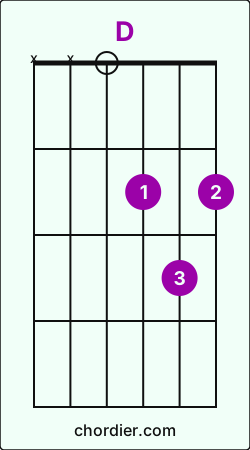 Guitar D chord diagram
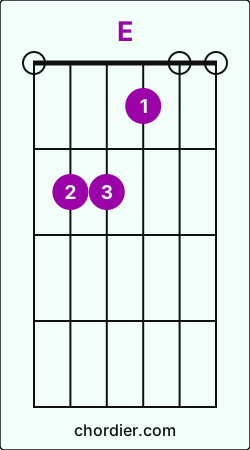 Guitar E chord diagram
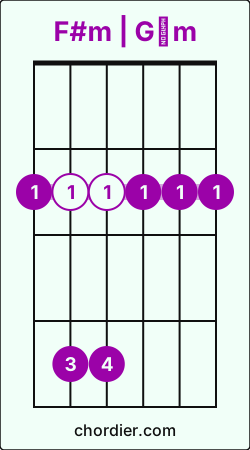 Guitar F#m | G♭m chord diagram
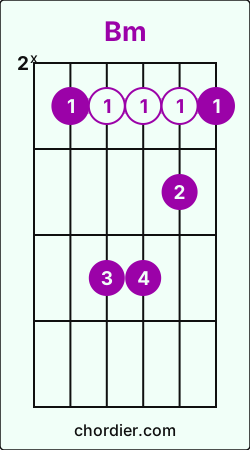 Guitar Bm chord diagram
[Opening]
[A]I blew things out of proportion, now you’re blue
[D]Put you in jail for something you didn‘t do
[A]I pinned your hands behind your back, oh
[D]Thought I had reason to attack, but no
[verse 2]
[A]Fighting with a true love is boxing with no gloves
[D]Chemistry ’til it blows up, ’til there’s no us
[E]Why’d I have to break what I [F#m]love so much?
[E]It’s on your face, and [D]I’m to blame, I need to say
[chorus]
[A]Hey, it’s all [E]me, in my [Bm]head
[D]I’m the one who burned us [A]down
But it’s [E]not what I [Bm]meant
[D]Sorry that I hurt you
[A]I don’t wanna do, I don’t wanna do this to [E]you (Ooh)
[Bm]I don’t wanna lose, I don’t wanna lose this [D]with you (Ooh)
I need to say, [A]hey, it’s all [E]me, just don’t [Bm]go
[D]Meet me in the afterglow
[verse 3]
[A]It’s so excruciating to see you low
[D]Just wanna lift you up and not let you go
[A]This ultraviolet morning light below
[D]Tells me this love is worth the fight, oh
[verse 4]
[A]I lived like an island, punished you in silence
[D]Went off like sirens, just crying
[E]Why’d I have to break what I [F#m]love so much?
[E]It’s on your face, [D]don’t walk away, I need to say
[chorus]
[A]Hey, it’s all [E]me, in my [Bm]head
[D]I’m the one who burned us [A]down
But it’s [E]not what I [Bm]meant
[D]Sorry that I hurt you
[A]I don’t wanna do, I don’t wanna do this to [E]you (Ooh)
[Bm]I don’t wanna lose, I don’t wanna lose this [D]with you (Ooh)
I need to say, [A]hey, it’s all [E]me, just don’t [Bm]go
[D]Meet me in the afterglow
[Closing]
[A]Tell me that you’re still mine
[E]Tell me that we’ll be just fine
[Bm]Even when I lose my mind, I need to say
[A]Tell me that it’s not my fault
[E]Tell me that I’m all you want
[Bm]Even when I break your heart, I need to say
[chorus]
[A]Hey, it’s all [E]me, in my [Bm]head
[D]I’m the one who burned us [A]down
But it’s [E]not what I [Bm]meant
[D]Sorry that I hurt you
[A]I don’t wanna do, I don’t wanna do this to [E]you (Ooh)
[Bm]I don’t wanna lose, I don’t wanna lose this [D]with you (Ooh)
I need to say, [A]hey, it’s all [E]me, just don’t [Bm]go
[D]Meet me in the afterglow
[outro]
[A] [E] [Bm] [D] [A] [E] [Bm] [D]
How to play Afterglow on Guitar (Step-by-step)
Taylor Swift - Afterglow on guitar requires 5 chords and 7 core chord transitions. You can find the full step-by-step guide below. Before you start, tune your instrument. The song uses the ↓-↓↑-↑↓↑ pattern; practice it muted first, or simplify to downstrokes while you learn the changes.
Afterglow uses these transitions most often: D → A (19), A → E (16), and E → Bm (16). These transitions may feel a little challenging at first, but with steady practice you can play this song quickly.When you are ready, begin with A - D chord transition.
1. A → D chord transition
To move from A to D;
- Lift your index finger from D string fret 2 and place it on G string fret 2.
- Slide your middle finger from G string fret 2 to E string fret 2.
- Slide your ring finger on B string from fret 2 to fret 3.
2. D → E chord transition
To move from D to E;
- Slide your index finger on G string from fret 2 to fret 1.
- Slide your middle finger from E string fret 2 to A string fret 2.
- Lift your ring finger from B string fret 3 and place it on D string fret 2.
3. E → F#m chord transition
To move from E to F#m;
- While playing E, lift your middle finger from A string fret 2.
- Lift your index finger from G string fret 1 and place it on E string fret 2.
- Slide your ring finger from D string fret 2 to A string fret 4.
- Place pinky on D string fret 4.
4. A → E chord transition
To move from A to E;
- Lift your index finger from D string fret 2 and place it on G string fret 1.
- Slide your middle finger from G string fret 2 to A string fret 2.
- Lift your ring finger from B string fret 2 and place it on D string fret 2.
5. E → Bm chord transition
To move from E to Bm;
- Lift your index finger from G string fret 1 and place it on E string fret 2.
- Slide your middle finger from A string fret 2 to B string fret 3.
- Slide your ring finger on D string from fret 2 to fret 4.
- Place pinky on G string fret 4.
6. Bm → D chord transition
To move from Bm to D;
- While playing Bm, lift your pinky from G string fret 4.
- Lift your index finger from E string fret 2 and place it on G string fret 2.
- Slide your middle finger from B string fret 3 to E string fret 2.
- Lift your ring finger from D string fret 4 and place it on B string fret 3.
7. Bm → A chord transition
To move from Bm to A;
- While playing Bm, lift your pinky from G string fret 4.
- Lift your index finger from E string fret 2 and place it on D string fret 2.
- Slide your middle finger from B string fret 3 to G string fret 2.
- Lift your ring finger from D string fret 4 and place it on B string fret 2.
Afterglow chord transition analysis
A short, data-driven summary of the chord flow in Afterglow.
- Afterglow includes 81 chord transitions, 7 of them unique.
- These transitions represent 0.02% of all chord transitions in Chordier.
- Afterglow contains 1 of the top 10 transitions across Chordier.
- These transition patterns show how Afterglow connects to the rest of Chordier. Mastering them helps you move to similar songs faster.After A, the most likely next chords across Chordier are D (29%), G (13%), and E (12%).
- A → D: 29%
- A → E: 12%
After D, the most likely next chords across Chordier are G (29%), A (17%), and Em (17%).- D → A: 17%
- D → E: 3%