
Eric Bogle - The Band Played Waltzing Matilda Chords
Before you play, tune your guitar and use the tools below to set up your view and flow.
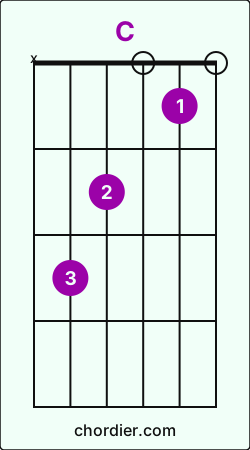 Guitar C chord diagram
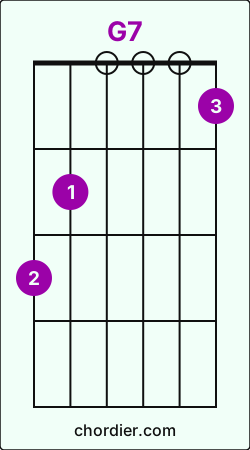 Guitar G7 chord diagram
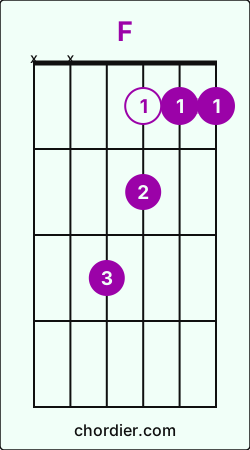 Guitar F chord diagram
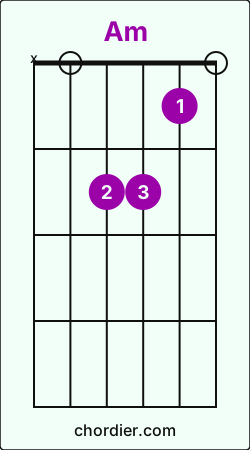 Guitar Am chord diagram
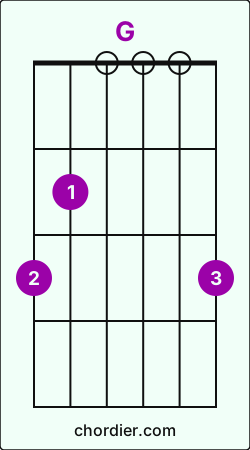 Guitar G chord diagram
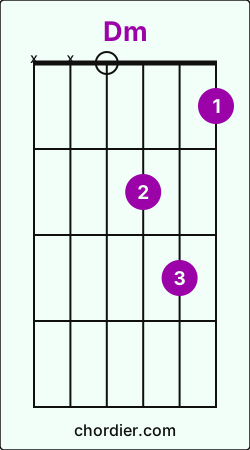 Guitar Dm chord diagram
[Opening]
[C] [G7] [C]
[C]Now, when [C]I was a young [F]man I [C]carried me [Am]pack,
and I [C]lived the free [G7]life of the [C]rover.
From the Murray’s green [F]basin to the [C]dusty out[Am]back,
well, I [C]waltzed my Ma[G7]tilda all [C]over.
Then in [G7]nineteen fifteen my [F]country said,
“[C]Son, it’s [G7]time you stop rambling,
there’s [F]work to be [C]done”
So they gave me a [F]tin hat and they [C]gave me a [Am]gun
and they [C]marched me a[G7]way to the [C]war. [F] [C]
And the [C]band played [F]Waltzing Ma[C]tilda,
as the ship pulled a[F]way from the [G]quay.
And [F]‘midst all the cheers, the flag [C]waving and [F]tears,
we [C]sailed off for [G7]Gallipo[C]li. [G7] [C]
[verse 2]
And how [C]well I re[F]member that [C]terrible [Am]day,
how our [C]blood stained the [G7]sand and the [C]water.
And how in that [F]hell that they [C]called Suvla [Am]Bay,
we were [C]butchered like [G7]lambs at the [C]slaughter.
Johnny [G7]Turk, he was ready, he’d [F]primed himself [C]well,
he [G7]showered us with bullets and he [F]rained us with [C]shell
And in five minutes [F]flat he’d blown [C]us all to [Am]hell,
nearly [C]blew us right [G7]back to Aus[C]tralia [F] [C]
But the [C]band played [F]Waltzing Ma[C]tilda,
when we stopped to [F]bury our [G]slain.
[F]We buried ours, and the [C]Turks buried [F]theirs,
then we [C]started all [G7]over a[C]gain. [G7] [C]
[verse 3]
And [C]those that were [F]left, well, we [C]tried to sur[Am]vive,
in that [C]mad world of [G7]blood, death and [C]fire.
And for ten weary [F]weeks I kept [C]myself a[Am]live,
though a[C]round me the [G7]corpses piled [C]higher.
Then a [G7]big Turkish shell knocked me [F]arse over [C]head,
and [G7]when I woke up in me [F]hospital [C]bed
And saw what it had [F]done, well, I [C]wished I was [Am]dead,
never [C]knew there was [G7]worse things than [C]dying. [F] [C]
For I’ll [C]go no more [F]Waltzing Ma[C]tilda,
All around the green [F]bush, far and [G]free.
To [F]hump tent and pegs, a [C]man needs both [F]legs,
no more ‘[C]Waltzing Ma[G7]tilda’ for [C]me. [G7] [C]
[verse 4]
So they [C]gathered the [F]crippled, the [C]wounded, the [Am]maimed,
and they [C]shipped us back [G7]home to Aus[C]tralia.
The legless, the [F]armless, the [C]blind and in[Am]sane,
those [C]proud wounded [G7]heroes of [C]Suvla.
And [G7]when our ship pulled into [F]Circular [C]Quay,
I [G7]looked at the place where [F]me legs used to [C]be.
And thanked Christ, there was [F]nobody [C]waiting for [Am]me,
to [C]grieve, to [G7]mourn, and to [C]pity. [F] [C]
But the [C]band played [F]Waltzing Ma[C]tilda,
as they carried us [F]down the gang[G]way.
But [F]nobody cheered, they [C]just stood and [Am]stared,
then they [C]turned all their [G7]faces a[C]way. [G7] [C]
[verse 5]
And so [C]now every [F]April I [C]sit on me [Am]porch,
and I [C]watch the pa[G7]rade pass be[C]fore me
And I see my old [F]comrades, how [C]proudly they [Am]march,
re[C]viving old [G7]dreams and past [C]glory.
And the [G7]old men march slowly, old [F]bones stiff and [C]sore;
they’re [G7]tired old heroes from a [F]forgotten [C]war.
And the young people [F]ask “What are [C]they marching [Am]for?”
and [C]I ask me[G7]self the same [C]question. [F] [C]
[C]But the band plays [F]Waltzing Ma[C]tilda,
and the old men still [F]answer the [G]call.
But as [F]year follows year, more old [C]men disa[F]ppear,
some day [C]no one will [G]march there at [C]all.
[Closing]
[C]Waltzing matilda, [F]waltzing matilda,
[C]who’ll come a[Am]waltzing ma[Dm]tilda with [G7]me?
And their [C]ghosts may be [G7]heard as they [C]march by that [F]Billabong,
[C]Who’ll come a[Am]waltzing ma[G7]tilda with [C]me?
How to play The Band Played Waltzing Matilda on Guitar (Step-by-step)
Eric Bogle - The Band Played Waltzing Matilda on guitar requires 6 chords and 9 core chord transitions. You can find the full step-by-step guide below. Before you start, tune your instrument. The song uses the ↓-↓↑-↑↓↑ pattern; practice it muted first, or simplify to downstrokes while you learn the changes.
The Band Played Waltzing Matilda uses these transitions most often: F → C (46), C → F (36), and C → G7 (35). These transitions may feel a little challenging at first, but with steady practice you can play this song quickly.When you are ready, begin with C - G7 chord transition.
1. C → G7 chord transition
To move from C to G7;
- Lift your index finger from B string fret 1 and place it on A string fret 2.
- Slide your middle finger from D string fret 2 to E string fret 3.
- Lift your ring finger from A string fret 3 and place it on E string fret 1.
2. C → F chord transition
To move from C to F;
- Lift your index finger from B string fret 1 and place it on E string fret 1.
- Slide your middle finger from D string fret 2 to G string fret 2.
- Keep ring finger on A string fret 3.
- Place pinky on D string fret 3.
3. C → Am chord transition
To move from C to Am;
- Keep index finger on B string fret 1.
- Keep middle finger on D string fret 2.
- Lift your ring finger from A string fret 3 and place it on G string fret 2.
4. G7 → F chord transition
To move from G7 to F;
- Lift your index finger from A string fret 2 and place it on E string fret 1.
- Slide your middle finger from E string fret 3 to G string fret 2.
- Lift your ring finger from E string fret 1 and place it on A string fret 3.
- Place pinky on D string fret 3.
5. F → G chord transition
To move from F to G;
- While playing F, lift your pinky from D string fret 3.
- Lift your index finger from E string fret 1 and place it on A string fret 2.
- Slide your middle finger from G string fret 2 to E string fret 3.
- Lift your ring finger from A string fret 3 and place it on E string fret 3.
6. C → G chord transition
To move from C to G;
- Lift your index finger from B string fret 1 and place it on A string fret 2.
- Slide your middle finger from D string fret 2 to E string fret 3.
- Lift your ring finger from A string fret 3 and place it on E string fret 3.
7. Am → Dm chord transition
To move from Am to Dm;
- Lift your index finger from B string fret 1 and place it on E string fret 1.
- Slide your middle finger from D string fret 2 to G string fret 2.
- Lift your ring finger from G string fret 2 and place it on B string fret 3.
8. Dm → G7 chord transition
To move from Dm to G7;
- Lift your index finger from E string fret 1 and place it on A string fret 2.
- Slide your middle finger from G string fret 2 to E string fret 3.
- Lift your ring finger from B string fret 3 and place it on E string fret 1.
9. Am → G7 chord transition
To move from Am to G7;
- Lift your index finger from B string fret 1 and place it on A string fret 2.
- Slide your middle finger from D string fret 2 to E string fret 3.
- Lift your ring finger from G string fret 2 and place it on E string fret 1.
The Band Played Waltzing Matilda chord transition analysis
A short, data-driven summary of the chord flow in The Band Played Waltzing Matilda.
- The Band Played Waltzing Matilda includes 203 chord transitions, 9 of them unique.
- These transitions represent 0.05% of all chord transitions in Chordier.
- The Band Played Waltzing Matilda contains 3 of the top 10 transitions across Chordier.
- These transition patterns show how The Band Played Waltzing Matilda connects to the rest of Chordier. Mastering them helps you move to similar songs faster.After C, the most likely next chords across Chordier are G (35%), F (16%), and D (11%).
- C → G: 35%
- C → F: 16%
After F, the most likely next chords across Chordier are C (40%), G (21%), and Am (11%).- F → C: 40%
- F → G: 21%