
Gene Pitney - The Man Who Shot Liberty Valance Chords
Before you play, tune your guitar and use the tools below to set up your view and flow.
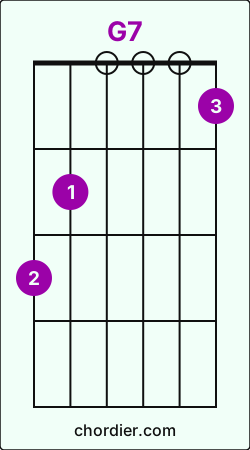 Guitar G7 chord diagram
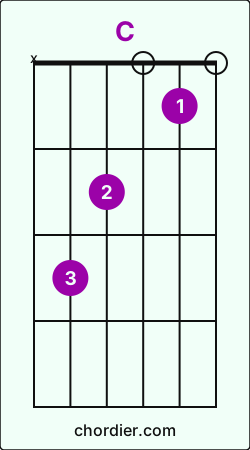 Guitar C chord diagram
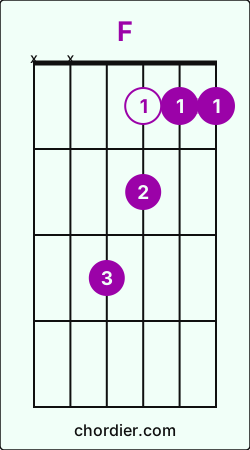 Guitar F chord diagram
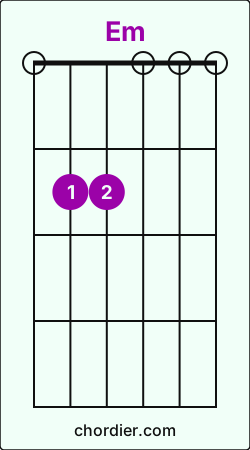 Guitar Em chord diagram
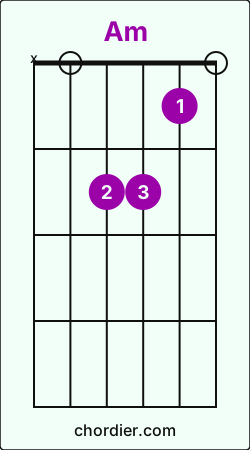 Guitar Am chord diagram
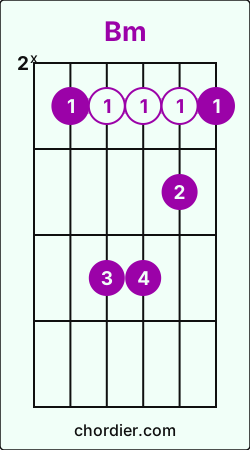 Guitar Bm chord diagram
[Opening]
[G7]When Liberty [C]Valance rode to [F]town
The women [Em]folk would [Am]hide they’d [F]hide [G7]
When Liberty [C]Valance walked a[F]round the men would [Em]step a[Am]side
[chorus]
Cause the [Em]point of a gun was the [Bm]only law
That [Em]Liberty under[F]stoo[G7]d
When it [C]came to shooting [Am]straight and fast [F]he was mighty [C]good [G7]
[verse 2]
From out of the [C]East a stranger [F]came
A law book [Em]in his [Am]hand a [F]man [G7]
The kind of a [C]man the West would [F]need to tame a [Em]troubled [Am]land
[chorus]
Cause the [Em]point of a gun was the [Bm]only law
That [Em]Liberty under[F]stoo[G7]d
When it [C]came to shooting [Am]straight and fast [F]he was mighty [C]good
[verse 3]
[Am]Many a [Em]man would [Am]face his gun
And [Em]many a man would [F]fa[G7]ll
The [C]man who shot [Am]Liberty Valance
[C]He shot [Am]Liberty Valance [F]he was the bravest of them [C]all [G7]
[verse 4]
The love of a [C]girl can make a [F]man stay on
When [Em]he should [Am]go stay [F]on [G7]
Just trying to [C]build a peaceful [F]life where love is [Em]free to [Am]grow
[verse 5]
But the [Em]point of a gun was the [Bm]only law
That [Em]Liberty under[F]sto[G7]od
When the [C]final showdown [Am]came to pass [F]a law book was no [C]good
[verse 6]
Alone and a[C]fraid she prayed that [F]he’d return
That [Em]fateful [Am]night oh that [F]night [G7]
When nothing she [C]said could keep her [F]man from going [Em]out to [Am]fight
[verse 7]
From the [Em]moment a girl gets to [Bm]be full grown
The [Em]very first thing she [F]lear[G7]ns
When [C]two men go out to [Am]face each other [F]only one re[C]turns
[verse 8]
[Am]Everyone [Em]heard two [Am]shots ring out
One [Em]shot made Liberty [F]fa[G7]ll
The [C]man who shot [Am]Liberty Valance
[C]He shot [Am]Liberty Valance [F]he was the bravest of them [C]all [G7]
[Closing]
The [C]man who shot [Am]Liberty Valance
[C]He shot [Am]Liberty Valance [F]he was the bravest of them [C]all [G7] [C]
How to play The Man Who Shot Liberty Valance on Guitar (Step-by-step)
Gene Pitney - The Man Who Shot Liberty Valance on guitar requires 6 chords and 8 core chord transitions. You can find the full step-by-step guide below. Before you start, tune your instrument. The song uses the ↓-↓↑-↓-↓↑-↓↑↓↑ pattern; practice it muted first, or simplify to downstrokes while you learn the changes.
The Man Who Shot Liberty Valance uses these transitions most often: G7 → C (15), C → Am (12), and Am → F (11). These transitions may feel a little challenging at first, but with steady practice you can play this song quickly.When you are ready, begin with G7 - C chord transition.
1. G7 → C chord transition
To move from G7 to C;
- Lift your index finger from A string fret 2 and place it on B string fret 1.
- Slide your middle finger from E string fret 3 to D string fret 2.
- Lift your ring finger from E string fret 1 and place it on A string fret 3.
2. C → F chord transition
To move from C to F;
- Lift your index finger from B string fret 1 and place it on E string fret 1.
- Slide your middle finger from D string fret 2 to G string fret 2.
- Keep ring finger on A string fret 3.
- Place pinky on D string fret 3.
3. F → Em chord transition
To move from F to Em;
- While playing F, first lift your index finger and pinky.
- Lift your middle finger from G string fret 2 and place it on A string fret 2.
- Slide your ring finger from A string fret 3 to D string fret 2.
4. Em → Am chord transition
To move from Em to Am;
- Lift your middle finger from A string fret 2 and place it on D string fret 2.
- Slide your ring finger from D string fret 2 to G string fret 2.
- Place index finger on B string fret 1.
5. Am → F chord transition
To move from Am to F;
- Lift your index finger from B string fret 1 and place it on E string fret 1.
- Slide your middle finger from D string fret 2 to G string fret 2.
- Lift your ring finger from G string fret 2 and place it on A string fret 3.
- Place pinky on D string fret 3.
6. F → G7 chord transition
To move from F to G7;
- While playing F, lift your pinky from D string fret 3.
- Lift your index finger from E string fret 1 and place it on A string fret 2.
- Slide your middle finger from G string fret 2 to E string fret 3.
- Lift your ring finger from A string fret 3 and place it on E string fret 1.
7. Em → Bm chord transition
To move from Em to Bm;
- Lift your middle finger from A string fret 2 and place it on B string fret 3.
- Slide your ring finger on D string from fret 2 to fret 4.
- Place index finger on E string fret 2.
- Place pinky on G string fret 4.
8. C → Am chord transition
To move from C to Am;
- Keep index finger on B string fret 1.
- Keep middle finger on D string fret 2.
- Lift your ring finger from A string fret 3 and place it on G string fret 2.
The Man Who Shot Liberty Valance chord transition analysis
A short, data-driven summary of the chord flow in The Man Who Shot Liberty Valance.
- The Man Who Shot Liberty Valance includes 110 chord transitions, 8 of them unique.
- These transitions represent 0.03% of all chord transitions in Chordier.
- The Man Who Shot Liberty Valance contains 2 of the top 10 transitions across Chordier.
- These transition patterns show how The Man Who Shot Liberty Valance connects to the rest of Chordier. Mastering them helps you move to similar songs faster.After C, the most likely next chords across Chordier are G (35%), F (16%), and D (11%).
- C → F: 16%
- C → Am: 10%
After F, the most likely next chords across Chordier are C (40%), G (21%), and Am (11%).- F → C: 40%
- F → G7: 3%