
Paramore - The Only Exception Chords
Before you play, tune your guitar and use the tools below to set up your view and flow. Using the Transpose tool, switch to D key to play this song with easier chords.
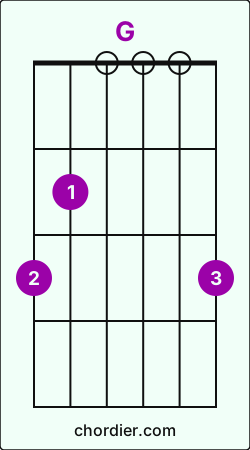 Guitar G chord diagram
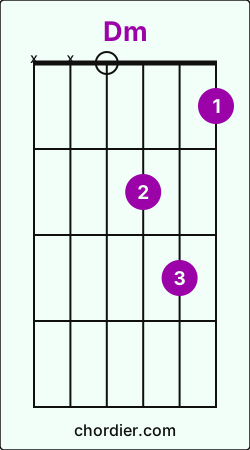 Guitar Dm chord diagram
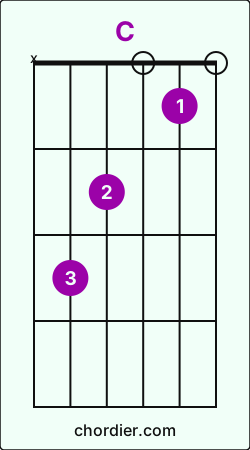 Guitar C chord diagram
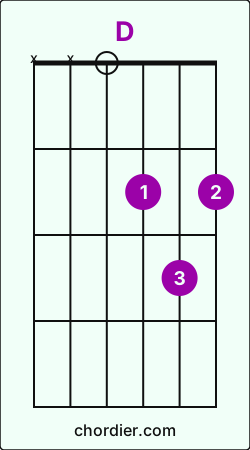 Guitar D chord diagram
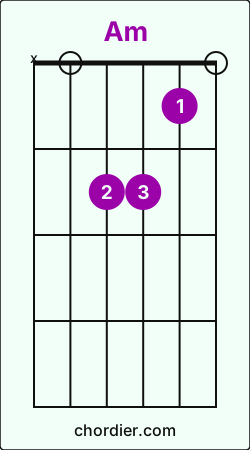 Guitar Am chord diagram
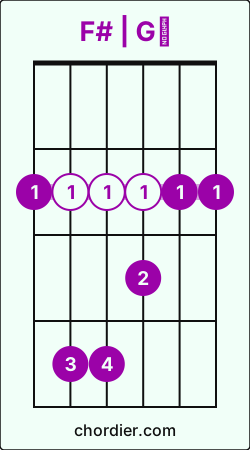 Guitar F# | G♭ chord diagram
[Opening]
[G] [Dm] [C] [G] [Dm] [C]
[G]When I was younger I saw my daddy [Dm]cry and curse at the [C]wind
He [G]broke his own heart and I watched as he tried to [Dm]re-assemble [C]it
And [G]my mama swore that she would never let [Dm]herself for[C]get
And [G]that was the day that I promised I’d never sing of [Dm]love
If it does not [C]exist, but darling…
[chorus]
[G]You are the only exception, [Dm]you are the [C]only exception.
[G]You are the only exception, [Dm]you are the [C]only exception [G]
[verse 2]
Maybe I know somewhere deep in my [Dm]soul that love never [C]lasts
And [G]we’ve got to find other ways to make it [Dm]alone or keep a straight [C]face
And [G]I’ve always lived like this, keeping a [Dm]comfortable [C]distance
And [G]up until now I had sworn to myself that I’m [Dm]content with loneli[C]ness
Because [C]none of it was ever worth the risk
[chorus]
[G]You are the only exception, [Dm]you are the [C]only exception.
[G]You are the only exception, [Dm]you are the [C]only exception [G]
[verse 3]
[G] [D] [Am] [G] [D]
I’ve got a [Am]tight grip on reality, but I can’t
Let [G]go of what’s in front of me [D]here
I know you’re [Am]leaving in the morning when you wake up
Leave me [G]with some kind of proof it’s not a [D]dream, [C]whoa
[chorus]
[G]You are the only exception, [Dm]you are the [C]only exception.
[G]You are the only exception, [Dm]you are the [C]only exception [G]
[chorus]
[G]You are the only exception, [Dm]you are the [C]only exception.
[G]You are the only exception, [Dm]you are the [C]only exception [G]
[Closing]
And [F#]I’m on my [C]way to believing [G]
Oh, and [F#]I’m on my [C]way to believing [G]
How to play The Only Exception on Guitar (Step-by-step)
Paramore - The Only Exception on guitar requires 6 chords and 9 core chord transitions. You can find the full step-by-step guide below. Before you start, tune your instrument. The song uses the ↓-↓↑-↑↓↑ pattern; practice it muted first, or simplify to downstrokes while you learn the changes.
The Only Exception uses these transitions most often: C → G (21), Dm → C (18), and G → Dm (18). These transitions may feel a little challenging at first, but with steady practice you can play this song quickly.When you are ready, begin with G - Dm chord transition.
1. G → Dm chord transition
To move from G to Dm;
- Lift your index finger from A string fret 2 and place it on E string fret 1.
- Slide your middle finger from E string fret 3 to G string fret 2.
- Lift your ring finger from E string fret 3 and place it on B string fret 3.
2. Dm → C chord transition
To move from Dm to C;
- Lift your index finger from E string fret 1 and place it on B string fret 1.
- Slide your middle finger from G string fret 2 to D string fret 2.
- Lift your ring finger from B string fret 3 and place it on A string fret 3.
3. C → G chord transition
To move from C to G;
- Lift your index finger from B string fret 1 and place it on A string fret 2.
- Slide your middle finger from D string fret 2 to E string fret 3.
- Lift your ring finger from A string fret 3 and place it on E string fret 3.
4. G → D chord transition
To move from G to D;
- Lift your index finger from A string fret 2 and place it on G string fret 2.
- Slide your middle finger from E string fret 3 to E string fret 2.
- Lift your ring finger from E string fret 3 and place it on B string fret 3.
5. D → Am chord transition
To move from D to Am;
- Lift your index finger from G string fret 2 and place it on B string fret 1.
- Slide your middle finger from E string fret 2 to D string fret 2.
- Lift your ring finger from B string fret 3 and place it on G string fret 2.
6. Am → G chord transition
To move from Am to G;
- Lift your index finger from B string fret 1 and place it on A string fret 2.
- Slide your middle finger from D string fret 2 to E string fret 3.
- Lift your ring finger from G string fret 2 and place it on E string fret 3.
7. D → C chord transition
To move from D to C;
- Lift your index finger from G string fret 2 and place it on B string fret 1.
- Slide your middle finger from E string fret 2 to D string fret 2.
- Lift your ring finger from B string fret 3 and place it on A string fret 3.
8. G → F# chord transition
To move from G to F#;
- Lift your index finger from A string fret 2 and place it on E string fret 2.
- Slide your middle finger from E string fret 3 to G string fret 3.
- Lift your ring finger from E string fret 3 and place it on A string fret 4.
- Place pinky on D string fret 4.
9. F# → C chord transition
To move from F# to C;
- While playing F#, lift your pinky from D string fret 4.
- Lift your index finger from E string fret 2 and place it on B string fret 1.
- Slide your middle finger from G string fret 3 to D string fret 2.
- Slide your ring finger on A string from fret 4 to fret 3.
The Only Exception chord transition analysis
A short, data-driven summary of the chord flow in The Only Exception.
- The Only Exception includes 72 chord transitions, 9 of them unique.
- These transitions represent 0.02% of all chord transitions in Chordier.
- The Only Exception contains 4 of the top 10 transitions across Chordier.
- These transition patterns show how The Only Exception connects to the rest of Chordier. Mastering them helps you move to similar songs faster.After G, the most likely next chords across Chordier are C (25%), D (24%), and Am (13%).
- G → D: 24%
- G → Dm: 2%
After C, the most likely next chords across Chordier are G (35%), F (16%), and D (11%).- C → G: 35%