
Eurythmics - There Must Be An Angel Chords
Before you play, tune your guitar and use the tools below to set up your view and flow.
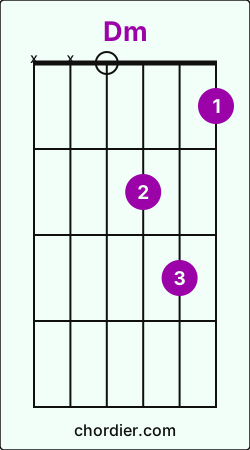 Guitar Dm chord diagram
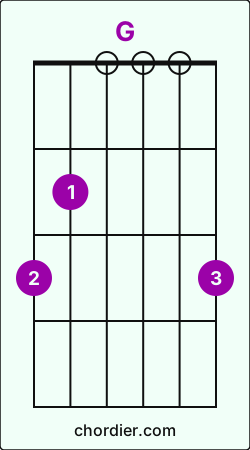 Guitar G chord diagram
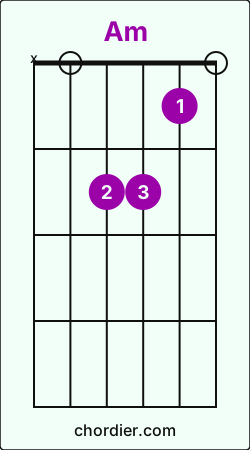 Guitar Am chord diagram
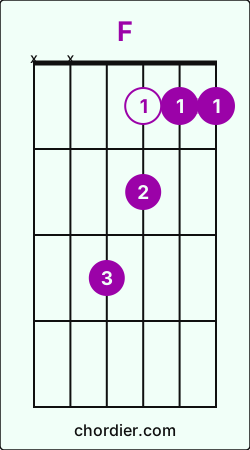 Guitar F chord diagram
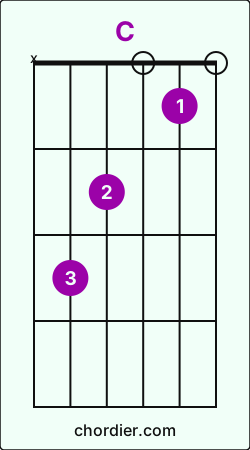 Guitar C chord diagram
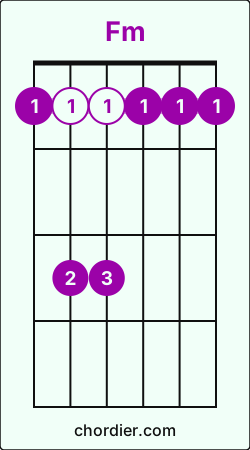 Guitar Fm chord diagram
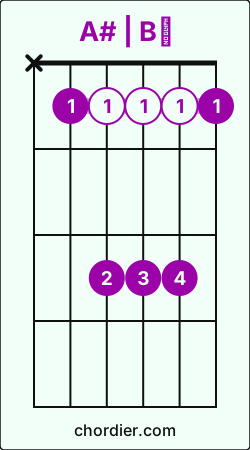 Guitar A# | B♭ chord diagram
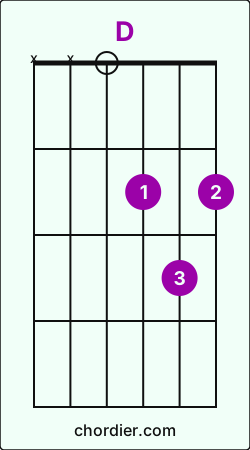 Guitar D chord diagram
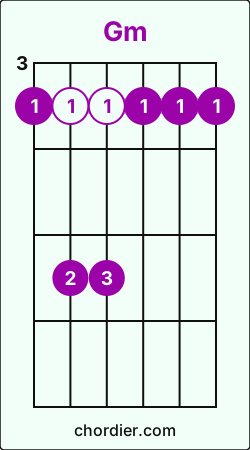 Guitar Gm chord diagram
[Opening]
No-one on earth could feel like [Dm]this
[G]I’m thrown and overblown with [Am]bliss [F]
There must be an [Dm]angel [G]
Playing with my [C]heart
[chorus]
I walk into an empty [Dm]room [G]
And suddenly my heart goes “[Am]boom” [F]
It’s an orchestra of [Dm]angels [G]
And they’re playing with my [C]heart
[chorus]
[F]Must be talking to an angel
[Fm]Must be talking to an angel
[C]Must be talking to an angel
[verse 2]
No-one on earth could feel like [Dm]this
[G]I’m thrown and overblown with [Am]bliss [F]
There must be an [Dm]angel [G]
Playing with my [C]heart
[verse 3]
And when I think that I’m a[Dm]lone [G]
It seems there’s more of us at [Am]home [F]
It’s a multitude of [Dm]angels [G]
And they’re playing with my [C]heart
[chorus]
[F]Must be talking to an angel
[Fm]Must be talking to an angel
[C]Must be talking to an angel
[verse 4]
[Bb]I must be hall[D]ucinating
[Gm]Watching angels celebrating
[Bb]Could this be re[D]activating
[Gm]All my senses dislocating?
[Bb]This must be a strange [D]deception
[Bb]By celestial intervention
[C]Leavin’ me the recollection
[F]Of your heaven[G]ly connection
[chorus]
[C]I walk into an empty [Dm]room [G]
And suddenly my heart goes “[Am]boom” [F]
It’s an orchestra of [Dm]angels [G]
And they’re playing with my [C]heart
[Closing]
da de da da N da [Dm]da [G]da da [Am]da da [F]
da do da da N da [Dm]da da da [G]da da da [C]da da
How to play There Must Be An Angel on Guitar (Step-by-step)
Eurythmics - There Must Be An Angel on guitar requires 9 chords and 14 core chord transitions. You can find the full step-by-step guide below. Before you start, tune your instrument. The song uses the ↓↑-↓↑-↓↑-↓↑ pattern; practice it muted first, or simplify to downstrokes while you learn the changes.
There Must Be An Angel uses these transitions most often: Dm → G (12), G → C (7), and Am → F (6). These transitions may feel a little challenging at first, but with steady practice you can play this song quickly.When you are ready, begin with Dm - G chord transition.
1. Dm → G chord transition
To move from Dm to G;
- Lift your index finger from E string fret 1 and place it on A string fret 2.
- Slide your middle finger from G string fret 2 to E string fret 3.
- Lift your ring finger from B string fret 3 and place it on E string fret 3.
2. G → Am chord transition
To move from G to Am;
- Lift your index finger from A string fret 2 and place it on B string fret 1.
- Slide your middle finger from E string fret 3 to D string fret 2.
- Lift your ring finger from E string fret 3 and place it on G string fret 2.
3. Am → F chord transition
To move from Am to F;
- Lift your index finger from B string fret 1 and place it on E string fret 1.
- Slide your middle finger from D string fret 2 to G string fret 2.
- Lift your ring finger from G string fret 2 and place it on A string fret 3.
- Place pinky on D string fret 3.
4. F → Dm chord transition
To move from F to Dm;
- While playing F, lift your pinky from D string fret 3.
- Lift your index finger from E string fret 1 and place it on E string fret 1.
- Keep middle finger on G string fret 2.
- Slide your ring finger from A string fret 3 to B string fret 3.
5. G → C chord transition
To move from G to C;
- Lift your index finger from A string fret 2 and place it on B string fret 1.
- Slide your middle finger from E string fret 3 to D string fret 2.
- Lift your ring finger from E string fret 3 and place it on A string fret 3.
6. C → Dm chord transition
To move from C to Dm;
- Lift your index finger from B string fret 1 and place it on E string fret 1.
- Slide your middle finger from D string fret 2 to G string fret 2.
- Lift your ring finger from A string fret 3 and place it on B string fret 3.
7. C → F chord transition
To move from C to F;
- Lift your index finger from B string fret 1 and place it on E string fret 1.
- Slide your middle finger from D string fret 2 to G string fret 2.
- Keep ring finger on A string fret 3.
- Place pinky on D string fret 3.
8. F → Fm chord transition
To move from F to Fm;
- While playing F, lift your middle finger from G string fret 2.
- Keep index finger on E string fret 1.
- Keep ring finger on A string fret 3.
- Keep pinky on D string fret 3.
9. Fm → C chord transition
To move from Fm to C;
- While playing Fm, lift your pinky from D string fret 3.
- Lift your index finger from E string fret 1 and place it on B string fret 1.
- Keep ring finger on A string fret 3.
- Place middle finger on D string fret 2.
10. C → Bb chord transition
To move from C to Bb;
- Lift your index finger from B string fret 1 and place it on A string fret 1.
- Slide your middle finger on D string from fret 2 to fret 3.
- Lift your ring finger from A string fret 3 and place it on G string fret 3.
- Place pinky on B string fret 3.
11. Bb → D chord transition
To move from Bb to D;
- While playing Bb, lift your pinky from B string fret 3.
- Lift your index finger from A string fret 1 and place it on G string fret 2.
- Slide your middle finger from D string fret 3 to E string fret 2.
- Lift your ring finger from G string fret 3 and place it on B string fret 3.
12. D → Gm chord transition
To move from D to Gm;
- Lift your index finger from G string fret 2 and place it on A string fret 1.
- Slide your middle finger from E string fret 2 to E string fret 3.
- Keep ring finger on B string fret 3.
- Place pinky on E string fret 3.
13. Gm → Bb chord transition
To move from Gm to Bb;
- Keep index finger on A string fret 1.
- Lift your middle finger from E string fret 3 and place it on D string fret 3.
- Slide your ring finger from B string fret 3 to G string fret 3.
- Lift your pinky from E string fret 3 and place it on B string fret 3.
14. F → G chord transition
To move from F to G;
- While playing F, lift your pinky from D string fret 3.
- Lift your index finger from E string fret 1 and place it on A string fret 2.
- Slide your middle finger from G string fret 2 to E string fret 3.
- Lift your ring finger from A string fret 3 and place it on E string fret 3.
There Must Be An Angel chord transition analysis
A short, data-driven summary of the chord flow in There Must Be An Angel.
- There Must Be An Angel includes 60 chord transitions, 14 of them unique.
- These transitions represent 0.02% of all chord transitions in Chordier.
- There Must Be An Angel contains 5 of the top 10 transitions across Chordier.
- These transition patterns show how There Must Be An Angel connects to the rest of Chordier. Mastering them helps you move to similar songs faster.After G, the most likely next chords across Chordier are C (25%), D (24%), and Am (13%).
- G → C: 25%
- G → Am: 13%
After Dm, the most likely next chords across Chordier are C (18%), G (16%), and Am (14%).- Dm → G: 16%