
Owl City - Vanilla Twilight Chords
Before you play, tune your guitar and use the tools below to set up your view and flow.
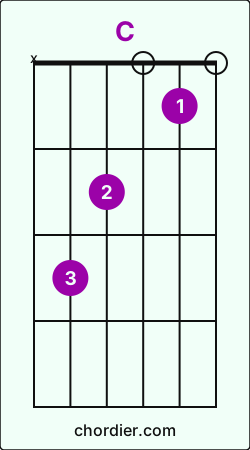 Guitar C chord diagram
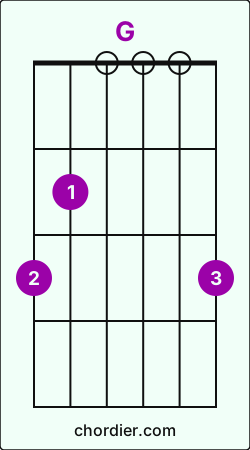 Guitar G chord diagram
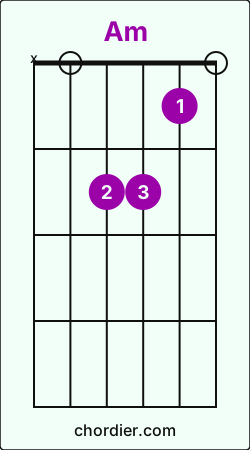 Guitar Am chord diagram
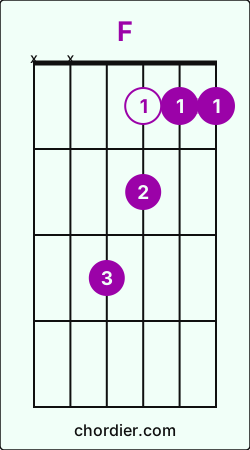 Guitar F chord diagram
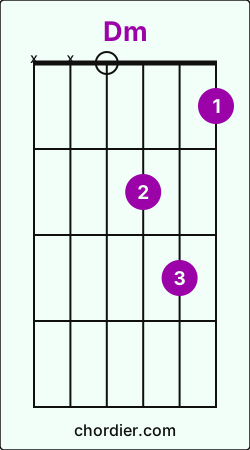 Guitar Dm chord diagram
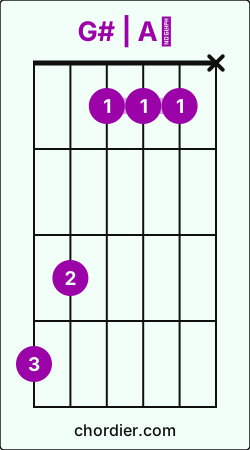 Guitar G# | A♭ chord diagram
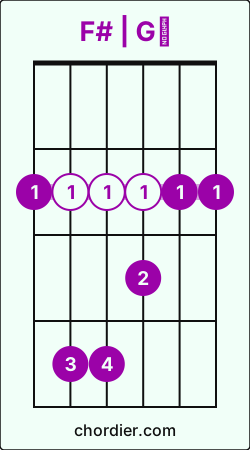 Guitar F# | G♭ chord diagram
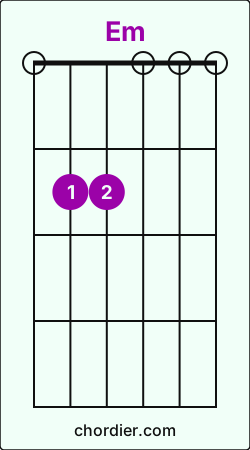 Guitar Em chord diagram
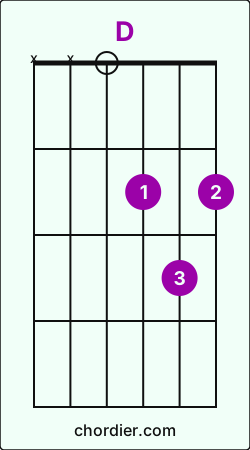 Guitar D chord diagram
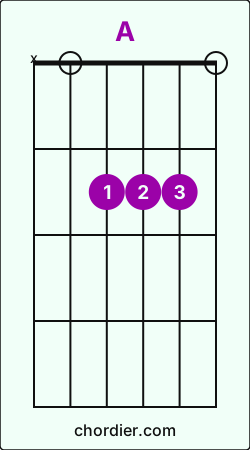 Guitar A chord diagram
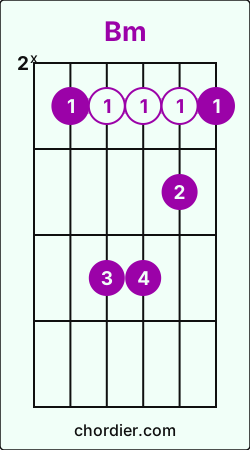 Guitar Bm chord diagram
[Opening]
[C]The stars lean [G]down to kiss you, [Am]and I lie awake [F]and miss you,
[C]Pour me a [G]heavy dose of [Am]atmosphere. [F] [C]’cause I’ll doze off [G]safe and soundly,
[Am]But I’ll miss your [F]arms around me, [C]I’ll send a [G]postcard to you [Dm]dear,
‘Cause I wish [F]you were here.
[verse 2]
[C] [G] [Am] [F] [C] [G] [Dm] [F] [C] [G] [Am] [F] [C] [G] [Dm] [F]
[C]I watch the [G]night turn light blue, [Am]but it’s not the same [F]without you,
[C]Because it takes [G]two to whisper [Dm]quietly, [F] [C]the silence [G]isn’t so bad,
[Am]Till I look at my [F]hands and feel sad, [C]’cause the spaces [G]between my fingers
[Dm]Are right where yours fit [F]perfectly. [C]I’ll find [G]repose in new ways,
[verse 3]
[Am]Though I haven’t [F]slept in two days, [C]’cause cold [G]nostalgia chills [Dm]me to the [F]bone.
[C]But drenched in [G]Vanilla twilight, [Am]I’ll sit on the [F]front porch all night,
[C]Waist deep in [G]thought because [Dm]when I think of you. [F]I don’t feel so [F]alone. [C] [G]
[G]I don’t feel so [Dm]alone. [C] [F] [G]I don’t feel so [Dm]alone. [C] [F]
[Am]As many [G#]times as I [G]blink I’ll [F#]think of [F]you, [F]tonight.
[Em] [F]I’ll [G] think of you tonight.
[Closing]
[D]When violet [A]eyes get brighter, [Bm]and heavy [G]wings grow lighter,
[D]I’ll taste the [A]sky and feel [Em]alive [G]again, [D]and I’ll forget the [A]world that I knew,
[Bm]But I swear I won’t [G]forget you, [D]oh if my [A]voice could reach [Em]back through the past, [G]
[A]I’d whisper in your ear, [A]oh darling I wish you were here.
[outro]
[D] [A] [Bm] [G] [D] [A] [Em] [G] [D] [A] [Bm] [G] [D] [A] [Em] [G]
[D] [A] [Bm] [G] [D] [A] [Em] [G] [D] [A] [Bm] [G] [D] [A] [Em] [G]
How to play Vanilla Twilight on Guitar (Step-by-step)
Owl City - Vanilla Twilight on guitar requires 11 chords and 20 core chord transitions. You can find the full step-by-step guide below. Before you start, tune your instrument. The song uses the ↓-↓↑-↑↓↑ pattern; practice it muted first, or simplify to downstrokes while you learn the changes.
Vanilla Twilight uses these transitions most often: C → G (17), F → C (16), and D → A (12). These transitions may feel a little challenging at first, but with steady practice you can play this song quickly.When you are ready, begin with C - G chord transition.
1. C → G chord transition
To move from C to G;
- Lift your index finger from B string fret 1 and place it on A string fret 2.
- Slide your middle finger from D string fret 2 to E string fret 3.
- Lift your ring finger from A string fret 3 and place it on E string fret 3.
2. G → Am chord transition
To move from G to Am;
- Lift your index finger from A string fret 2 and place it on B string fret 1.
- Slide your middle finger from E string fret 3 to D string fret 2.
- Lift your ring finger from E string fret 3 and place it on G string fret 2.
3. Am → F chord transition
To move from Am to F;
- Lift your index finger from B string fret 1 and place it on E string fret 1.
- Slide your middle finger from D string fret 2 to G string fret 2.
- Lift your ring finger from G string fret 2 and place it on A string fret 3.
- Place pinky on D string fret 3.
4. F → C chord transition
To move from F to C;
- While playing F, lift your pinky from D string fret 3.
- Lift your index finger from E string fret 1 and place it on B string fret 1.
- Slide your middle finger from G string fret 2 to D string fret 2.
- Keep ring finger on A string fret 3.
5. G → Dm chord transition
To move from G to Dm;
- Lift your index finger from A string fret 2 and place it on E string fret 1.
- Slide your middle finger from E string fret 3 to G string fret 2.
- Lift your ring finger from E string fret 3 and place it on B string fret 3.
6. Dm → F chord transition
To move from Dm to F;
- Lift your index finger from E string fret 1 and place it on E string fret 1.
- Keep middle finger on G string fret 2.
- Slide your ring finger from B string fret 3 to A string fret 3.
- Place pinky on D string fret 3.
7. Dm → C chord transition
To move from Dm to C;
- Lift your index finger from E string fret 1 and place it on B string fret 1.
- Slide your middle finger from G string fret 2 to D string fret 2.
- Lift your ring finger from B string fret 3 and place it on A string fret 3.
8. F → G chord transition
To move from F to G;
- While playing F, lift your pinky from D string fret 3.
- Lift your index finger from E string fret 1 and place it on A string fret 2.
- Slide your middle finger from G string fret 2 to E string fret 3.
- Lift your ring finger from A string fret 3 and place it on E string fret 3.
9. Am → G# chord transition
To move from Am to G#;
- Lift your index finger from B string fret 1 and place it on D string fret 1.
- Slide your middle finger from D string fret 2 to A string fret 3.
- Lift your ring finger from G string fret 2 and place it on E string fret 4.
10. G# → G chord transition
To move from G# to G;
- Lift your index finger from D string fret 1 and place it on A string fret 2.
- Slide your middle finger from A string fret 3 to E string fret 3.
- Lift your ring finger from E string fret 4 and place it on E string fret 3.
11. G → F# chord transition
To move from G to F#;
- Lift your index finger from A string fret 2 and place it on E string fret 2.
- Slide your middle finger from E string fret 3 to G string fret 3.
- Lift your ring finger from E string fret 3 and place it on A string fret 4.
- Place pinky on D string fret 4.
12. F# → F chord transition
To move from F# to F;
- Slide your index finger on E string from fret 2 to fret 1.
- Slide your middle finger on G string from fret 3 to fret 2.
- Slide your ring finger on A string from fret 4 to fret 3.
- Slide your pinky on D string from fret 4 to fret 3.
13. F → Em chord transition
To move from F to Em;
- While playing F, first lift your index finger and pinky.
- Lift your middle finger from G string fret 2 and place it on A string fret 2.
- Slide your ring finger from A string fret 3 to D string fret 2.
14. G → D chord transition
To move from G to D;
- Lift your index finger from A string fret 2 and place it on G string fret 2.
- Slide your middle finger from E string fret 3 to E string fret 2.
- Lift your ring finger from E string fret 3 and place it on B string fret 3.
15. D → A chord transition
To move from D to A;
- Lift your index finger from G string fret 2 and place it on D string fret 2.
- Slide your middle finger from E string fret 2 to G string fret 2.
- Slide your ring finger on B string from fret 3 to fret 2.
16. A → Bm chord transition
To move from A to Bm;
- Lift your index finger from D string fret 2 and place it on E string fret 2.
- Slide your middle finger from G string fret 2 to B string fret 3.
- Lift your ring finger from B string fret 2 and place it on D string fret 4.
- Place pinky on G string fret 4.
17. Bm → G chord transition
To move from Bm to G;
- While playing Bm, lift your pinky from G string fret 4.
- Lift your index finger from E string fret 2 and place it on A string fret 2.
- Slide your middle finger from B string fret 3 to E string fret 3.
- Lift your ring finger from D string fret 4 and place it on E string fret 3.
18. A → Em chord transition
To move from A to Em;
- While playing A, lift your index finger from D string fret 2.
- Lift your middle finger from G string fret 2 and place it on A string fret 2.
- Slide your ring finger from B string fret 2 to D string fret 2.
19. Em → G chord transition
To move from Em to G;
- Lift your middle finger from A string fret 2 and place it on E string fret 3.
- Slide your ring finger from D string fret 2 to E string fret 3.
- Place index finger on A string fret 2.
20. G → A chord transition
To move from G to A;
- Lift your index finger from A string fret 2 and place it on D string fret 2.
- Slide your middle finger from E string fret 3 to G string fret 2.
- Lift your ring finger from E string fret 3 and place it on B string fret 2.
Vanilla Twilight chord transition analysis
A short, data-driven summary of the chord flow in Vanilla Twilight.
- Vanilla Twilight includes 129 chord transitions, 20 of them unique.
- These transitions represent 0.03% of all chord transitions in Chordier.
- Vanilla Twilight contains 7 of the top 10 transitions across Chordier.
- These transition patterns show how Vanilla Twilight connects to the rest of Chordier. Mastering them helps you move to similar songs faster.After G, the most likely next chords across Chordier are C (25%), D (24%), and Am (13%).
- G → D: 24%
- G → Am: 13%
After F, the most likely next chords across Chordier are C (40%), G (21%), and Am (11%).- F → C: 40%
- F → G: 21%