
The Longest Johns - Wellerman Chords
Before you play, tune your guitar and use the tools below to set up your view and flow.
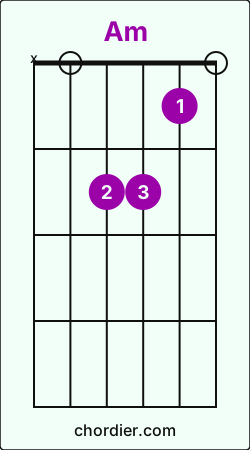 Guitar Am chord diagram
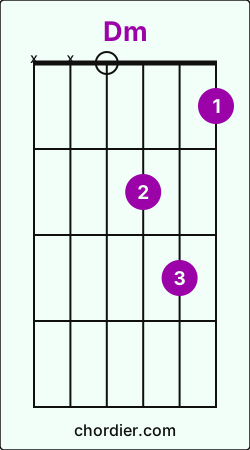 Guitar Dm chord diagram
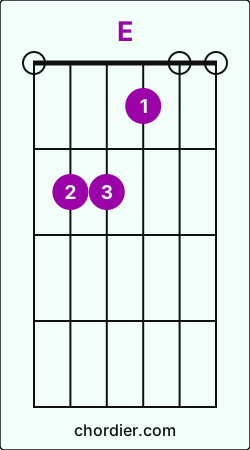 Guitar E chord diagram
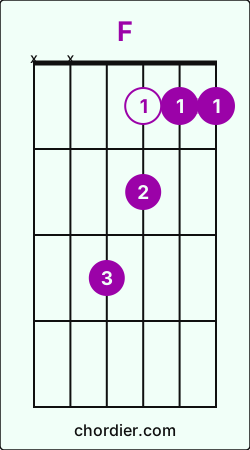 Guitar F chord diagram
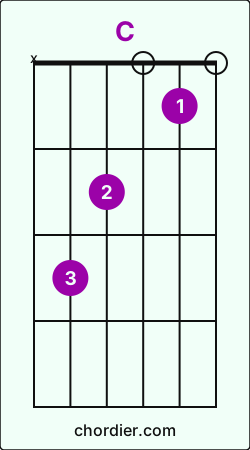 Guitar C chord diagram
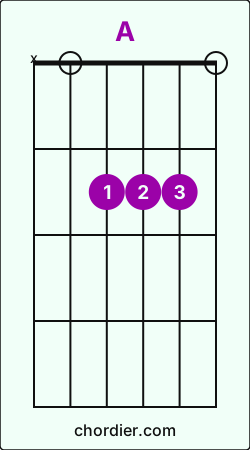 Guitar A chord diagram
[Opening]
[Am]There once was a ship that put to sea, and the [Dm]name of the ship was the [Am]Billy of Tea
The [Am]winds blew hard, her bow dipped down, o [E]blow, my bully boys, [Am]blow
[F]Soon may the [C]Wellerman come, to [Dm]bring us sugar and [Am]tea and rum
[F]One day, when the [C]tonguing is done, we’ll [E]take our leave and [Am]go
[verse 2]
She [Am]had not been two weeks from shore, when [Dm]down on her a [Am]right whale bore
The [Am]captain called all hands and swore, he’d [E]take that whale in [Am]tow
[F]Soon may the [C]Wellerman come, to [Dm]bring us sugar and [Am]tea and rum
[F]One day, when the [C]tonguing is done, we’ll [E]take our leave and [Am]go
[verse 3]
[Am]Before the boat had hit the water, the [Dm]whale’s tail came [Am]up and caught her
All [Am]hands to the side, harpooned and fought her, when [E]she dived down [Am]below
[F]Soon may the [C]Wellerman come, to [Dm]bring us sugar and [Am]tea and rum
[F]One day, when the [C]tonguing is done, we’ll [E]take our leave and [Am]go
[verse 4]
No [Am]line was cut, no whale was freed; the [Dm]Captain’s mind was [Am]not of greed
But [Am]he belonged to the whaleman’s creed; she [E]took the ship in [Am]tow
[F]Soon may the [C]Wellerman come, to [Dm]bring us sugar and [Am]tea and rum
[F]One day, when the [C]tonguing is done, we’ll [E]take our leave and [Am]go
[verse 5]
For [Am]forty days, or even more, the [Dm]line went slack, then [Am]tight once more
All [Am]boats were lost (there were only four), but [E]still that whale did [Am]go
[F]Soon may the [C]Wellerman come, to [Dm]bring us sugar and [Am]tea and rum
[F]One day, when the [C]tonguing is done, we’ll [E]take our leave and [Am]go
[verse 6]
As [Am]far as I’ve heard, the fight’s still on; the [Dm]line’s not cut and the [Am]whale’s not gone
The [Am]Wellerman makes his regular call, to [Dm]encourage the Captain, [Am]crew, and all
[F]Soon may the [C]Wellerman come, to [Dm]bring us sugar and [Am]tea and rum
[F]One day, when the [C]tonguing is done, we’ll [E]take our leave and [Am]go [A]
[Closing]
[F]Soon may the [C]Wellerman come, to [Dm]bring us sugar and [Am]tea and rum
[F]One day, when the [C]tonguing is done, we’ll [E]take our leave and [Am]go
How to play Wellerman on Guitar (Step-by-step)
The Longest Johns - Wellerman on guitar requires 6 chords and 8 core chord transitions. You can find the full step-by-step guide below. Before you start, tune your instrument. The song uses the ↓-↓↑-↑↓↑ pattern; practice it muted first, or simplify to downstrokes while you learn the changes.
Wellerman uses these transitions most often: Dm → Am (14), F → C (14), and Am → F (13). These transitions may feel a little challenging at first, but with steady practice you can play this song quickly.When you are ready, begin with Am - Dm chord transition.
1. Am → Dm chord transition
To move from Am to Dm;
- Lift your index finger from B string fret 1 and place it on E string fret 1.
- Slide your middle finger from D string fret 2 to G string fret 2.
- Lift your ring finger from G string fret 2 and place it on B string fret 3.
2. Am → E chord transition
To move from Am to E;
- Lift your index finger from B string fret 1 and place it on G string fret 1.
- Slide your middle finger from D string fret 2 to A string fret 2.
- Lift your ring finger from G string fret 2 and place it on D string fret 2.
3. Am → F chord transition
To move from Am to F;
- Lift your index finger from B string fret 1 and place it on E string fret 1.
- Slide your middle finger from D string fret 2 to G string fret 2.
- Lift your ring finger from G string fret 2 and place it on A string fret 3.
- Place pinky on D string fret 3.
4. F → C chord transition
To move from F to C;
- While playing F, lift your pinky from D string fret 3.
- Lift your index finger from E string fret 1 and place it on B string fret 1.
- Slide your middle finger from G string fret 2 to D string fret 2.
- Keep ring finger on A string fret 3.
5. C → Dm chord transition
To move from C to Dm;
- Lift your index finger from B string fret 1 and place it on E string fret 1.
- Slide your middle finger from D string fret 2 to G string fret 2.
- Lift your ring finger from A string fret 3 and place it on B string fret 3.
6. C → E chord transition
To move from C to E;
- Lift your index finger from B string fret 1 and place it on G string fret 1.
- Slide your middle finger from D string fret 2 to A string fret 2.
- Lift your ring finger from A string fret 3 and place it on D string fret 2.
7. Am → A chord transition
To move from Am to A;
- Lift your index finger from B string fret 1 and place it on D string fret 2.
- Slide your middle finger from D string fret 2 to G string fret 2.
- Lift your ring finger from G string fret 2 and place it on B string fret 2.
8. A → F chord transition
To move from A to F;
- Lift your index finger from D string fret 2 and place it on E string fret 1.
- Keep middle finger on G string fret 2.
- Slide your ring finger from B string fret 2 to A string fret 3.
- Place pinky on D string fret 3.
Wellerman chord transition analysis
A short, data-driven summary of the chord flow in Wellerman.
- Wellerman includes 81 chord transitions, 8 of them unique.
- These transitions represent 0.02% of all chord transitions in Chordier.
- Wellerman contains 2 of the top 10 transitions across Chordier.
- These transition patterns show how Wellerman connects to the rest of Chordier. Mastering them helps you move to similar songs faster.After Am, the most likely next chords across Chordier are F (26%), G (21%), and C (16%).
- Am → F: 26%
- Am → Dm: 8%
After Dm, the most likely next chords across Chordier are C (18%), G (16%), and Am (14%).- Dm → Am: 14%