
Lionel Bart - Who Will Buy Chords
Before you play, tune your guitar and use the tools below to set up your view and flow.
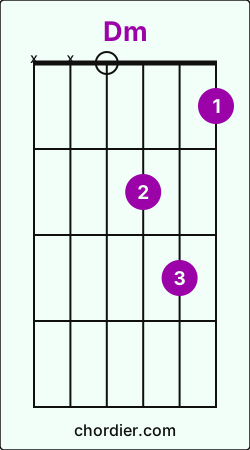 Guitar Dm chord diagram
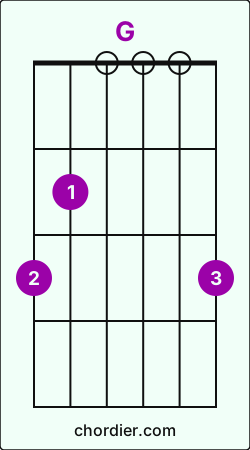 Guitar G chord diagram
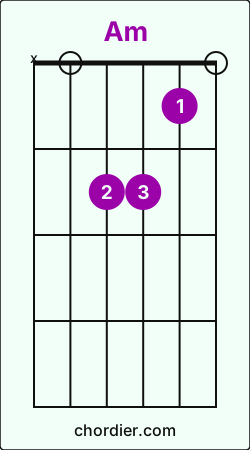 Guitar Am chord diagram
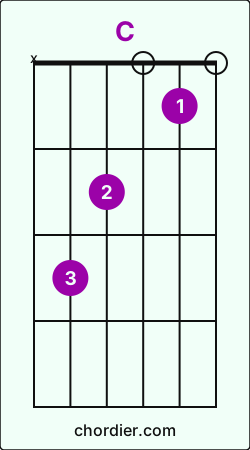 Guitar C chord diagram
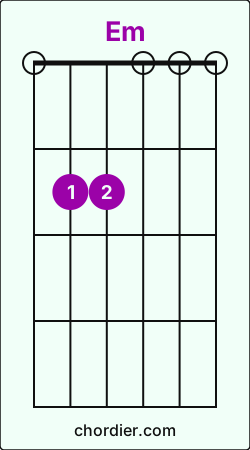 Guitar Em chord diagram
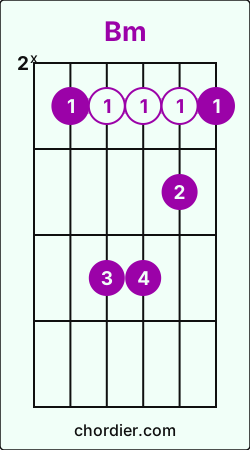 Guitar Bm chord diagram
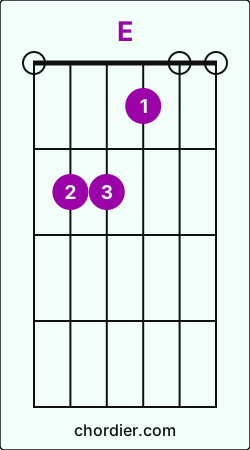 Guitar E chord diagram
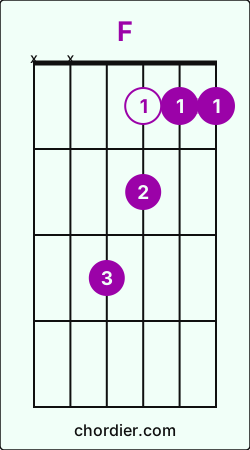 Guitar F chord diagram
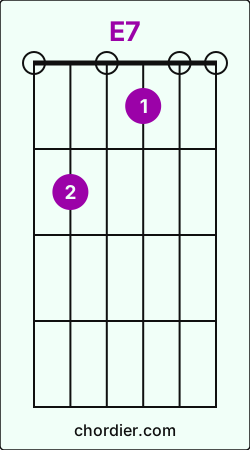 Guitar E7 chord diagram
[Opening]
[Dm]Who will buy this wonderful morning
Such a sky you [G]never did [Am]see
[Dm]Who will tie it up with a ribbon
And [Dm]put it in a [G]box for [C]me
[verse 2]
So I could [Dm]see it at [G]my [Am]leisure
When[Dm]ever [G]things go [C]wrong
And I would [Em]keep it as a [Bm]treasure
To [Em]last my whole life [E]long
[chorus]
[Am]Who will buy this wonderful feeling
[Am]I’m so high I swear I could [F]fly
[Am]Me oh my, I don’t want to lose it
So [Dm]what am I to do to [Em]keep this sky so [F]blue
There [Em]must be [Dm]someone [F]who [E]will [Am]buy
[verse 3]
[NC]Who will buy this wonderful morning
Such a sky you [G]never did [F]see
[Am]Who will tie it up with a ribbon
And [Dm]put it in a [G]box for [C]me
[verse 4]
There’ll never [Dm]be a day so [C]sunny
It [Dm]could not [G]happen [C]twice
Where is the [Em]man with all the [Bm]money
It’s [Em]cheap at [E7]half the [E]price
[chorus]
[Am]Who will buy this wonderful feeling
[Am]I’m so high I swear I could [F]fly
[Am]Me oh my, I don’t want to lose it
So [Dm]what am I to do to [Em]keep the sky so [F]blue
There [Em]must be [Dm]someone [F]who [E7]will [Am]buy!
[Closing]
[NC]Who will buy my sweet red [G]roses
Two [Dm]blooms for [Em]a [Am]penny
[outro]
[F] [E] [Am]
How to play Who Will Buy on Guitar (Step-by-step)
Lionel Bart - Who Will Buy on guitar requires 9 chords and 20 core chord transitions. You can find the full step-by-step guide below. Before you start, tune your instrument. The song uses the ↓-↓↑-↑↓↑ pattern; practice it muted first, or simplify to downstrokes while you learn the changes.
Who Will Buy uses these transitions most often: Dm → G (6), Am → Dm (5), and E → Am (4). These transitions may feel a little challenging at first, but with steady practice you can play this song quickly.When you are ready, begin with Dm - G chord transition.
1. Dm → G chord transition
To move from Dm to G;
- Lift your index finger from E string fret 1 and place it on A string fret 2.
- Slide your middle finger from G string fret 2 to E string fret 3.
- Lift your ring finger from B string fret 3 and place it on E string fret 3.
2. G → Am chord transition
To move from G to Am;
- Lift your index finger from A string fret 2 and place it on B string fret 1.
- Slide your middle finger from E string fret 3 to D string fret 2.
- Lift your ring finger from E string fret 3 and place it on G string fret 2.
3. Am → Dm chord transition
To move from Am to Dm;
- Lift your index finger from B string fret 1 and place it on E string fret 1.
- Slide your middle finger from D string fret 2 to G string fret 2.
- Lift your ring finger from G string fret 2 and place it on B string fret 3.
4. G → C chord transition
To move from G to C;
- Lift your index finger from A string fret 2 and place it on B string fret 1.
- Slide your middle finger from E string fret 3 to D string fret 2.
- Lift your ring finger from E string fret 3 and place it on A string fret 3.
5. C → Dm chord transition
To move from C to Dm;
- Lift your index finger from B string fret 1 and place it on E string fret 1.
- Slide your middle finger from D string fret 2 to G string fret 2.
- Lift your ring finger from A string fret 3 and place it on B string fret 3.
6. C → Em chord transition
To move from C to Em;
- While playing C, lift your index finger from B string fret 1.
- Lift your middle finger from D string fret 2 and place it on A string fret 2.
- Slide your ring finger from A string fret 3 to D string fret 2.
7. Em → Bm chord transition
To move from Em to Bm;
- Lift your middle finger from A string fret 2 and place it on B string fret 3.
- Slide your ring finger on D string from fret 2 to fret 4.
- Place index finger on E string fret 2.
- Place pinky on G string fret 4.
8. Em → E chord transition
To move from Em to E;
- Keep middle finger on A string fret 2.
- Keep ring finger on D string fret 2.
- Place index finger on G string fret 1.
9. E → Am chord transition
To move from E to Am;
- Lift your index finger from G string fret 1 and place it on B string fret 1.
- Slide your middle finger from A string fret 2 to D string fret 2.
- Lift your ring finger from D string fret 2 and place it on G string fret 2.
10. Am → F chord transition
To move from Am to F;
- Lift your index finger from B string fret 1 and place it on E string fret 1.
- Slide your middle finger from D string fret 2 to G string fret 2.
- Lift your ring finger from G string fret 2 and place it on A string fret 3.
- Place pinky on D string fret 3.
11. Dm → Em chord transition
To move from Dm to Em;
- While playing Dm, lift your index finger from E string fret 1.
- Lift your middle finger from G string fret 2 and place it on A string fret 2.
- Slide your ring finger from B string fret 3 to D string fret 2.
12. Em → F chord transition
To move from Em to F;
- Lift your middle finger from A string fret 2 and place it on G string fret 2.
- Slide your ring finger from D string fret 2 to A string fret 3.
- Place index finger on E string fret 1.
- Place pinky on D string fret 3.
13. Dm → F chord transition
To move from Dm to F;
- Lift your index finger from E string fret 1 and place it on E string fret 1.
- Keep middle finger on G string fret 2.
- Slide your ring finger from B string fret 3 to A string fret 3.
- Place pinky on D string fret 3.
14. F → E chord transition
To move from F to E;
- While playing F, lift your pinky from D string fret 3.
- Lift your index finger from E string fret 1 and place it on G string fret 1.
- Slide your middle finger from G string fret 2 to A string fret 2.
- Lift your ring finger from A string fret 3 and place it on D string fret 2.
15. G → F chord transition
To move from G to F;
- Lift your index finger from A string fret 2 and place it on E string fret 1.
- Slide your middle finger from E string fret 3 to G string fret 2.
- Lift your ring finger from E string fret 3 and place it on A string fret 3.
- Place pinky on D string fret 3.
16. Em → E7 chord transition
To move from Em to E7;
- While playing Em, lift your ring finger from D string fret 2.
- Keep middle finger on A string fret 2.
- Place index finger on G string fret 1.
17. E7 → E chord transition
To move from E7 to E;
- Keep index finger on G string fret 1.
- Keep middle finger on A string fret 2.
- Place ring finger on D string fret 2.
18. F → E7 chord transition
To move from F to E7;
- While playing F, first lift your ring finger and pinky.
- Lift your index finger from E string fret 1 and place it on G string fret 1.
- Slide your middle finger from G string fret 2 to A string fret 2.
19. E7 → Am chord transition
To move from E7 to Am;
- Lift your index finger from G string fret 1 and place it on B string fret 1.
- Slide your middle finger from A string fret 2 to D string fret 2.
- Place ring finger on G string fret 2.
20. Em → Am chord transition
To move from Em to Am;
- Lift your middle finger from A string fret 2 and place it on D string fret 2.
- Slide your ring finger from D string fret 2 to G string fret 2.
- Place index finger on B string fret 1.
Who Will Buy chord transition analysis
A short, data-driven summary of the chord flow in Who Will Buy.
- Who Will Buy includes 60 chord transitions, 20 of them unique.
- These transitions represent 0.02% of all chord transitions in Chordier.
- Who Will Buy contains 5 of the top 10 transitions across Chordier.
- These transition patterns show how Who Will Buy connects to the rest of Chordier. Mastering them helps you move to similar songs faster.After Dm, the most likely next chords across Chordier are C (18%), G (16%), and Am (14%).
- Dm → C: 18%
- Dm → G: 16%
After Am, the most likely next chords across Chordier are F (26%), G (21%), and C (16%).- Am → F: 26%
- Am → G: 21%