
Sabrina Carpenter - Why Chords
Before you play, tune your guitar and use the tools below to set up your view and flow. Using the Transpose tool, switch to C key to play this song with easier chords.
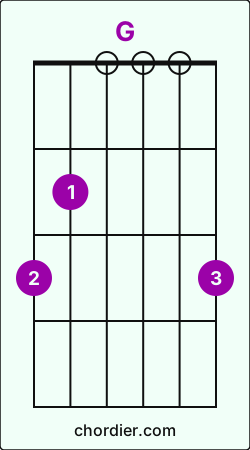 Guitar G chord diagram
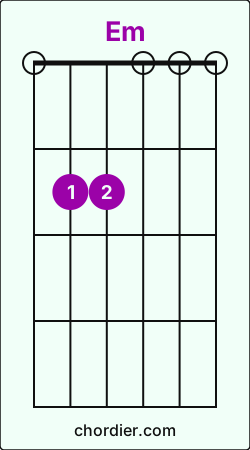 Guitar Em chord diagram
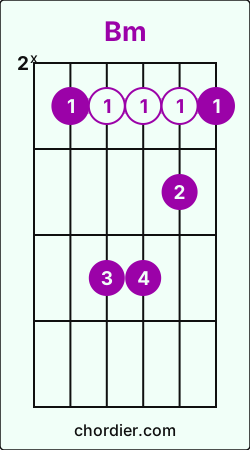 Guitar Bm chord diagram
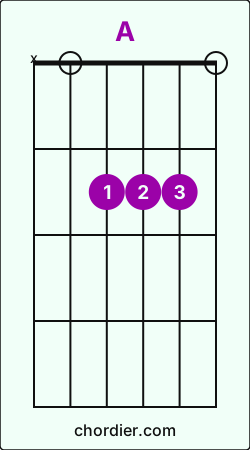 Guitar A chord diagram
[Opening]
[G]You like New York City in the [Em]daytime, [Bm]I like New York City [A]in the nighttime
[G]You say you like sleeping [Em]with the air off, [Bm]I don’t, I need it [A]on
[G]You like the light [Em]coming through the windows, [Bm]I sleep late, so I just [A]keep ’em all closed
[G]You ignore the [Em]music on the radio, [Bm]I don’t, I [A]sing-a-long
[chorus]
[G]I don’t ask for [Em]you to [Bm]change, baby no [A]no no
And [G]you don’t ask [Em]for me to [Bm]change [A]
[chorus]
Tell me how we’re not [Em]alike, but we [Bm]work so well and [A]we don’t even know why
[G]Funny how the [Em]stars crossed right, ’cause [Bm]we work so well and [A]we don’t even know why
[G]You can call it [Em]fire and ice, but [Bm]we work so well and [A]we don’t even know why
[G]We don’t even [Em]know why, no no, [Bm]we don’t even know why, no [A]no no
[verse 2]
No no no no, [Em]we like it in the daytime, [Bm]we like it in the [A]end of time
No no no no, [Em]we like it in the daytime, [Bm]we like it in the [A]end of time
[verse 3]
[G]Cold outside and you’re [Em]just in a T-shirt, [Bm]I have cold blood [A]even in a sweater
[G]You start your night [Em]sipping by the Kilo, [Bm]I don’t, I know you [A]know
[chorus]
[G]I don’t ask for [Em]you to [Bm]change, baby no [A]no no
And [G]you don’t ask [Em]for me to [Bm]change [A]
[chorus]
Tell me how we’re not [Em]alike, but we [Bm]work so well and [A]we don’t even know why
[G]Funny how the [Em]stars crossed right, ’cause [Bm]we work so well and [A]we don’t even know why
[G]You can call it [Em]fire and ice, but [Bm]we work so well and [A]we don’t even know why
[G]We don’t even [Em]know why, no no, [Bm]we don’t even know why, no [A]no no
[chorus]
No no no no, [Em]we like it in the daytime (we don’t even know)
[Bm]We like it in the [A]end of time (we don’t even know)
No no no no, [Em]we like it in the daytime
[Bm](We don’t even know, [A]know, know, know, know)
[Closing]
[G]Somehow we end up on the [Em]same side, [Bm]and you wouldn’t think that [A]we’d be alright
[G]Even our eyes are [Em]different colors, [Bm]but we see fine [A]
[G]Somehow we end up on the [Em]same side (up on the same side)
[Bm]And you wouldn’t think that [A]we’d be alright, (think that we’d be alright)
[G]Even our eyes are [Em]different colors, [Bm]but we see fine [A]
[chorus]
(Oh)Tell me how [Em]we’re not alike
But we [Bm]work so well and [A]we don’t even know why, (’cause we work so well and we don’t even know why, why)
[G]Funny how the [Em]stars crossed right, ’cause [Bm]we work so well and [A]we don’t even know why
(But we don’t even know why), [G]you can call it [Em]fire and ice
But [Bm]we work so well and [A]we don’t even know why, (’cause we work so well and we don’t even know why, why)
[G]We don’t even [Em]know why, no no, [Bm]we don’t even know why, no [A]no no
[chorus]
No no no no, [Em]we like it in the daytime (we don’t even know)
[Bm]We like it in the [A]end of time (we don’t even know)
No no no no, [Em]we like it in the daytime
[Bm]We like it in [A]the nighttime
How to play Why on Guitar (Step-by-step)
Sabrina Carpenter - Why on guitar requires 4 chords and 5 core chord transitions. You can find the full step-by-step guide below. Before you start, tune your instrument. The song uses the ↓↑-↓↑-↓↑-↓↑ pattern; practice it muted first, or simplify to downstrokes while you learn the changes.
Why uses these transitions most often: Bm → A (32), Em → Bm (32), and G → Em (23). These transitions may feel a little challenging at first, but with steady practice you can play this song quickly.When you are ready, begin with G - Em chord transition.
1. G → Em chord transition
To move from G to Em;
- While playing G, lift your index finger from A string fret 2.
- Lift your middle finger from E string fret 3 and place it on A string fret 2.
- Slide your ring finger from E string fret 3 to D string fret 2.
2. Em → Bm chord transition
To move from Em to Bm;
- Lift your middle finger from A string fret 2 and place it on B string fret 3.
- Slide your ring finger on D string from fret 2 to fret 4.
- Place index finger on E string fret 2.
- Place pinky on G string fret 4.
3. Bm → A chord transition
To move from Bm to A;
- While playing Bm, lift your pinky from G string fret 4.
- Lift your index finger from E string fret 2 and place it on D string fret 2.
- Slide your middle finger from B string fret 3 to G string fret 2.
- Lift your ring finger from D string fret 4 and place it on B string fret 2.
4. A → G chord transition
To move from A to G;
- Lift your index finger from D string fret 2 and place it on A string fret 2.
- Slide your middle finger from G string fret 2 to E string fret 3.
- Lift your ring finger from B string fret 2 and place it on E string fret 3.
5. A → Em chord transition
To move from A to Em;
- While playing A, lift your index finger from D string fret 2.
- Lift your middle finger from G string fret 2 and place it on A string fret 2.
- Slide your ring finger from B string fret 2 to D string fret 2.
Why chord transition analysis
A short, data-driven summary of the chord flow in Why.
- Why includes 118 chord transitions, 5 of them unique.
- These transitions represent 0.03% of all chord transitions in Chordier.
- Why contains 3 of the top 25 transitions across Chordier.
- These transition patterns show how Why connects to the rest of Chordier. Mastering them helps you move to similar songs faster.After Em, the most likely next chords across Chordier are C (26%), G (18%), and D (17%).
- Em → Bm: 5%
After Bm, the most likely next chords across Chordier are G (25%), A (19%), and Em (13%).- Bm → A: 19%