
Taylor Swift - You’re on Your Own, Kid Chords
Before you play, tune your guitar and use the tools below to set up your view and flow.
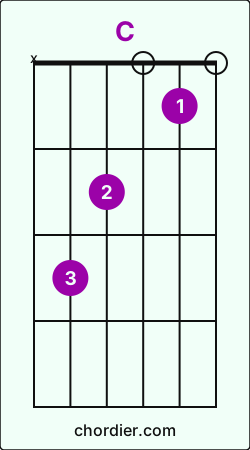 Guitar C chord diagram
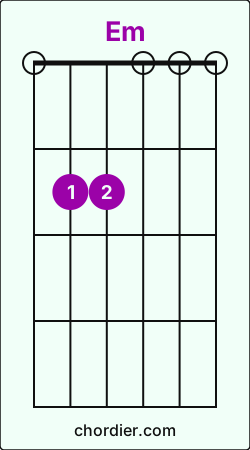 Guitar Em chord diagram
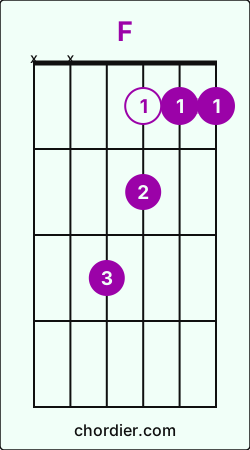 Guitar F chord diagram
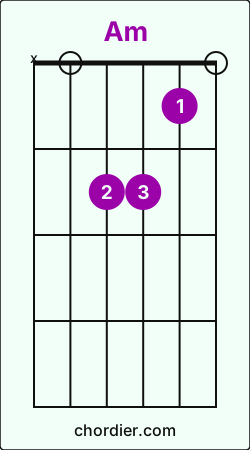 Guitar Am chord diagram
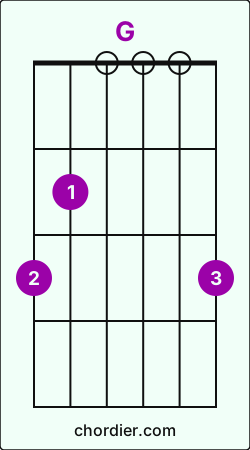 Guitar G chord diagram
[Opening]
[C] Summer went away, still the yearning stays
[Em] I play it [F]cool with, the best of them, [C] I wait patiently,
He’s gonna notice me, [Em] It’s [F]okay, we’re the best of [Am]friends
[G]Anyway, [C] I hear it in your voice,
[verse 2]
You’re smoking with your boys, [Em] I touch my [F]phone as if
It’s your face, [C] I didn’t choose this town,
I dream of getting out, [Em] there’s just [F]one who
Could make me [Am]stay, [G]all my days
[verse 3]
[F] From sprinkler [G]splashes to fireplace [C]ashes
I waited [Am]ages to see you [F]there; I searched the [G]party of better [C]bodies
Just to [Am]learn that you never [F]cared
You’re on your [G]own, kid; you always have [C]been
[verse 4]
[C] I see the great escape, so long Daisy Mae, [Em] I picked the [F]petals,
He loves me, not, [C] something different bloomed,
Writing in my room, [Em] I play my [F]songs in
The parking [Am]lot, I [G]run away
[verse 5]
[F] From sprinkler [G]splashes to, fireplace [C]ashes
I called a [Am]taxi to take me [F]there
I searched the [G]party of better [C]bodies
Just to [Am]learn that, my dreams aren’t [F]rare
You’re on your [G]own, kid; you always have been
[verse 6]
[F] [G] [C] [Am] [F] [G] [C] [Am] [F] [G]
[F] From sprinkler [G]splashes to fireplace [C]ashes
I gave my [Am]blood, sweat and tears for [F]this
I hosted [G]parties and starved my [C]body
Like I’d be [Am]saved by a perfect [F]kiss
The jokes weren’t [G]funny, I took the [C]money
My friends from [Am]home don’t know what to [F]say
I looked [G]around in a blood-soaked [C]gown
And I saw [Am]something they can’t take [F]away
‘Cause there were pages [G]turned with the bridges [C]burned
Everything you [Am]lose is a step you [F]take
So make the friendship [G]bracelets, take the moment and [C]taste it
You got no [Am]reason to be [F]afraid, you’re on your [G]own, kid
[Closing]
[F] Yeah, you can [G]face this, [F] you’re on your [G]own, kid
You always have [C]been
How to play You’re on Your Own, Kid on Guitar (Step-by-step)
Taylor Swift - You’re on Your Own, Kid on guitar requires 5 chords and 8 core chord transitions. You can find the full step-by-step guide below. Before you start, tune your instrument. The song uses the ↓-↓↑-↓↑-↓↑ pattern; practice it muted first, or simplify to downstrokes while you learn the changes.
You’re on Your Own, Kid uses these transitions most often: F → G (18), G → C (15), and Am → F (12). These transitions may feel a little challenging at first, but with steady practice you can play this song quickly.When you are ready, begin with C - Em chord transition.
1. C → Em chord transition
To move from C to Em;
- While playing C, lift your index finger from B string fret 1.
- Lift your middle finger from D string fret 2 and place it on A string fret 2.
- Slide your ring finger from A string fret 3 to D string fret 2.
2. Em → F chord transition
To move from Em to F;
- Lift your middle finger from A string fret 2 and place it on G string fret 2.
- Slide your ring finger from D string fret 2 to A string fret 3.
- Place index finger on E string fret 1.
- Place pinky on D string fret 3.
3. F → C chord transition
To move from F to C;
- While playing F, lift your pinky from D string fret 3.
- Lift your index finger from E string fret 1 and place it on B string fret 1.
- Slide your middle finger from G string fret 2 to D string fret 2.
- Keep ring finger on A string fret 3.
4. F → Am chord transition
To move from F to Am;
- While playing F, lift your pinky from D string fret 3.
- Lift your index finger from E string fret 1 and place it on B string fret 1.
- Slide your middle finger from G string fret 2 to D string fret 2.
- Lift your ring finger from A string fret 3 and place it on G string fret 2.
5. Am → G chord transition
To move from Am to G;
- Lift your index finger from B string fret 1 and place it on A string fret 2.
- Slide your middle finger from D string fret 2 to E string fret 3.
- Lift your ring finger from G string fret 2 and place it on E string fret 3.
6. G → C chord transition
To move from G to C;
- Lift your index finger from A string fret 2 and place it on B string fret 1.
- Slide your middle finger from E string fret 3 to D string fret 2.
- Lift your ring finger from E string fret 3 and place it on A string fret 3.
7. G → F chord transition
To move from G to F;
- Lift your index finger from A string fret 2 and place it on E string fret 1.
- Slide your middle finger from E string fret 3 to G string fret 2.
- Lift your ring finger from E string fret 3 and place it on A string fret 3.
- Place pinky on D string fret 3.
8. C → Am chord transition
To move from C to Am;
- Keep index finger on B string fret 1.
- Keep middle finger on D string fret 2.
- Lift your ring finger from A string fret 3 and place it on G string fret 2.
You’re on Your Own, Kid chord transition analysis
A short, data-driven summary of the chord flow in You’re on Your Own, Kid.
- You’re on Your Own, Kid includes 84 chord transitions, 8 of them unique.
- These transitions represent 0.02% of all chord transitions in Chordier.
- You’re on Your Own, Kid contains 6 of the top 10 transitions across Chordier.
- These transition patterns show how You’re on Your Own, Kid connects to the rest of Chordier. Mastering them helps you move to similar songs faster.After F, the most likely next chords across Chordier are C (40%), G (21%), and Am (11%).
- F → C: 40%
- F → G: 21%
After G, the most likely next chords across Chordier are C (25%), D (24%), and Am (13%).- G → C: 25%
- G → F: 9%