
Alan Jackson - You Can Always Come Home Chords
Before you play, tune your guitar and use the tools below to set up your view and flow. Using the Transpose tool, switch to A,G,D keys to play this song with easier chords.
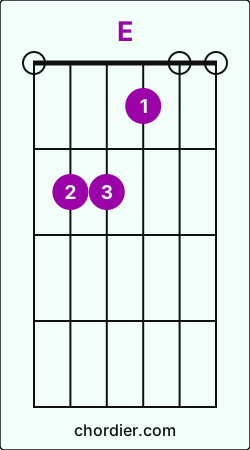 Guitar E chord diagram
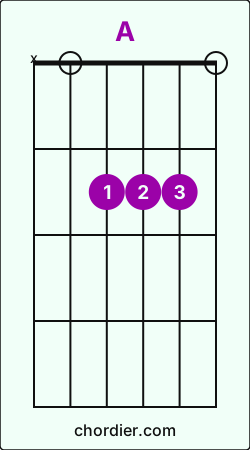 Guitar A chord diagram
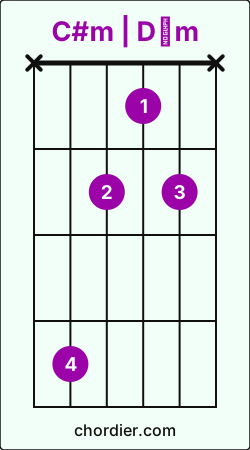 Guitar C#m | D♭m chord diagram
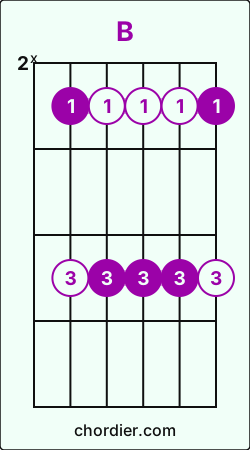 Guitar B chord diagram
[Opening]
[E] [A] [E] [C#m] [A] [B] [E] [E] [A] [E] [C#m] [B] [A]
Spread your [E]wings, don’t [A]be afraid to [E]try
[E]The world can be [C#m]hard, you gotta live a
[A]little ‘fore you [B]die
So open that [E]door, step out [A]in the bright [E]sunshine
[C#m]Follow your heart, and [B]remember any [A]time
[chorus]
You can always come [E]home
[A]Wherever life’s road [E]leads, you can [C#m]get back
To a [A]love that’s strong and [B]free
You never be [E]alone, in [A]your heart there’s still [E]a place
No matter how [C#m]right or [B]wrong you’ve [A]gone
You can always come [E]home
[verse 2]
So pack your [E]bags, [A]smile and say [E]goodbye
And chase those d[C#m]reams, and [A]when you lay down and [B]die
You know that there’s [E]someone praying for [A]you every [E]day
Even if you [C#m]never [B]find your [A]way
[chorus]
You can always come [E]home
[A]Wherever life’s road [E]leads, you can [C#m]get back
To a [A]love that’s strong and [B]free
You never be [E]alone, in your [A]heart there’s [E]still a place
No matter how [C#m]right or [B]wrong you’ve [A]gone
You can always come [E]home
[Closing]
[E] [A] [E] [C#m] [A] [B] [E] [A] [E] [C#m] [B] [A] [A] [E]
When I was [E]young, my [A]daddy said [E]to me
The very same [C#m]words and I [A]took those words with [B]me
When I was [E]afraid, I’d pull them [A]out and [E]think
[C#m]Just how much they [B]mean to [A]me
[chorus]
You can always come [E]home
Where[A]ver life’s road [E]leads, you can [C#m]get back
To a [A]love that’s strong and [B]free
You never be [E]alone, in your [A]heart there’s [E]still a place
No matter how [C#m]right or [B]wrong you’ve [A]gone
You can always come [E]home
[outro]
[E] [A] [E] [C#m] [A] [B] [E] [A] [E] [C#m] [B] [A] [A] [E]
How to play You Can Always Come Home on Guitar (Step-by-step)
Alan Jackson - You Can Always Come Home on guitar requires 4 chords and 6 core chord transitions. You can find the full step-by-step guide below. Before you start, tune your instrument. The song uses the ↓-↓↑-↑↓↑ pattern; practice it muted first, or simplify to downstrokes while you learn the changes.
You Can Always Come Home uses these transitions most often: A → E (27), E → A (18), and E → C#m (18). These transitions may feel a little challenging at first, but with steady practice you can play this song quickly.When you are ready, begin with E - A chord transition.
1. E → A chord transition
To move from E to A;
- Lift your index finger from G string fret 1 and place it on D string fret 2.
- Slide your middle finger from A string fret 2 to G string fret 2.
- Lift your ring finger from D string fret 2 and place it on B string fret 2.
2. E → C#m chord transition
To move from E to C#m;
- Keep index finger on G string fret 1.
- Lift your middle finger from A string fret 2 and place it on D string fret 2.
- Slide your ring finger from D string fret 2 to B string fret 2.
- Place pinky on A string fret 4.
3. C#m → A chord transition
To move from C#m to A;
- While playing C#m, lift your pinky from A string fret 4.
- Lift your index finger from G string fret 1 and place it on D string fret 2.
- Slide your middle finger from D string fret 2 to G string fret 2.
- Keep ring finger on B string fret 2.
4. A → B chord transition
To move from A to B;
- Lift your index finger from D string fret 2 and place it on E string fret 2.
- Slide your middle finger from G string fret 2 to D string fret 4.
- Lift your ring finger from B string fret 2 and place it on G string fret 4.
- Place pinky on B string fret 4.
5. B → E chord transition
To move from B to E;
- While playing B, lift your pinky from B string fret 4.
- Lift your index finger from E string fret 2 and place it on G string fret 1.
- Slide your middle finger from D string fret 4 to A string fret 2.
- Lift your ring finger from G string fret 4 and place it on D string fret 2.
6. C#m → B chord transition
To move from C#m to B;
- Lift your index finger from G string fret 1 and place it on E string fret 2.
- Slide your middle finger on D string from fret 2 to fret 4.
- Lift your ring finger from B string fret 2 and place it on G string fret 4.
- Slide your pinky from A string fret 4 to B string fret 4.
You Can Always Come Home chord transition analysis
A short, data-driven summary of the chord flow in You Can Always Come Home.
- You Can Always Come Home includes 108 chord transitions, 6 of them unique.
- These transitions represent 0.03% of all chord transitions in Chordier.
- You Can Always Come Home contains 1 of the top 25 transitions across Chordier.
- These transition patterns show how You Can Always Come Home connects to the rest of Chordier. Mastering them helps you move to similar songs faster.After E, the most likely next chords across Chordier are A (25%), D (14%), and B (11%).
- E → A: 25%
- E → C#m: 6%
After A, the most likely next chords across Chordier are D (29%), G (13%), and E (12%).- A → E: 12%
- A → B: 4%