
Edison Lighthouse - Love Grows (Where My Rosemary Goes) Chords
Before you play, tune your guitar and use the tools below to set up your view and flow.
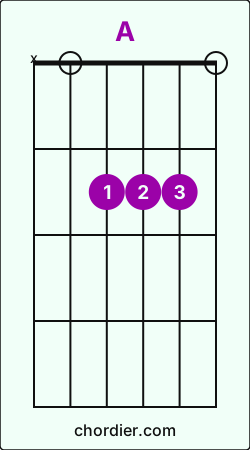 Guitar A chord diagram
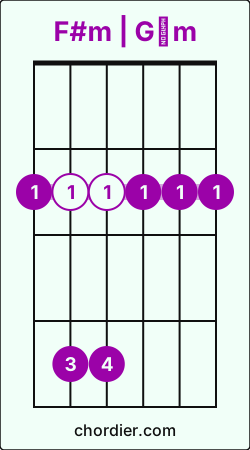 Guitar F#m | G♭m chord diagram
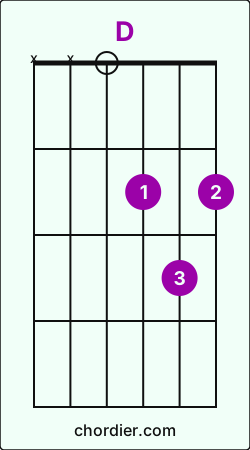 Guitar D chord diagram
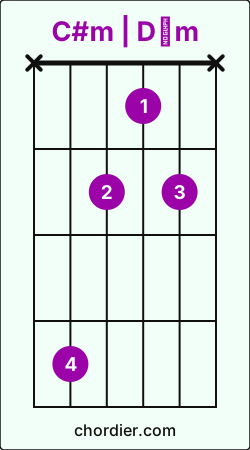 Guitar C#m | D♭m chord diagram
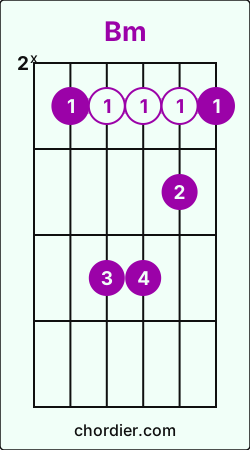 Guitar Bm chord diagram
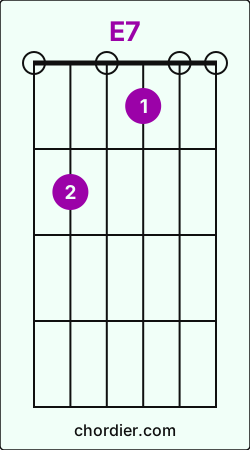 Guitar E7 chord diagram
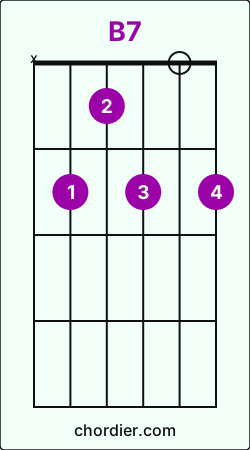 Guitar B7 chord diagram
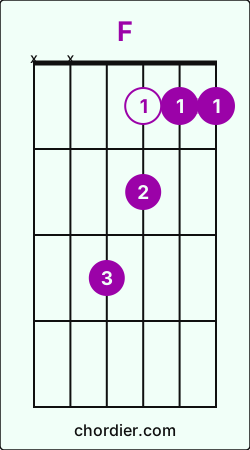 Guitar F chord diagram
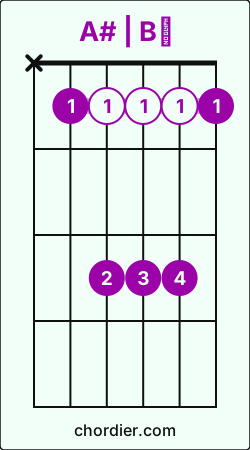 Guitar A# | B♭ chord diagram
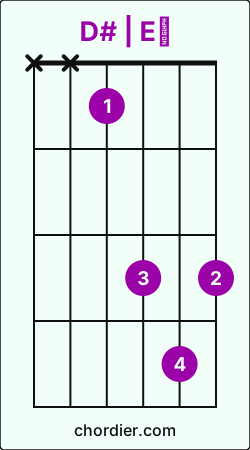 Guitar D# | E♭ chord diagram
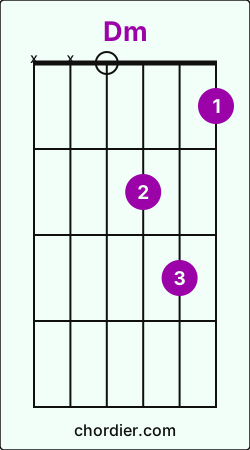 Guitar Dm chord diagram
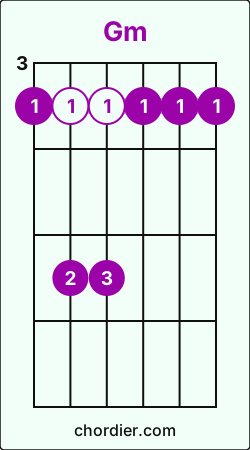 Guitar Gm chord diagram
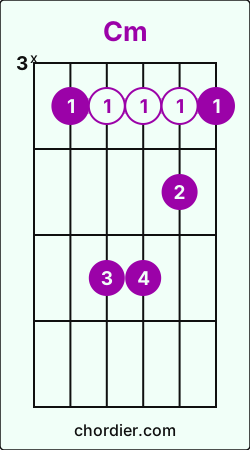 Guitar Cm chord diagram
[Opening]
[A]She ain’t [F#m]got [A]no money,
Her [A]clothes are [F#m]kinda [A]funny
Her [D]hair is kinda wild and [D]free
Oh but [A]love [C#m]grows where my [F#m]Rosemary [A]goes
And [D]nobody [Bm]knows [E7]like [A]me
[Closing]
[A]She talks kinda lazy, [F#m]people say she’s crazy
[D]And her life’s a [D]mystery
Oh but [A]love [C#m]grows where my [F#m]Rosemary [A]goes
And [D]nobody [Bm]knows [E7]like [A]me
[chorus]
There’s [D]something about her [E7]hand holding [A]mine,
It’s a [F#m]feeling that’s [Bm]fine and I just [E7]gotta [A]say, Hey!
She’s [D]really got a [E7]magical [A]spell
and it’s [F#m]working so [B7]well
That I can’t get a[E7]way
[chorus]
[A]I’m a [F#m]lucky [A]fella [F#m]
[A]And I just [F#m]gotta [A]tell [F#m]her [A]
[D]That I love her endlessly
Because [A]love [C#m]grows where my [F#m]Rosemary [A]goes
And [D]nobody [Bm]knows like [A]me
[chorus]
There’s [D]something about her hand holding [A]mine,
It’s a [F#m]feeling that’s [Bm]fine and I just gotta [A]say, Hey!
She’s [D]really got a [E7]magical [A]spell
and it’s [F#m]working so [B7]well
That I can’t get a[E7]way [F]
[chorus]
[Bb]I’m a lucky fella and I just gotta tell her
[Eb]That I love her endlessly
Because [Bb]love [Dm]grows where my [Gm]Rosemary [Bb]goes
And [Eb]nobody [Cm]knows like [Bb]me
Because [Bb]love [Dm]grows where my [Gm]Rosemary [Bb]goes
And [Eb]nobody [Cm]knows …. like [Bb]me
How to play Love Grows (Where My Rosemary Goes) on Guitar (Step-by-step)
Edison Lighthouse - Love Grows (Where My Rosemary Goes) on guitar requires 13 chords and 21 core chord transitions. You can find the full step-by-step guide below. Before you start, tune your instrument. The song uses the ↓-↓↑-↑↓↑ pattern; practice it muted first, or simplify to downstrokes while you learn the changes.
Love Grows (Where My Rosemary Goes) uses these transitions most often: A → F#m (11), A → D (9), and F#m → A (9). These transitions may feel a little challenging at first, but with steady practice you can play this song quickly.When you are ready, begin with A - F#m chord transition.
1. A → F#m chord transition
To move from A to F#m;
- While playing A, lift your middle finger from G string fret 2.
- Lift your index finger from D string fret 2 and place it on E string fret 2.
- Slide your ring finger from B string fret 2 to A string fret 4.
- Place pinky on D string fret 4.
2. A → D chord transition
To move from A to D;
- Lift your index finger from D string fret 2 and place it on G string fret 2.
- Slide your middle finger from G string fret 2 to E string fret 2.
- Slide your ring finger on B string from fret 2 to fret 3.
3. A → C#m chord transition
To move from A to C#m;
- Lift your index finger from D string fret 2 and place it on G string fret 1.
- Slide your middle finger from G string fret 2 to D string fret 2.
- Keep ring finger on B string fret 2.
- Place pinky on A string fret 4.
4. C#m → F#m chord transition
To move from C#m to F#m;
- While playing C#m, lift your middle finger from D string fret 2.
- Lift your index finger from G string fret 1 and place it on E string fret 2.
- Slide your ring finger from B string fret 2 to A string fret 4.
- Lift your pinky from A string fret 4 and place it on D string fret 4.
5. D → Bm chord transition
To move from D to Bm;
- Lift your index finger from G string fret 2 and place it on E string fret 2.
- Slide your middle finger from E string fret 2 to B string fret 3.
- Lift your ring finger from B string fret 3 and place it on D string fret 4.
- Place pinky on G string fret 4.
6. Bm → E7 chord transition
To move from Bm to E7;
- While playing Bm, first lift your ring finger and pinky.
- Lift your index finger from E string fret 2 and place it on G string fret 1.
- Slide your middle finger from B string fret 3 to A string fret 2.
7. E7 → A chord transition
To move from E7 to A;
- Lift your index finger from G string fret 1 and place it on D string fret 2.
- Slide your middle finger from A string fret 2 to G string fret 2.
- Place ring finger on B string fret 2.
8. F#m → D chord transition
To move from F#m to D;
- While playing F#m, lift your pinky from D string fret 4.
- Lift your index finger from E string fret 2 and place it on G string fret 2.
- Slide your ring finger from A string fret 4 to B string fret 3.
- Place middle finger on E string fret 2.
9. D → E7 chord transition
To move from D to E7;
- While playing D, lift your ring finger from B string fret 3.
- Slide your index finger on G string from fret 2 to fret 1.
- Slide your middle finger from E string fret 2 to A string fret 2.
10. F#m → Bm chord transition
To move from F#m to Bm;
- Keep index finger on E string fret 2.
- Lift your ring finger from A string fret 4 and place it on D string fret 4.
- Slide your pinky from D string fret 4 to G string fret 4.
- Place middle finger on B string fret 3.
11. F#m → B7 chord transition
To move from F#m to B7;
- Lift your index finger from E string fret 2 and place it on D string fret 1.
- Slide your ring finger from A string fret 4 to G string fret 2.
- Lift your pinky from D string fret 4 and place it on E string fret 2.
- Place middle finger on A string fret 2.
12. B7 → E7 chord transition
To move from B7 to E7;
- While playing B7, first lift your ring finger and pinky.
- Lift your index finger from D string fret 1 and place it on G string fret 1.
- Keep middle finger on A string fret 2.
13. Bm → A chord transition
To move from Bm to A;
- While playing Bm, lift your pinky from G string fret 4.
- Lift your index finger from E string fret 2 and place it on D string fret 2.
- Slide your middle finger from B string fret 3 to G string fret 2.
- Lift your ring finger from D string fret 4 and place it on B string fret 2.
14. E7 → F chord transition
To move from E7 to F;
- Lift your index finger from G string fret 1 and place it on E string fret 1.
- Slide your middle finger from A string fret 2 to G string fret 2.
- Place ring finger on A string fret 3.
- Place pinky on D string fret 3.
15. F → Bb chord transition
To move from F to Bb;
- Lift your index finger from E string fret 1 and place it on A string fret 1.
- Slide your middle finger from G string fret 2 to D string fret 3.
- Lift your ring finger from A string fret 3 and place it on G string fret 3.
- Slide your pinky from D string fret 3 to B string fret 3.
16. Bb → Eb chord transition
To move from Bb to Eb;
- Lift your index finger from A string fret 1 and place it on D string fret 1.
- Slide your middle finger from D string fret 3 to E string fret 3.
- Keep ring finger on G string fret 3.
- Slide your pinky on B string from fret 3 to fret 4.
17. Bb → Dm chord transition
To move from Bb to Dm;
- While playing Bb, lift your pinky from B string fret 3.
- Lift your index finger from A string fret 1 and place it on E string fret 1.
- Slide your middle finger from D string fret 3 to G string fret 2.
- Lift your ring finger from G string fret 3 and place it on B string fret 3.
18. Dm → Gm chord transition
To move from Dm to Gm;
- Lift your index finger from E string fret 1 and place it on A string fret 1.
- Slide your middle finger from G string fret 2 to E string fret 3.
- Keep ring finger on B string fret 3.
- Place pinky on E string fret 3.
19. Gm → Bb chord transition
To move from Gm to Bb;
- Keep index finger on A string fret 1.
- Lift your middle finger from E string fret 3 and place it on D string fret 3.
- Slide your ring finger from B string fret 3 to G string fret 3.
- Lift your pinky from E string fret 3 and place it on B string fret 3.
20. Eb → Cm chord transition
To move from Eb to Cm;
- Lift your index finger from D string fret 1 and place it on B string fret 1.
- Slide your middle finger from E string fret 3 to D string fret 1.
- Lift your ring finger from G string fret 3 and place it on A string fret 3.
- Slide your pinky from B string fret 4 to E string fret 3.
21. Cm → Bb chord transition
To move from Cm to Bb;
- Lift your index finger from B string fret 1 and place it on A string fret 1.
- Slide your middle finger on D string from fret 1 to fret 3.
- Lift your ring finger from A string fret 3 and place it on G string fret 3.
- Slide your pinky from E string fret 3 to B string fret 3.
Love Grows (Where My Rosemary Goes) chord transition analysis
A short, data-driven summary of the chord flow in Love Grows (Where My Rosemary Goes).
- Love Grows (Where My Rosemary Goes) includes 80 chord transitions, 21 of them unique.
- These transitions represent 0.02% of all chord transitions in Chordier.
- Love Grows (Where My Rosemary Goes) contains 1 of the top 10 transitions across Chordier.
- These transition patterns show how Love Grows (Where My Rosemary Goes) connects to the rest of Chordier. Mastering them helps you move to similar songs faster.After A, the most likely next chords across Chordier are D (29%), G (13%), and E (12%).
- A → D: 29%
- A → F#m: 6%
After F#m, the most likely next chords across Chordier are D (22%), A (19%), and E (14%).- F#m → D: 22%
- F#m → A: 19%